

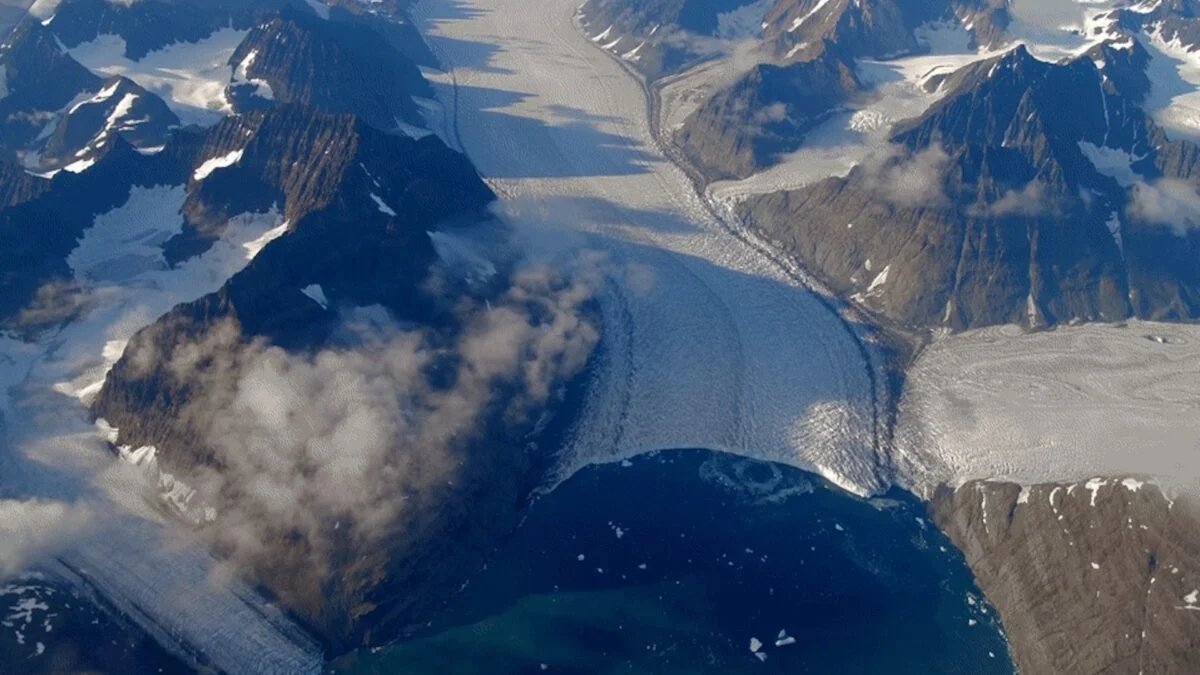
Massive structures of slow, swirling, plume-like patterns were found hidden deep inside Greenland’s ice sheet years ago, but their source remained a mystery. Now, scientists believe they may have tracked down the mechanism responsible for Greenland’s plumes, and it’s wild.
A team of international researchers suggests the enigmatic structures lurking beneath the surface may be caused by thermal convection, a process through which the ice undergoes slow, churning movements due to a transfer of heat. Thermal convection is typically observed in Earth’s viscous mantle; therefore, its detection in ice goes against intuition.
“We typically think of ice as a solid material, so the discovery that parts of the Greenland ice sheet actually undergo thermal convection, resembling a boiling pot of pasta, is as wild as it is fascinating,” Andreas Born, a professor at the University of Bergen in Norway and co-author of a new paper on the discovery, said in a statement.
Freak of nature
The Greenland ice sheet covers around 80% of the world’s largest island, spanning across 660,000 square miles (1.7 million square kilometers) and holding 10% of Earth’s fresh water. If it were to fully melt, the ice sheet would add up to 24 feet (7.4 meters) to global sea levels.
Understanding the physics of the ice sheet can help scientists better model its mass balance and contribution to sea-level rise. That’s what the team behind the recent study set out to do, using computer modeling to investigate the physical processes taking place beneath the ice.
The scientists explored whether ice convection could be responsible for the mysterious plume-like structures deep inside Greenland’s ice sheet. They discovered that the phenomenon may be driven by vertical temperature differences, indicating that parts of the ice sheet are softer than previously assumed.
“Ice is at least a million times softer than Earth’s mantle, though, so the physics just work out,” Robert Law, geologist at the University of Bergen and lead author of the study, said in a statement. “It’s like an exciting freak of nature.”
Churning ice
Thermal convection is a mode of heat transfer caused by the movement of fluids. As a pot of water boils, the fluid at the bottom heats up and becomes less dense, thereby rising to the top and being replaced by cooler, denser water.
Discovering that the ice in Greenland may undergo thermal convection and is therefore softer than previously assumed does not solely correlate with the rate at which it will melt, according to the researchers.
“Improving our understanding of ice physics is a really major way to be more certain about the future,” Law said. “But on its own, softer ice does not necessarily mean that the ice will melt faster or that sea level rise will be higher. We need further studies to fully isolate that.”
“The more we learn about the hidden processes inside the ice, the better prepared we’ll be for the changes coming to coastlines around the world,” he added.
