

It seems like every now and then, my Wi-Fi starts misbehaving. Something is slower than it should be, the signal drops in rooms it never used to, or a device that worked fine yesterday now can’t hold a connection. I used to do what most people do: restart the router, mutter at it, and restart it again. It worked, sometimes. But one day I wanted an actual answer, not a ritual.
That search led me to WiFi Analyzer by VREM Software Development, a free, open-source Android app that turns your phone into a portable network diagnostic tool. If you’ve ever wanted to know what’s actually wrong with your Wi-Fi — not guess — this app will tell you.
OS
Android
Price model
Free (open source)
WiFi Analyzer helps you visualize nearby networks and find the least crowded channels for a stronger, more stable connection. It turns complex signal data into simple graphs so you can quickly optimize your Wi-Fi setup.
WiFi Analyzer gives you an honest, real-time picture of every network in range
Your neighbors have more routers than you think
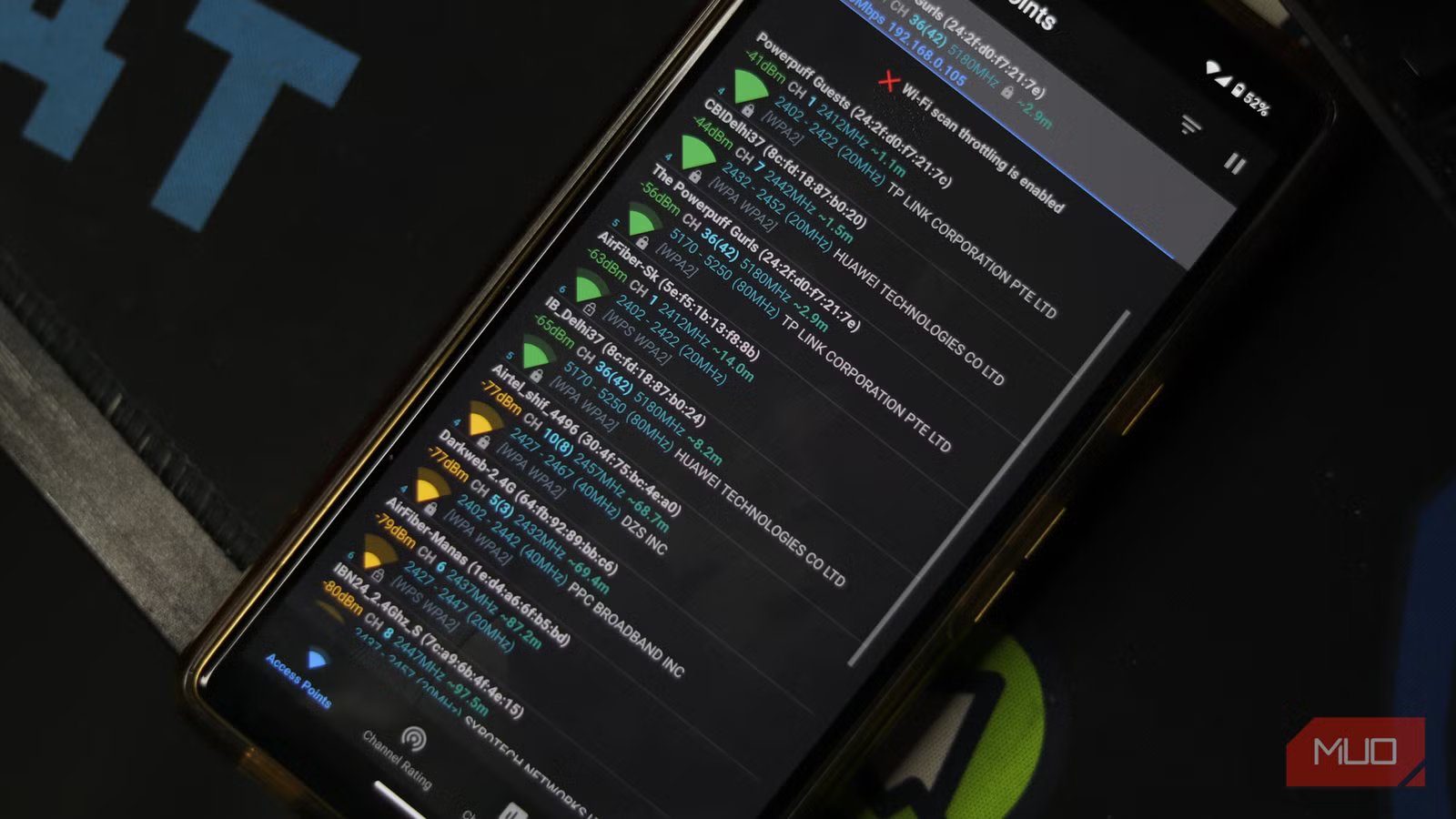
The first screen you land on once you download and install the app is Access Points, the app’s home base. This is your home’s Wi-Fi landscape at a glance. Every network your phone can detect shows up here — yours, your neighbors’, all of them — listed with their network name (SSID), signal strength in dBm, the channel they’re broadcasting on, the frequency it’s using, and an estimated distance from your phone. The interface uses intuitive color-coding that gives you a quick read on signal quality. Green indicates a strong signal, yellow for a moderate signal, and red for a faint or struggling signal. Your own network will typically sit near the top when you’re close to the router.
The dBm (decibels per milliwatt) reading is the number you want to pay attention to first. Because it’s measured on a negative scale, the closer the number is to zero, the stronger the signal.
- -30 to -50 dBm: Excellent (ideal for 4K streaming or gaming).
- -60 to -70 dBm: Good/Functional (solid for browsing and video calls).
- -80 dBm or lower: A whisper (expect frequent drops and lag).
My router shows up at -51 dBm when I’m standing nearby, with an estimated distance of about 3.5 meters. That’s a solid, healthy reading. My neighbor’s Airtel router, broadcasting on channel 2, comes in at -55 dBm from roughly 5.5 meters away, which is also respectable, but clearly a floor down.
You’ll also notice a banner that reads “Wi-Fi scan throttling is enabled” on Android 9 and above. This is an Android system restriction that limits how frequently third-party apps can actively scan for networks. While it saves battery, it means your data updates are slower than real-time. If you need more precision, you can disable Wi-Fi scan throttling in Android Developer Options to allow the app to refresh your connection data without the built-in “governor” slowing it down.
Navigation in the app is split between a bottom tab bar — Access Points, Channel Rating, Channel Graph, and Time Graph — and a full hamburger menu in the top-left corner that also includes Export, Available Channels, Vendors, Settings, and About. The bottom tabs cover the four tools you’ll use most.
Here’s how to find out if your neighbors are the problem
Channel 6. Always channel 6
Once you’ve gotten your bearings on the Access Points screen, switch to the Channel Graph. What you see is a visual map of the radio frequency spectrum — each network plotted as an arch on a graph, with channels on the X-axis and signal strength on the Y-axis. On 2.4GHz, this view can look chaotic in apartment buildings. In my case, my Grill Bar network is on channel 9 (shown in purple), and the neighboring Airtel network is on channel 2 (shown in teal). Their footprints don’t overlap, which explains why my 2.4GHz performance has been relatively stable. If they were piled onto the same channel, the bars would be visibly colliding on screen, and that visual collision is exactly what interference looks like.
Switching the band to 5GHz shows the Airtel 5G network occupying channels 155–163, with its bar dropping to around -79 dBm. It’s weak, a bit distant, but more importantly, alone. The 6GHz graph is empty in my environment, marked with a red ❌ because none of the local hardware supports Wi-Fi 6E. That’s actually useful information, too. An empty band is an opportunity if you ever decide to upgrade to a Wi-Fi 6E router.
You can switch between bands by tapping the band indicator in the top-right corner of the Channel Graph screen. It cycles through 2.4, 5, and 6GHz. On the wider bands with more channels, pinch to zoom and swipe to scroll through the full spectrum.
Related
The Wi-Fi channel your router chose is probably the worst one
Just because your router can pick a channel, doesn’t mean it should.
If you want a clearer answer instead of eyeballing graphs, switch over to Channel Rating in the menu. The app assigns a star rating to every available channel based on its congestion level. On 2.4GHz, channels 1 through 4 show two competing access points, which explains the slightly bruised yellow stars. Channels 5 through 11, meanwhile, show just one access point each and are rated with full green stars. The app’s own recommendation reads: Best Channels: 20 MHz 5, 6, 9, 10, 11, 7, 8. As it happens, my router is already on channel 9, which explains why performance has been fine from this location.
If your screen tells a less flattering story, say channels 1, 6, and 11 are drowning in yellow or red, then you’ve got your answer. Take the highest-rated channel number, log in to your router’s admin panel (usually at 192.168.1.1 in your browser, though it’s helpful to know what to do if you can’t access your router page), and manually assign your 2.4GHz channel to match it. It’s one settings change, and in a congested building, it can feel like you’ve just unclogged a pipe.
As for 5GHz, it’s practically untouched here. Every channel shows a full green star, no competing networks in sight. If your router supports it, and you’re still hanging around on 2.4GHz, this alone is a pretty convincing reason to switch.
Now it’s time to walk around the house
…But walk slowly because the data is watching
The Channel Graph explains the spectrum. The Time Graph explains the geography. They answer different questions, and confusing one for the other is how you end up rearranging furniture for no reason.
Switch to Time Graph from the menu. What you see is a live chart plotting the signal strength of every detected network over successive scans, each one a step in time along the horizontal axis. The vertical axis is dBm. Each network gets its own colored line. As the app keeps scanning, the graph scrolls to the right, building a history of what it’s seeing.
Now, take your phone with you, move through your home room by room, and watch the lines respond. When I was standing close to my router, Grill Bar’s green line held steady around -45 dBm, with an estimated distance of just 1.7 meters. The app was reporting 72Mbps at that point. As I moved farther down the hallway toward the far end of the building, that same green line steadily dropped to -76 dBm, at a distance of 61.4 meters and a speed of 14Mbps. The header at the top of the screen updates in real time as you move, showing current dBm, estimated distance, and link speed, so you don’t have to keep glancing at the graph.
As you move into weak-signal territory, new networks start appearing in the legend. Networks that were invisible from the router’s room show up faintly, all of them irrelevant until you’re far enough from your own router that they start competing.
Related
Your router’s location matters more than your internet speed
Moving your router to a better location can optimize your network.
Pause for 10 to 15 seconds in each room and let the signal stabilize before moving on. Sharp drops that recover the moment you step back through a doorway are almost always a wall composition issue, and concrete and metal are the usual suspects. Signals that fluctuate wildly without any movement from you point toward interference rather than distance. Microwave ovens are a classic offender on 2.4GHz; older cordless phones are another. The app won’t name the source, but it will show you exactly when the disruption starts.
You know too much to restart the router mindlessly now
What this little walkaround really does is point a finger at the actual problem, instead of leaving you guessing.
If the dead zone shows up in one stubborn spot, like near a particular wall or corner, that’s usually a placement issue. Your signal is being blocked or stretched too thin. In that case, you’re looking at practical fixes: move the router, drop in a mesh node, or even run a cable to a second access point if you’re feeling ambitious.
But if the dead zone seems to follow you everywhere, like the whole place is underperforming at once, that’s a different story. That usually points to channel congestion or interference, which, thankfully, is something you’ve already started tackling with the Channel Rating view.
