

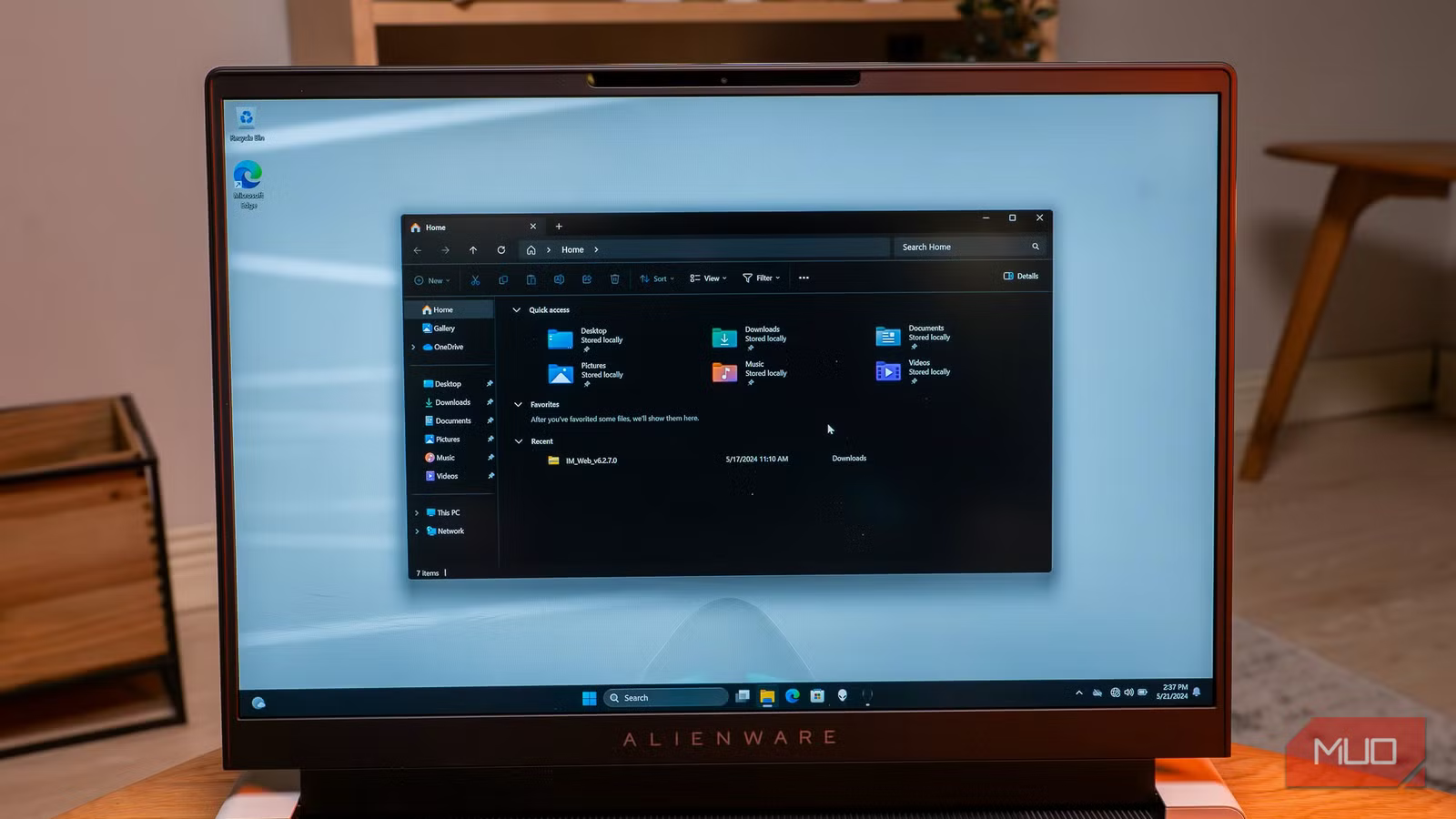
If your Windows 11 File Explorer feels sluggish, especially when opening folders crammed with documents, photos, or videos, you’re not imagining things. A default feature called auto-discovery scans folder contents to determine optimal display settings, and while this sounds helpful in theory, it’s been wreaking havoc on performance since the Windows XP era.
Fortunately, a simple registry tweak can prevent File Explorer from wasting time scanning files, delivering noticeably snappier folder navigation.
What Windows 11’s Automatic Folder Type Discovery does
It’s a smart feature that makes File Explorer
Tashreef Shareef / MakeUseOfCredit: Tashreef Shareef / MakeUseOf
To understand why this fix works, you have to look at what Windows is actually doing behind the scenes. When you double-click a directory, Windows 11 doesn’t simply read the filenames and show them to you. Instead, it pauses to perform a content audit. It furiously analyzes the file headers to answer a question you never actually asked: whether the folder is full of music, photos, documents, or videos. If it detects MP3s, it switches the view to Music mode; if it finds JPEGs, it shifts to Pictures mode to prioritize thumbnails.
While this sounds intuitive, it’s actually a performance nightmare. On folders with thousands of items, like your Downloads folder or a large work project, this “sniff test” takes measurable processing time. Worse, Windows has a habit of forgetting these preferences, meaning it often re-scans the same folder repeatedly in an endless loop of amnesia. The delay between opening the folder and the operating system deciding how to render it results in that jarring, sticky visual lag.
By applying the tweak below, which is one of the most effective ways to fix Windows File Explorer when it’s slow, we are essentially telling Windows to stop guessing and just show us the files. We are forcing a universal “Generic” view that loads instantly, regardless of its contents.
How to implement the “NotSpecified” override
Let’s disable Folder Type Discovery and speed up File Explorer
Fixing this requires a surgical strike inside the Windows Registry Editor. While the Registry often scares people away, thinking it is only for computer engineers, it is really just a database of settings. As long as you follow the steps comfortably, it is perfectly safe.
You will want to start by opening the Run dialogby pressing Win+R on your keyboard. Type regedit into the box that appears, then press Enter to accept the prompt asking for permission to make changes.
Just to be safe, before making any registry changes, create a backup. In the Registry Editor, click File > Export, select All under Export Range, choose a location, and save the backup file.
Once the editor is open, navigate to the location that controls how Windows creates its folder views. You can click through the folders on the left, but it is much easier to simply copy the path below and paste it into the address bar at the very top of the Registry window.
HKEY_CURRENT_USER\Software\Classes\Local Settings\Software\Microsoft\Windows\Shell\Bags\AllFolders\Shell If you paste that in and hit Enter, you should land in a folder named Shell. Once you are inside the final Shell folder, look at the large empty white space on the right side of the window. Right-click anywhere in that empty space, hover over New, and select String Value. You need to name this new value FolderType — make sure you capitalize the F and the T, with no spaces.
Related
How to Fix Windows Registry Errors (And When Not to Bother)
Fiddling with the Windows Registry can be harmful to your PC. Here’s how to fix registry problems and when to not bother at all.
Now that the value exists, you need to give it a command. Double-click your newly created FolderType entry. In the box labeled Value data, type the word NotSpecified. Again, this needs to be one word with a capital N and a capital S. Click OK to save it. You have now effectively created a stop sign for the folder discovery process.
To see the results, you don’t even need to reboot your entire computer. You just need to restart the file browsing process. There are ways to restart File Explorer without a full reboot; typically, you open your Task Manager, find Windows Explorer in the list of running processes, right-click it, and select Restart. Your taskbar might blink out of existence for a moment, but it will reappear quickly.
There are faster ways to go about it
If you don’t like to tinker much
For a quicker approach, open PowerShell as an administrator and run this command:
Set-ItemProperty -Path ‘HKCU:\Software\Classes\Local Settings\Software\Microsoft\Windows\Shell\Bags\AllFolders\Shell’ -Name ‘FolderType’ -Value ‘NotSpecified’ -Type String After executing the command, open Task Manager (Ctrl + Shift + Esc), locate Windows Explorer under Processes, right-click it, and select Restart to apply the changes without a full system reboot.
You can also create and use a .reg file by pasting the following into Notepad:
Windows Registry Editor Version 5.00
[HKEY_CURRENT_USER\SOFTWARE\Classes\Local Settings\Software\Microsoft\Windows\Shell\Bags\AllFolders\Shell]
“FolderType”=”NotSpecified” Save it with a .reg extension, double-click the file, and confirm the security prompt to merge the changes.
You should now experience snappier navigation
Once you’ve implemented this tweak, all your folders will display with a consistent, generic view. You won’t see specialized layouts for music, photos, or videos unless you change the folder view globally or configure individual folder preferences in File Explorer’s View options. For most users, this trade-off is insignificant compared to the performance gains.
If you want to restore the automatic folder discovery feature, simply delete the FolderType registry key from the same path in Registry Editor. Windows will revert to its default behavior of analyzing folder contents and adjusting views automatically.
