

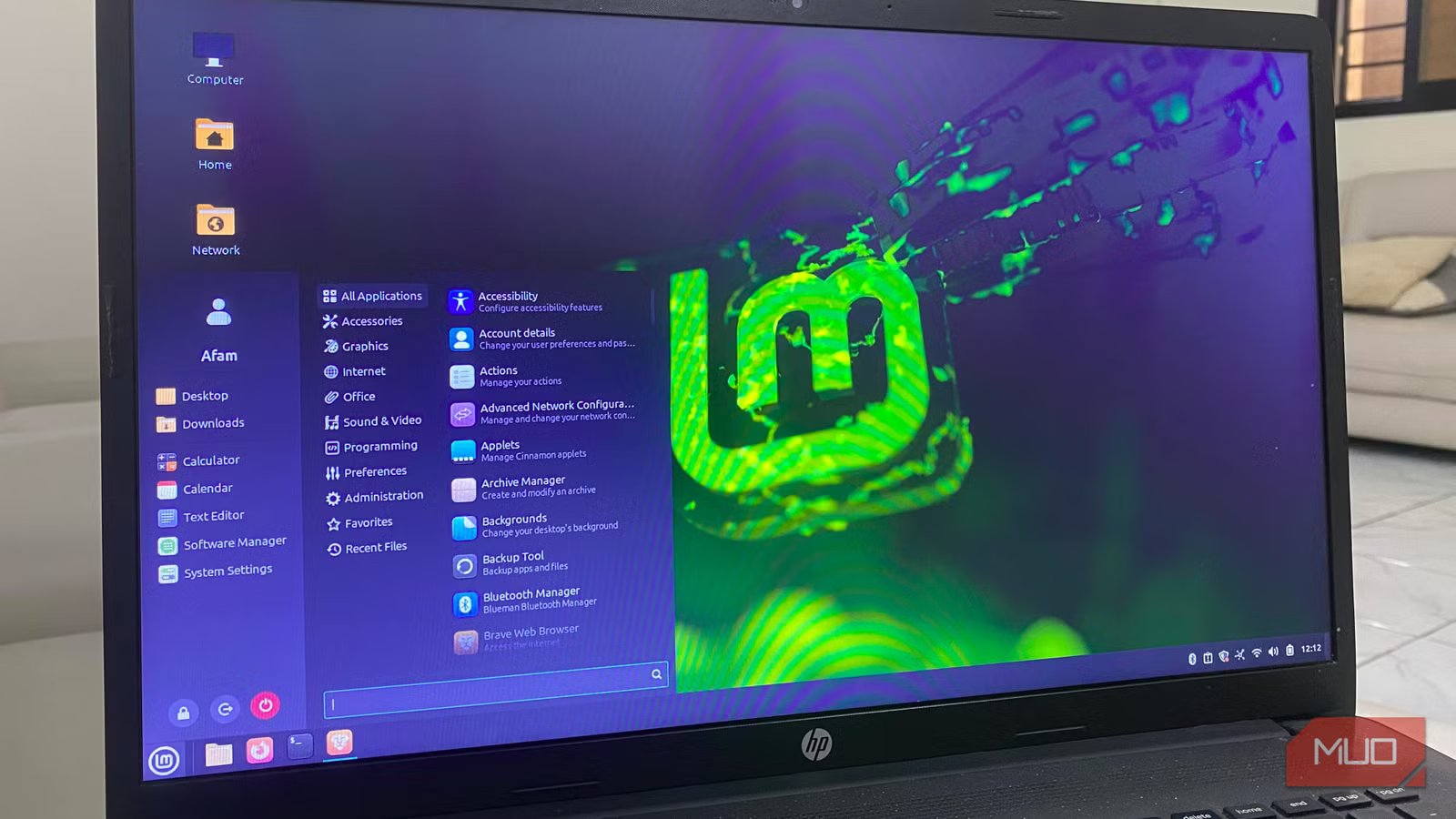
There’s a very specific kind of person who doesn’t just dislike technology. They’ve quietly declared emotional independence from it. They don’t want to optimize anything. They don’t want to “learn a system.” They don’t care what’s under the hood as long as it doesn’t start screaming at them mid-task. If a device asks too many questions, its first instinct is not curiosity, but betrayal.
So, naturally, I installed Linux for one of them. Not as some grand evangelism project. I wasn’t trying to convert anyone. This wasn’t “welcome to the future.” This was more like, “Here, try this, and please don’t hate me.” No terminal, no tweaks, and certainly no secret keyboard shortcuts whispered like forbidden knowledge. Just Linux Mint, with Cinnamon. Placed in front of them like a normal, boring computer. And then I did the hardest thing you can do as a Linux user: shut up.
First impressions mattered more than anything
If it feels weird in five minutes, it’s already dead
Screenshot by Raghav Sethi – NAR
You don’t get a grace period with someone who hates tech. There’s no “it gets better once you configure it.” No onboarding curve, and no second chances. If it feels off in the first five minutes, that’s it. You’ve lost them. They will never trust that machine again. So I watched.
They moved the mouse, opened the menu, and clicked on a browser. No sighs, no hesitation, or “what is this?” And that’s when I realized something uncomfortable. Linux Mint didn’t win them over by being impressive. It won by being forgettable. The layout felt familiar in that vague, déjà vu kind of way. Bottom panel, the menu in the corner, and the windows behaving like … well, windows. Nothing tried to be clever. And that’s exactly why it worked.
Over the next few days, I kept waiting for something to break: a complaint, a question, or a confused “Why is it doing that?” I got nothing. They browsed, watched videos, opened documents, and then closed the lid. Like some stealthy pro? At one point, I actually asked, “Everything working okay?” The response: “Yeah … why wouldn’t it be?” That was the moment.
Because this is where Linux has changed in a way people don’t fully appreciate. It no longer demands attention to exist. It doesn’t tap you on the shoulder every five minutes asking for permission to continue being a computer. Printing worked, Wi-Fi stayed connected, and updates didn’t stage a full theatrical production every time they showed up. The system behaved. Ironically, that’s the most radical thing it could do.
The cracks show in subtle, annoying ways
Not broken, just slightly off — and that’s enough
Now, let’s not pretend this was some flawless utopia. The problems didn’t crash the system. They didn’t trigger panic. They just … lingered. File locations caused that tiny pause. You know the one. That half-second hesitation where someone is scanning the screen thinking, “This isn’t where I thought it would be.” Not confusion, but doubt, and doubt is sneaky. Installing new software was another moment. The Software Manager is genuinely good, clean, and very searchable. Way better than it used to be. But it still asks for a decision. Search for an app. Pick between options and click install. This did result in a couple of calls asking what app to install. And yes, this friend isn’t big on texting, either.
Related
I forced myself to use Linux without the terminal for a week
The terminal is pretty optional if your’re not a power user.
And yet, for someone who already doesn’t trust tech, even that small process feels like stepping onto slightly unstable ground. Not dangerous, but not solid either. Then there are the tiny inconsistencies. Different app styles. The occasional window that looks like it time-traveled from 2008 and refuses to explain itself. Nothing catastrophic, but enough to remind you that under the polished surface, Linux is still a bit of a patchwork quilt held together by very smart people who don’t always agree on fonts.
The terminal never showed up
The biggest victory was what didn’t happen
Credit: Roine Bertelson/MakeUseOf
I was fully prepared for the moment. That inevitable point where I’d have to step in and say something like, “Okay, just open a terminal and paste this.” It never came, not even once. Everything they needed was accessible through the interface. Updates, settings, apps, basically everything. No hidden rituals or command-line incantations. And more importantly, they never felt like anything was missing. Because they didn’t know the terminal existed. And that’s the quiet revolution right there. Linux didn’t lose power. It just stopped shoving it in your face like a gym bro flexing in a mirror you didn’t ask for.
Is Linux actually ready for people who hate tech
After a couple of weeks, I asked the only question that actually matters. “Does anything about this computer feel wrong?” They looked at me like I’d asked if the chair had a personality.
“No. It just works.”
That’s it. No excitement. No curiosity or follow-up questions. And honestly, that’s the best possible outcome. Because this was never about making someone care about Linux. That’s a losing game. This was about making the computer disappear as a problem. And for the most part, it did. But here’s the catch. This only worked because I didn’t do what Linux users love doing. I didn’t tweak, I didn’t optimize, and I definitely didn’t install twelve “essential” tools or explain why there’s a better way to manage windows. Except for making sure they had the password, I left it alone. The second you start turning it into a project, you lose the person. So yes, Linux is ready. More ready than it’s ever been. But only if we stop trying to prove how good it is. And start letting it do its job like it has nothing to prove at all.
If they’re still using it? Yeah, and I’m still waiting for that terminal question.
