

Your phone already does a lot. It takes calls, sends messages, lets you browse the internet, and just about everything else. But modern Android phones are blurring the lines between what a smartphone and a proper computer can do, so if you’re feeling your phone is a little limited for what you want to do, there’s a solution.
I installed a full Linux desktop on my Pixel 9a, and not only is it buttery smooth, but it’s also quite capable. I ended up turning my Pixel into a pocket workstation, and the result was a device way more capable than I gave it credit for.
Why bother putting Linux on a Pixel?
Sometimes, Android just isn’t enough anymore
Desktop-class ARM boards have been in the news for a while now. The hype got me thinking; if these boards can run full Linux distros, why not my phone? Modern Pixels already have plenty of RAM, fast storage, and solid GPUs. What they don’t have is a traditional desktop environment or the usual Linux tooling laid out in a way developers are used to.
Instead of flashing a custom ROM or sacrificing the excellent Pixel UI, the goal was to layer a full Linux environment alongside Android and see how far I could push my phone as both a phone and a portable workstation.
Getting Linux running is surprisingly simple
A quick setup that feels almost too easy
Image taken by Yadullah Abidi | No attribution required.
As mentioned before, you don’t need to do anything flashy or unlock the bootloader on your Pixel to install desktop Linux. Android 16 now natively supports a Linux terminal, but if you want the full desktop experience, support is shaky.
For a full desktop experience, the easiest way is to use the Termux and Termux X11 apps combined with proot-distro to install a full Debian or Ubuntu distro. Setting up isn’t hard, but it’s not straightforward either. If you’ve never dealt with a Linux terminal or installed Linux from scratch on a system, the installation can be a little tricky. It’s not complicated per se, but you have to install a bunch of tools and dependencies in just the right order, otherwise you won’t reach the graphical desktop.
OS
Android
Price model
Free, Open-source
Thankfully, tons of install scripts available on GitHub automate this process for you, so instead of installing individual tools, the distribution, and the XFCE desktop, you just run an installation script to install everything automatically. I used the Mobile HackLab script from jarvesusaram99 on GitHub. It installs everything you need, plus a bunch of extra utilities like Firefox, Wget, cURL, VS Code, and even Wine to get you started. It also has a rather friendly terminal interface that tells you exactly what’s going on.
OS
Android
Price model
Free, Open-source
Termux X11 is a companion app for Termux that provides a native X11 display server, letting you run full Linux GUI desktops and apps directly on Android without needing VNC.
Turning your phone into a real workstation
Terminals, apps, and actual productivity on a phone
Image taken by Yadullah Abidi | No attribution required.
A Linux desktop on a 6 or 7-inch display is more of a proof-of-concept than an actual workstation. It works, but you need some peripherals to be able to do some actual work.
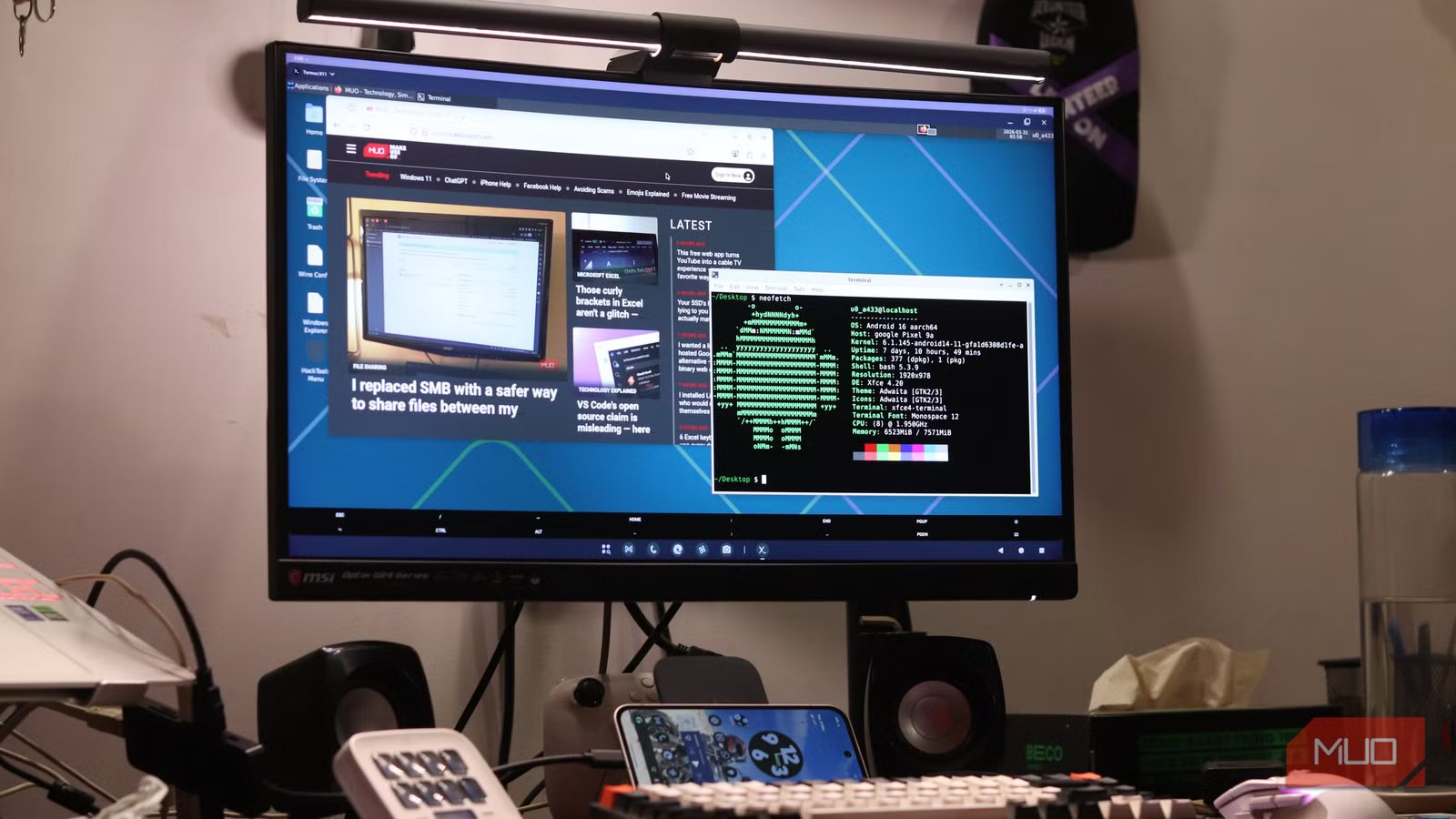
The next logical step is to plug in a keyboard, mouse, and an external display. You can use just about any USB-C hub with an HDMI port and a couple of USB ports to achieve this, and before you know it, your Pixel has turned into a computer.
Once connected, Android’s desktop or casting mode and the Linux GUI combine into something that feels very close to a small thin-and-light laptop, especially when the shell, editor, browser, and file manager are running inside the Linux session instead of separate Android apps. It’s perfectly reasonable to run a full code editor like VS Code (or equivalent), Python servers, Git, and even a terminal multiplexer in this setup. The phone’s storage acts as the backing disk for everything, so you’ve got plenty of storage for a temporary workstation.
Image taken by Yadullah Abidi | No attribution required.
Because the Linux environment has access to hardware-accelerated graphics, scrolling, window dragging, and video playback are smoother than VNC over Android equivalents that get a Linux desktop to show up on your phone.
For daily work, you can easily write and test scripts, edit Markdown documents, manage Git repositories, and even do light web development work directly from the Pixel, using the phone’s data connection and Wi-Fi like any normal computer.
When the sessions need to move, disconnecting the monitor moves everything back onto the phone screen without killing the Linux desktop, so a half-written article or a half-debugged script can go wherever you’re headed next.
It’s powerful—but not perfect
Where performance shines and where it falls apart
As fun as it is to see a Linux desktop running on your Pixel, there are still limits you need to account for. There are tweaks you can make to improve the Pixel desktop experience, but it’s not a complete replacement for a dedicated laptop, and heavy workloads like large compiles, container-heavy deployments, and multi-tab browsing will quickly remind you that you need actual compute power.
Storage, although plentiful, is also more constrained than on a traditional desktop. Allocating tens of gigabytes to multiple distros or huge datasets will erode away your phone’s storage, meaning you won’t have enough left for the phone to function as usual.
There are also the usual sandboxing quirks: file sharing between Android and Linux isn’t always seamless, and some hardware features remain locked away behind Android’s permission system. That said, the setup is far more solid than old-school VNC hacks, and the no-root requirement means getting started is as easy as punching a few commands in Termux. There’s no risk of bricking your Pixel if you do this, which makes the entire process well worth a shot.
This setup makes more sense than it should
Why a pocket workstation isn’t as crazy as it sounds
This kind of pocket workstation shines in specific scenarios like emergency fixes, on-the-go development, some writing, or documentation work. If a Git repo needs a quick patch and I’m away from my desk, I don’t need to carry my laptop around with me. The same applies to running small servers like Copyparty on Android, mobile IDEs, or web editors.
Related
4 things you can do with a Linux terminal on Android that no regular app can match
Your phone is more capable than Android lets on.
Even for non-developers, the setup is surprisingly practical: a distraction-free, light writing environment, a familiar Linux desktop with admin tools, or a private browsing profile that stays inside the Linux VM instead of the main Android environment.
Remember, it’s not about replacing a desktop PC, but about shrinking a decent Linux machine to fit into your pocket. Whenever you need one, it’s ready to go with a USB-C cable and a few accessories.
