

I love shiny gadgets as much as the next person, but few things bring me as much joy as splitting wood. As someone conditioned to look at specs, I thought a bigger chainsaw would be a better chainsaw for the job, but I’ve since purchased a tiny one, and I’m quite glad I did.
I thought I should buy the longest chainsaw I could
I grew up watching my dad load up a wood stove and light a fire to help keep our family warm. It surprised me and my family alike to find that, a decade later, I’d be buying a wood stove for my home and splitting wood myself. Now I live on several acres of land, and trees regularly provide us with free firewood—as long as we have the right tools.
I bought a Greenworks chainsaw, in part, because it offered a model with an 18-inch blade. I don’t know much about chainsaws, but I figured if I wanted to saw fallen trees, I’d need as big a number as possible. This chainsaw served me well for a while, until it didn’t, through no fault of its own.
When my chainsaw broke, I took a chance on a smaller one
I have never been taught how to use a chainsaw. At first, I was amazed by how powerful it felt. Then I started trying to saw my way through plants I really shouldn’t have, and the chain popped off. I had a friend help me put it back on, but the chain would no longer spin. I couldn’t figure out the problem, and I didn’t know someone, or a shop, that could fix it for me.
Credit: Bertel King / How-To Geek
The local stores around me sell Stihl yard tools, and that’s the one brand our local hardware shop says they it services. Attempting to look up why this is, I found that Stihl’s American headquarters is in Virginia Beach, less than a two-hour drive from where I live. Stihl products cost more, but if I can get it repaired by someone knowledgeable, that justifies the added expense.
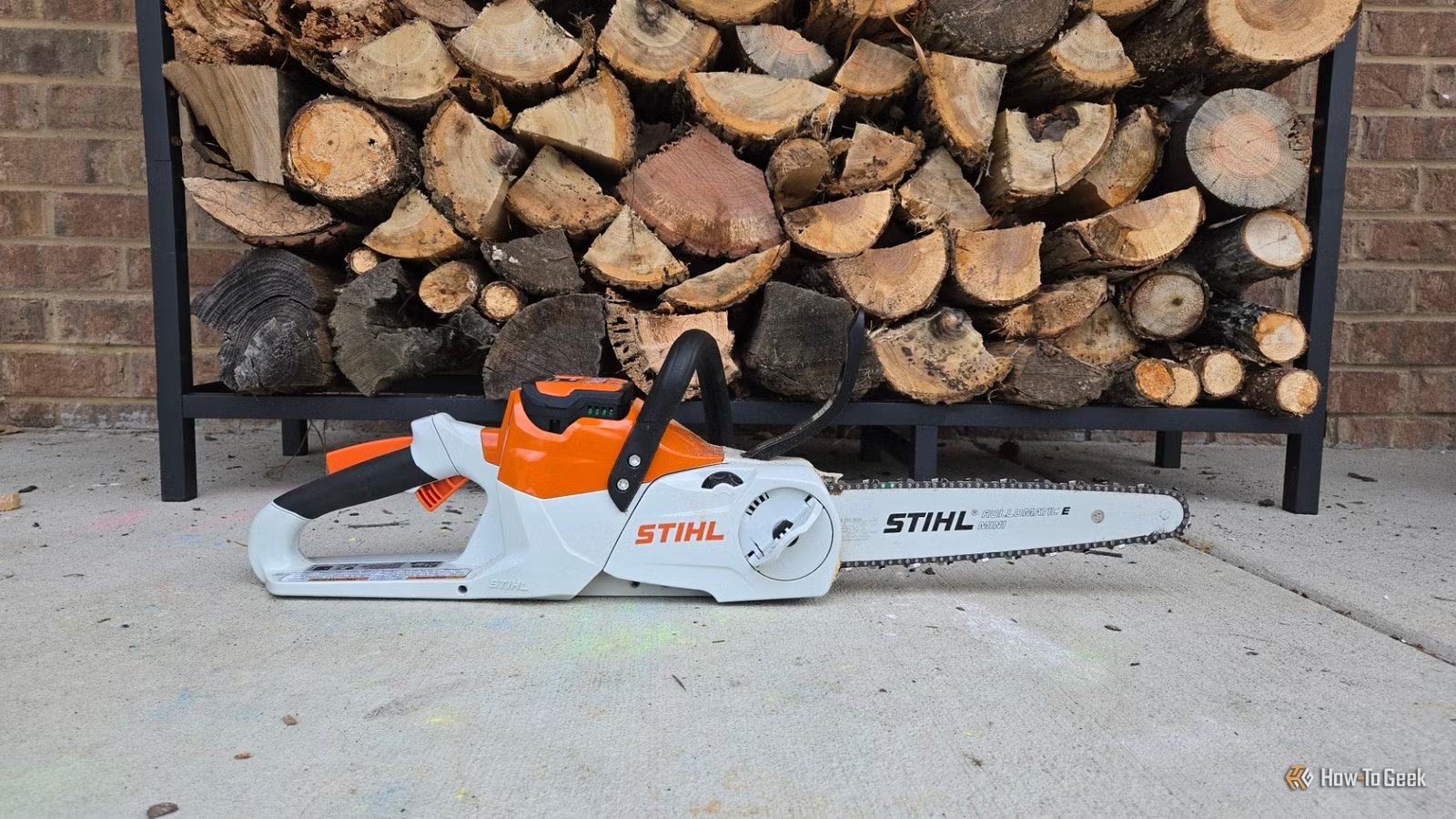
The only electric model I saw in my local Southern States was only 12 inches long, despite costing quite a bit more than my existing chainsaw. Given that we were out of firewood at the time, and we were forecast to receive up to two feet of snow in just a few days (which can be quite intimidating for the non-mountainous parts of a southern state), I didn’t have time to order something else. With all of my portable power stations (complete with portable solar panels), I wasn’t concerned about keeping the lights on, but running our 5-ton heat pump off our batteries would be a non-starter. To stay warm, we’d need wood. So I bought the 12-inch Stihl MSA 70 C battery-operated chainsaw and went home.
12 inches is plenty to cut the wood I generally cut
Most of the trees and branches that have fallen or were cut down near my home, turns out, are under a foot in diameter. It makes sense. Larger trees have larger, more extensive roots, and take more effort to bring down. Some trees that fail to break through the canopy end up being starved for light, eventually stop growing, and die. Some large trees, following a windy day or heavy snowfall, drop branches that are thick enough to be tree trunks in their own right.
For the time being, I can produce more than enough firewood just by targeting the fallen trees and branches that my 12-inch chainsaw can handle. Larger trees tend to be a challenge for me to take on alone anyway, regardless of the chainsaw I have on hand.
A smaller chainsaw is particularly handy for trimming branches around the house. It cuts through such wood instantly, since these branches don’t strain the weaker motor.
The size and weight are much more manageable
Creating firewood is a physically intense task. It involves dragging heavy branches, swinging a maul, and carrying split pieces from one location to another. Having to carry a heavy chainsaw doesn’t help, and a long bar and chain weigh more than a shorter one. Likewise, a chainsaw powerful enough to manage a longer bar is also going to weigh more.
Credit: Bertel King / How-To Geek
A short chainsaw is easy to carry and use for extended periods of time, allowing me to work for longer before I get tired. It’s also easy to control and manage, making it safer. All of this combined helps me get more wood chopped in less time.
I save money upfront and on maintenance
I’ve had to give more thought to preserving my chainsaws than I have other power tools. I abuse my lawn mower without much thought. My leaf blower turns on with no problem whenever I need it. The only reason I struggle with my string trimmer is I keep forgetting how to properly reload it when the string runs out.
With my chainsaw, I’ve learned that I may need to replace the bar and chain more often than I expected. When the time comes, not only is a smaller chainsaw more affordable than a larger option, but so are the parts I may eventually need to replace.
I’m not saying everyone needs to ditch their bigger chainsaw. The biggest downside to my smaller one is its weaker motor. It struggles to make its way through dense hardwood where a larger, more powerful chainsaw might not—though DeWALT’s new 60V 12-inch chainsaw might be able to handle the job thanks to its extra punch, without being any longer.
A 12-inch chainsaw is also not the best way to go about sawing through a 20-inch log. Larger chainsaws have their place, and I’m still committed to learning how to fix mine—but I know now that the smaller one is my first choice, and I’d only grab the larger one if a job demands it.
