

‘I’ll tell you something I’ve not told anyone,” says Celia Rowlson-Hall. “This might make me sound a little wild, but I don’t care.” The choreographer is recounting her experience on The Testament of Ann Lee, a fever dream of a film starring Amanda Seyfried as the leader of 18th-century Christian sect the Shakers, whose ecstatic prayer rituals could involve dancing for days. “The night before we started filming, I was sleeping and, literally, the ghost of Ann Lee was over my bed with angels around and she said: ‘Go forth!’” Rowlson-Hall laughs at herself for revealing this. “Was that my imagination allowing myself to go forth? Maybe, probably,” she smiles. “It was so intense that I will never forget it.”
In Mona Fastvold’s film, we see Lee, a blacksmith’s daughter from Manchester, having vivid religious visions that trigger her evangelism. Much like creative visions, I say. Maybe in a different time Lee would have been an artist? “She was an artist, without a doubt,” says Rowlson-Hall. To be an artist, she continues, “you have to believe in more than just what you see in front of you. It’s a concoction of faith and drive, a little delusion and a lot of energy. Like gunpowder.” Lee definitely had those qualities, leading the Shakers to the US, preaching piety, pacifism, celibacy and the confession of sins, and inspiring devotion as well as ire.
‘Dance is probably the answer to nearly everything’ … Celia Rowlson-Hall at the LA premiere of The Testament of Ann Lee. Photograph: Brianna Bryson/WireImage
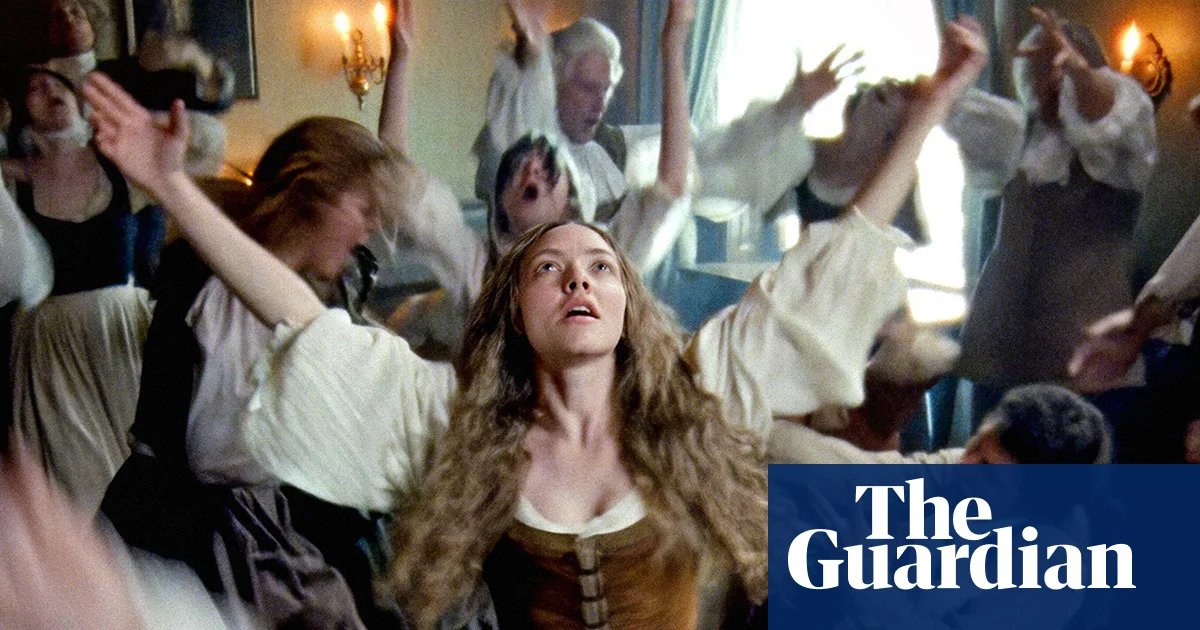
The Shakers worshipped with chanting and dancing. In the film, we see Lee in Manchester in a sweat-soaked room full of people whose hands raise to the sky, then drop and slap on their chests, rhythmic fervour rising to a boil. It’s a strange and powerful film, a kind of musical, although not the kind of musical you’ve ever seen before. The music, by Oscar-winning composer Daniel Blumberg (The Brutalist), is based on surviving Shaker hymns, but there was very little source material for the choreographer to work with. She had to engage imagination – something she’s not short of.
double quotation markEverything that happens to us, we take in – so where does it live in the body?
Rowlson-Hall grew up in small-town Virginia and started dancing aged five. As a kid she loved Buster Keaton and Charlie Chaplin. As a student she had her mind blown by Pina Bausch’s dance theatre, and when she discovered the films of British dance company DV8, she decided: “I want to do this.” She started out dancing for New York choreographers Faye Driscoll and Monica Bill Barnes but soon moved to choreographing her own music videos, TV and commercials. She liked that film gave you something that could be seen by anyone, anywhere, not just for one night in a downtown theatre.
She made dances for Lena Dunham’s series Girls and Charlotte Wells’s film Aftersun (in which she also played the grownup Sophie), music videos for MGMT, Coldplay and Alicia Keys and her own leftfield dance films, such as Ma, about a virgin mother’s pilgrimage across the American south-west. And she recently returned to theatre, creating a show called Sissy, featuring actor Marisa Tomei. Her style, well, it’s everything: pop, commercial, weird, satirical, contemporary, tap, social dance, ballet. It’s fun and colourful but ultra cool. It’s “dance like nobody’s watching”, except everybody’s watching Rowlson-Hall right now.
‘I wanted to say things that I could not say in words’ … Celia Rowlson-Hall as the adult Sophie in the 2022 film Aftersun. Photograph: Collection Christophel/Alamy
The Testament of Ann Lee has a darker, earthier mood, especially in a devastating sequence where Lee gives birth four times. All her children die. Rowlson-Hall’s own son, then a year old, was with her the day of that shoot and she wells up remembering it. Lee’s experience undoubtedly compounded her belief that sexual relations were the root of all evil, and the Shakers’ physical worship, perhaps, was a route to healing, or at least survival.
“Everything that happens to us we take in,” says Rowlson-Hall. “So where does it live on the body? And if you take in pain and loss, how are you going to get it out?” It’s impossible not to notice in the film how close the dances of God and sin are, the rhythm of prayer and the rhythm of sex. “It did feel very feral,” she says of those mass worship scenes. “The body looks like it’s about to explode.” Fastvold has likened the Manchester gatherings to a rave. It’s not so different from the Haçienda, perhaps: people are always seeking something (escape, community, transcendence), and the body is key to how we find it.
Like the Haçienda? … The Testament of Ann Lee. Photograph: Everett Collection Inc/Alamy
“I personally think dance is probably the answer to nearly everything,” she says. “The body is where your intuition lies, your deep truth and knowing. And if you’re not, sort of, shaking it around, it can get lost.” That felt true for Rowlson-Hall growing up. “I wanted to say things that I could not say in words, because that was too scary,” she says.
When she came out, aged 30, “all of a sudden my relationship to dance changed”. (Rowlson-Hall is married to director Mia Lidofsky. Their wedding was featured in Vogue). “I almost stopped dancing because I felt like this thing that had been pushing against me the whole time was finally out,” she says. “I’m still trying to re-find my relationship to dance 10 years later.” As she said herself, the body will have the answers.
The Testament of Ann Lee is in UK cinemas from 27 February
