

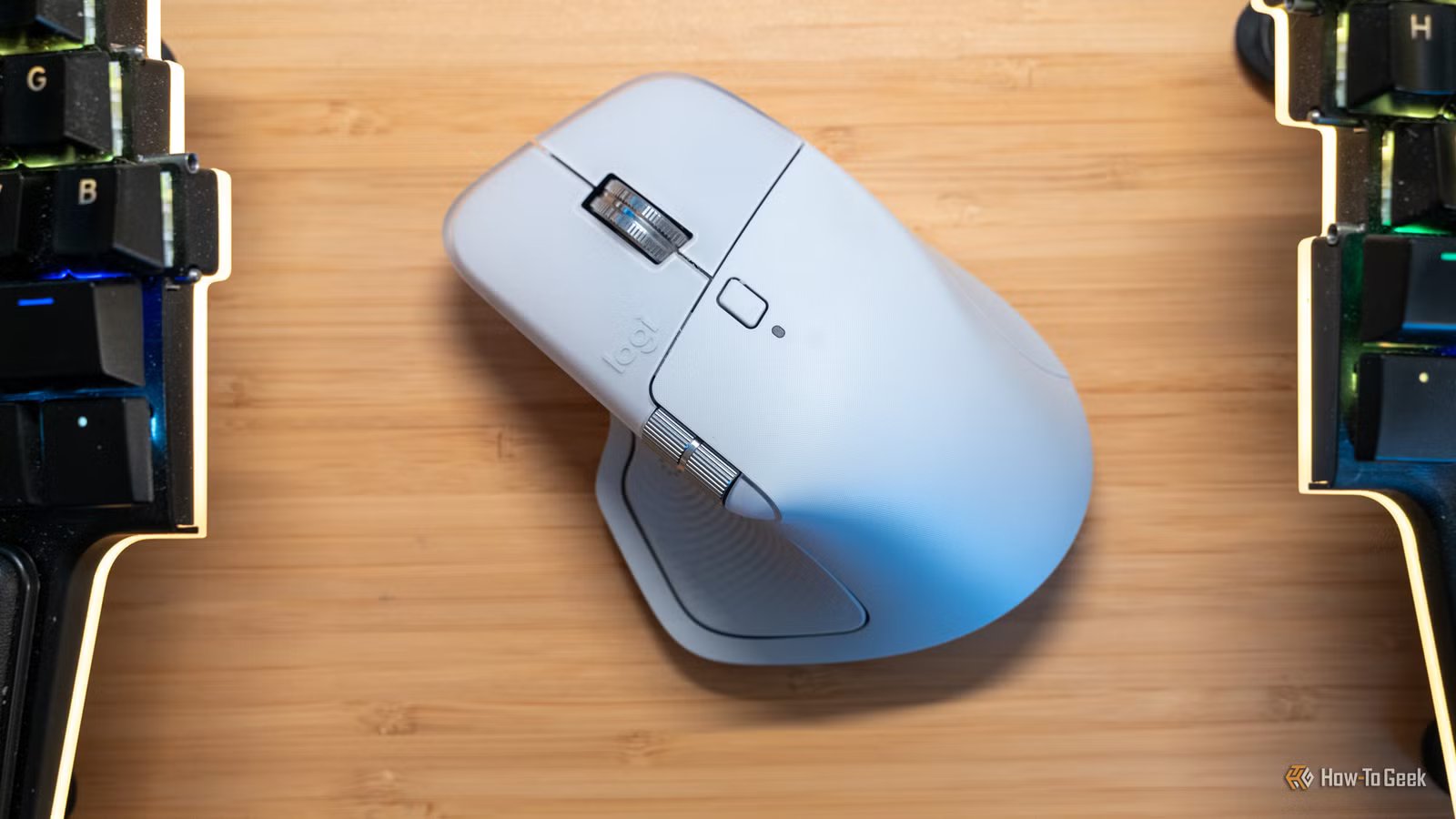
Going into this review, I thought the Logitech MX Master 4 was going to be yet another minor upgrade over the previous generation. I was wrong, and in a way that I never expected—one single button. Here’s why I think the MX Master 4 might be worth upgrading to because of one small update that changed my entire workflow.
10/10
Weight
150
Sensor
8,000 DPI
Wireless?
Yes
Brand
Logitech
The Logitech MX Master 4 features an all-new haptic engine for a unique and customizable clicking experience. It’s quieter then ever before, but without sacrificing the satisfying feel you’ve come to know and love. Plus, there’s an all-new customizable action button, updated material, and more.
Pros & Cons
- New customizable action button
- Better material that doesn’t stain as easy
- 70-day battery life
- Haptic engine is a nice touch
- $20 more than the previous generation at launch
See our process
How We Test and Review Products at How-To Geek
We go hands-on with every product to ensure it’s worth your time and money.
Price and availability
The Logitech MX Master 4 comes in three colorways—graphite, black, and pale gray—and costs $119.99. It’s available to purchase from Amazon, Best Buy, Logitech, Staples, Office Depot, Micro Center, Target, and Adorama.
Weight
150
Sensor
8,000 DPI
Wireless?
Yes
Brand
Logitech
Battery
70 days of use
Color Options
Graphite, Black, Pale Gray
Connectivity
Wired, Bluetooth, Bolt 2.4GHz
Programmable Buttons
6
A refinement of what was already great
I’m glad Logitech didn’t reinvent the mouse
Credit: Patrick Campanale / How-To Geek
I’ve been a Logitech MX Master user for over a decade. In that time, Logitech has refined the mouse quite a lot. Going from the MX Master 2/S to the MX Master 3 changed a lot about the mouse, but the jump from MX Master 3 or 3S to the MX Master 4 isn’t a complete design overhaul. I’d call it a design refinement.
The overall feel of the mouse is mostly unchanged, though the layout is slightly different. The material is easier to clean, and, after months of use, my light gray model is still looking the same as it did the day I pulled it out of the box. This can’t be said for my MX Master 3, as it took on a new appearance within just a few months of use because I’m quite hard on my mice.
You’ll find a slightly redesigned gesture pad, more prominent backward and forward buttons, and a slightly more defined metal scroll wheel as headlining features of the updated MX Master 4. The same middle button is there, and the side scroll wheel has also been upgraded with a more premium feeling metal.
Overall, when going between my MX Master 3 and the MX Master 4, I don’t feel a whole lot of difference in layout or ergonomics, so if you like the MX Master 3, then you’ll like the MX Master 4.
The haptic engine took some getting used to, but I don’t mind it
The move away from physical buttons will never make sense to me
Credit: Patrick Campanale / How-To Geek
When I first pulled the MX Master 4 out of the box, I did what I always do—click buttons. I like to see how the switches feel on a mouse first thing, and the MX Master 4 is no exception. Except I wasn’t happy with the buttons out of the box. The switches felt mushy and not good, and I was wondering if there was something wrong with the mouse or if Logitech changed to a more mushy switch.
Logitech changed switches alright—but not to a more mushy one. Logitech actually went with a haptic engine in the MX Master 4, which is a very unique move I think. When the mouse is powered off, the haptic engine simply isn’t on, so the button clicks don’t feel all that great. However, when you turn the mouse on, it feels normal, which threw me off quite a bit.
If I didn’t know that the left and right buttons (and the gesture pad) were haptic, I wouldn’t figure it out by using the mouse. Logitech somehow made haptics feel native, and I love that.
Within Logi Options+ you can fully configure how the haptics of the mouse work. Some of the options include: haptics when changing virtual desktops, haptics when using the action ring, or even allow applications themselves to integrate with the mouse haptics. You’re also able to change how strong the haptics are, depending on if you want button clicks to be more firm or lighter.
Overall, I think Logitech did a great job with its haptics implementation for the MX Master 4 and I have no complaints about it (even though I thought I would at first).
Sometimes it’s the little things that make the biggest difference
Credit: Patrick Campanale / How-To Geek
The MX Master lineup has had the same core buttons since the original model, and I fully expected that to still be the case with the MX Master 4—but I was wrong. While Logitech is touting their new action ring as one of the key features of the MX Master 4, I feel like they’re underselling the mouse’s best feature: a new button.
There’s now a third button in front of the backward/forward buttons that have been there for years, and it’s my favorite feature of the MX Master 4. Why is a button so exciting? Well, by default, the button is used for Logitech’s new action ring feature. However, I reprogrammed it to app expose on my Mac.
You see, I used to have to use gestures to access expose on my Mac, which is something I do quite frequently. I already have the gesture pad button programmed to open mission control, but expose required me to hold the gesture pad and slide the mouse downward. This gesture works 9 out of 10 times, but it’s sometimes annoying to trigger. With the new button, I can trigger expose or mission control with a single click.
Of course, you could change that shortcut to be anything else that you want it to be. Some of the built-in options are screenshot, play/pause media, show/hide the desktop, and many other functions. At the end of the day though, it’s just one extra button that’s in the perfect place to make using the mouse that much nicer—and Logitech is severely under promoting this.
Should you buy the Logitech MX Master 4?
Credit: Patrick Campanale / How-To Geek
If you already own an MX Master 3 or 3S, I would probably skip the Logitech MX Master 4 unless you really need that new button or haptic engine. Functionally, there’s not much different here to justify the $120 price point unless you really want one of the handful of new features.
However, if you’re coming from an MX Master 2S or older, I would definitely say it’s worth the upgrade. You’ll get USB-C charging, all the new features, and the new Bolt adapter (just don’t buy the MX Master 4 for Mac, because it doesn’t come with the Bolt adapter).
I have zero complaints about this mouse—which is rare for me. It really does everything it needs to, and it does it well. If I had to pick something to complain about, it would be the price. Just about all of the Logitech MX Master lineup has launched at $99.99, but the MX Master 4 is $119.99.
This could be due to tariffs, increased part cost, or Logitech could just be delivering a long overdue price increase. Keeping the same price for over a decade is pretty impressive in the tech space, so I do applaud Logitech for that.
Outside of the $20 price bump, I don’t have any other complaints for the MX Master 4. If you’re itching to upgrade from an MX Master 3, or you are still rocking an MX Master 2, you won’t be disappointed with the MX Master 4.
10/10
Weight
150
Sensor
8,000 DPI
Wireless?
Yes
Brand
Logitech
The Logitech MX Master 4 features an all-new haptic engine for a unique and customizable clicking experience. It’s quieter then ever before, but without sacrificing the satisfying feel you’ve come to know and love. Plus, there’s an all-new customizable action button, updated material, and more.
