

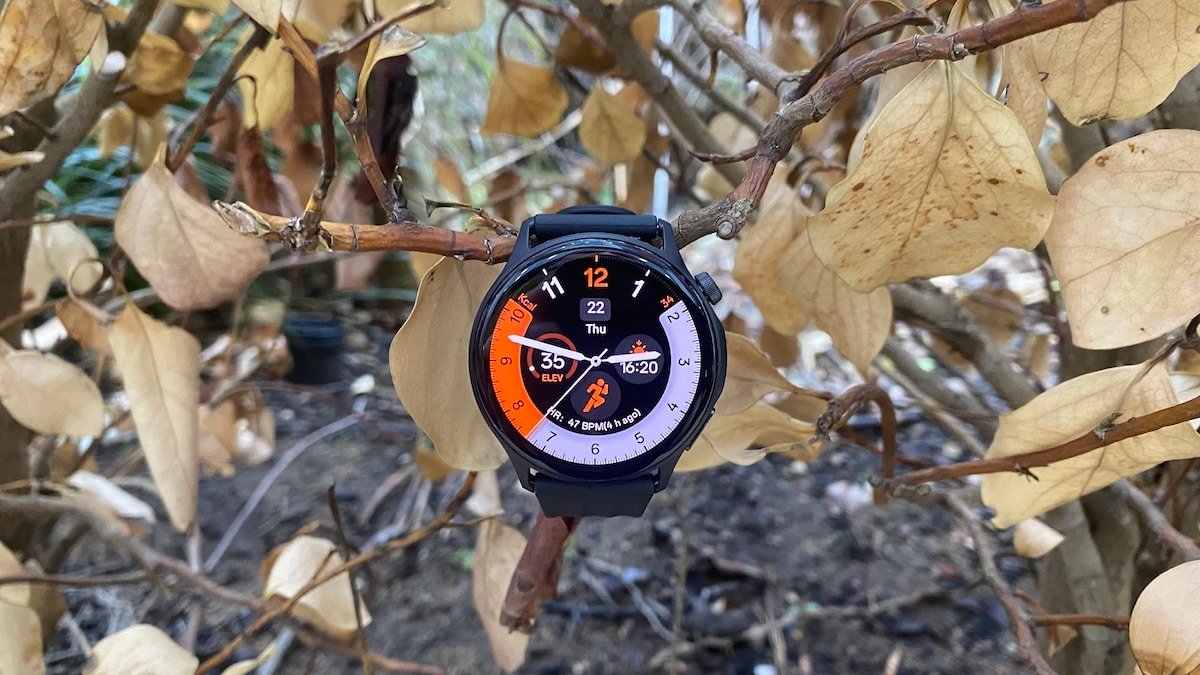
OnePlus Watch Lite
Use of information
8.0/10
Pros
- Lightweight and comfortable to wear
- Bright, sharp AMOLED display
- Strong battery life for the size
- Clean, responsive interface
- Accurate GPS and heart rate tracking
Cons
- No speaker for calls or media
- No app store
- No offline music support
I reviewed both the 47mm and 43mm versions of the OnePlus Watch 3 last year. They felt solid, had bright AMOLED displays and packed in plenty of features. The main difference was the size, but the overall experience was pretty much the same. Now comes the OnePlus Watch Lite. It looks like part of the same family, but once you dig in, it’s clear this one’s built with a different idea in mind.
There’s no Wear OS here, just a lightweight custom system. Some features have been dropped, but the upside is better battery life, a slimmer build, a simpler day-to-day feel, along with a more budget-friendly price-tag. After testing the more powerful models, I wanted to see if this stripped-back version still delivers where it counts.
OnePlus Watch Lite: One minute review
The Watch Lite isn’t trying to be a cheaper Watch 3. It’s doing its own thing. The hardware feels solid, the display is excellent, and battery life is solid. You’re not getting Wear OS, you’re not getting a speaker, and you can’t install apps – but none of that feels like a dealbreaker if you know what you’re signing up for.
It handles the essentials well. Health tracking is consistent, GPS and heart rate during workouts hold up, and the interface is quick and clean. Coming from the Watch 3 and 43mm, I didn’t feel like I was missing much in everyday use. Sure, there are trade-offs, but they’re the kind that make the watch easier to live with, not harder. If you just want something that tracks your day, logs your workouts and doesn’t try to do too much, the Watch Lite nails it.
OnePlus Watch Lite can be purchased from OnePlus*
Jump to
Design, hardware
Health & fitness tracking
Sports tracking
Smartwatch features
OnePlus Watch Lite review: Design, hardware
Look & feel
The OnePlus Watch Lite keeps the familiar round shape seen across the Watch 3 range, but trims things down with a thinner and lighter build. At 35 grams and just 8.9mm thick, it feels noticeably less bulky on the wrist, especially when compared to the 47mm Watch 3, which tips the scales at 50 grams and has a chunkier presence. Even the 43mm version, which already cuts the size down, still carries more weight and thickness than the Lite.
This device is very unisex. I felt the 43mm wasn’t really right for me, but with a diameter of 45mm I think Watch Lite is better suited for men.
The drop in thickness and weight makes a real difference in everyday wear. The device sits flatter on the wrist, slips under a sleeve without catching, and just disappears more easily during the day. The fluoroelastomer strap feels soft and doesn’t cause any irritation, even after long hours. The whole thing wears more like a fitness band than a full-on smartwatch, but without looking cheap or plasticky. Quite the contrary.
Design-wise, OnePlus has done a decent job keeping things premium. The case is still stainless steel and the strap is the same quality as the Watch 3 models. You lose the sapphire glass and titanium bezel from the flagship version, but the 2.5D curved glass looks clean. The one rotating crown is easy to use, though I did miss the second button now and then for quick actions.
The 1.46 AMOLED display is one of the Lite’s highlights. It’s bright, sharp and responsive. The thing peaks at 3000 nits, which makes it more readable outdoors than both Watch 3 models. And because it sits flush with the body rather than framed or recessed, this gives it a sleeker look.
If you’re coming from the 47mm Watch 3, this feels like a different experience altogether. There’s less wrist presence, fewer high-end materials, but a lot more comfort. Compared to the 43mm, it’s closer in size but still feels more minimal in both look and build.
Under the hood
The OnePlus Watch Lite runs on the MES2800BP chip, paired with embedded eMMC storage. This setup is designed to run OnePlus’ lightweight OxygenOS Watch 7.1 platform smoothly, without the overhead of Wear OS. In return, you get snappy performance for basic tasks like notifications, health tracking and watch face switching.
By contrast, both the 47mm and 43mm Watch 3 models come equipped with the Snapdragon W5 paired with the BES2800BP coprocessor. That combination supports full Wear OS 5.0, allowing access to the Play Store, app syncing, third-party watch faces, and more advanced features like Google Maps navigation or offline Spotify.
A very thin watch
Connectivity reflects this split too. The Watch Lite offers Bluetooth 5.2 for phone pairing, but skips out on Wi-Fi. Both Watch 3 variants include dual-band Wi-Fi alongside Bluetooth, giving them more independence from the phone.
There’s also no speaker on the Lite, so phone call support and media playback are limited to notifications only. The mic is still present, but its functionality is constrained by the simplified OS and lack of voice assistant support.
Overall, the Lite feels like a step down in processing power and versatility, but it doesn’t feel underpowered for what it’s meant to do. It’s a watch built for essential tracking and notifications rather than full smartwatch capability.
Battery life
Battery endurance on the OnePlus Watch Lite is strong relative to its price and size. With a 339 mAh cell the company claims up to 10 days of max use which sounds about right. Around a week is what you get with typical mixed usage and around 4 days with always‑on display active. Charging from zero to full takes roughly 90 minutes, and a brief 10‑minute top up promises around 24 hours of additional runtime.
Comparing that to the larger OnePlus Watch 3 models shows how different design priorities change the experience. The 47mm Watch 3 uses a 500 mAh battery that delivers up to 5 days in smart mode and up to 16 days with power saving engaged. In practice, heavy use pulls that down, but it still outlasts many Wear OS competitors thanks to OnePlus’ custom battery management.
In real terms the Lite’s battery life feels closer to the larger Watch 3 in everyday usage than to the smaller one. You get more days between charges than the 43mm Watch 3 sees under typical use, even though the Lite lacks some of the background features that tax the bigger models. This points to efficient power use across sensors and the display, which helps if you want multi day tracking without managing charge every night.
Where the Watch 3 models clearly differ is in their use of power saver modes. The 47mm Watch 3 stretches battery life further when you drop functionality, and that is helpful on longer trips. The Lite offers simple charge and go longevity without special modes.
OnePlus Watch Lite vs Watch 3 range: Tech specs comparison
Feature
OnePlus Watch Lite
OnePlus Watch 3 (47mm)
OnePlus Watch 3 (43mm)
Release date
Dec-25
Feb-25
Jul-25
Case material
Stainless steel case, Plastic bottom, 2.5D curved glass, Fluororubber strap
Stainless steel case, Plastic bottom, 2.5D Sapphire Crystal cover plate, Titanium bezel, Fluororubber strap
Stainless steel case, Plastic bottom, Fluororubber strap
Number of buttons
Rotating crown
Rotating crown + flat action button
Rotating crown + flat action button
Shape
Round
Round
Round
Size
44.98 x 44.98 x 8.9 mm
47.6 x 46.6 x 11.75 mm
43.2 x 43.2 x 11 mm
Display type
AMOLED
AMOLED
AMOLED
Display resolution
464 x 464 pixels, up to 3000 nits brightness
466 x 466 pixels, up to 2200 nits brightness
466 x 466 pixels, up to 1000 nits brightness
Display size
1.46 inch
1.5 inch
1.32 inch
Weight (without strap)
35 grams
50g without strap
38g without strap
Sensors
Accelerometer, gyroscope, optical heart rate sensor, optical pulse oximeter, geomagnetic sensor, wrist temperature, light sensor, air pressure sensor
Accelerometer, gyroscope, optical heart rate sensor, optical pulse oximeter, geomagnetic sensor, wrist temperature, ECG, light sensor, barometer
Accelerometer, gyroscope, optical heart rate sensor, optical pulse oximeter, geomagnetic sensor, light sensor, barometer
Water-resistance
5 ATM, IP68
5 ATM, IP68
5 ATM, IP68
Satellite connectivity
Dual Frequency L1+L5 (Beidou, GPS, Galileo, GLONASS, QZSS)
Dual Frequency L1+L5 (Beidou, GPS, Galileo, GLONASS, QZSS)
Dual Frequency L1+L5 (Beidou, GPS, Galileo, GLONASS, QZSS)
Microphone
Yes
Yes
Yes
Speakers
No
Yes
Yes
NFC
Yes
Yes
Yes
Music storage
No
Yes
Yes
Processor & memory
MES2800BP, eGB EMMC
Snapdragon W5, BES2800BP, 32GB storage, 2GB RAM
Snapdragon W5, BES2800BP, 32GB storage, 2GB RAM
Connectivity
Bluetooth 5.2
Bluetooth 5.2, WiFi 5G/2.4G, 802.11 a/b/g/n
Bluetooth 5.2, WiFi 5G/2.4G, 802.11 a/b/g/n
Battery capacity
339 mAh
500 mAh
345 mAh
Battery life
Up to 10 days max, 7 days typical, 4 days with always-on display. Full charge takes 90 minutes, 10 minutes charge for 24 hours using
Up to 5 days smart mode, 3 days heavy use, 16 days power saver
Up to 60h standard use, 36h heavy use, 7 days power saver, 10 min charge for 1 day use
Operating system
OxygenOS Watch 7.1
ColorOS Watch 7.0 + Wear OS 5.0
ColorOS Watch 7.0 + Wear OS 5.0
Colours
Black Steel, Silver Steel
Obsidian Titanium, Emerald Titanium
Black Steel, Silver Steel
OnePlus Watch Lite review: Health & fitness tracking
Health tracking on the Watch Lite is one of the areas where it holds up well. Which is not really surprising as this is essentially a fitness watch.
You get the usuals, such as 24/7 heart rate monitoring, SpO2 readings, mindfulness tracking, wrist temperature and sleep data with stages. It’s all the stuff I used regularly on the Watch 3 range. And to be honest, I didn’t feel like I was missing much on the Lite.
The one omission is ECG, which was only on the larger Watch 3 anyway, and not something I relied on much day to day. Mind you, the sensor is there. It just hasn’t been enabled yet for the UK region. In some other regions it does work – so it’s just a matter of time before the company secures regulatory approval to allow its functionality in this country.
The sleep tracking breaks things down into light, deep and REM stages, plus overall sleep time and trends. It’s basic but useful, especially if you just want a quick read in the morning without getting lost in graphs. Heart rate tracking felt accurate most of the time, though it’s a little slower to respond when your heart rate spikes quickly. Not a huge issue unless you’re constantly jumping between states, and for general wellness tracking, it’s solid.
The wrist temperature sensor is still here too, and while it doesn’t give you moment-to-moment feedback, it adds a bit more context to your overnight data. I’ve always found it more useful over time rather than as a standalone number. Mindfulness tracking runs in the background and just shows up as a score based on heart rate variability, which is fine for getting a general feel for recovery or pressure through the day.
Also worth mentioning is the 60 second wellness checkup, which spits out some novel things. For example, arterial stiffness and vascular age. Both are indicators of the elasticity of your blood vessels.
All of this info syncs into the OHealth app, which I think is one of the cleaner options out there. The layout’s simple, the trends are easy to find, and it doesn’t try to be too clever. There’s not much in the way of insights or recommendations, but the core data is clear and consistent. If you just want to keep an eye on your health without going deep into metrics, the Watch Lite handles it well. It tracks what matters and leaves out the fluff.
OnePlus Watch Lite review: Sports tracking
The Watch Lite handles workout tracking better than I expected for something in this price range. It covers a wide range of activity types, over 100 modes in total, so whether you’re out for a run, lifting in the gym, or doing something more niche like hiking or rowing, it’s probably in the list. There’s also automatic detection for a few common activities like walking and running, which kicks in reliably enough.
GPS performance has been solid, even in Central London. It locks on quickly before a session, and once connected, the signal stays stable even in tougher spots like tree cover or around tall buildings. The dual-band satellite support definitely helps here, and I’ve seen similar performance to the Watch 3 models. That part feels consistent across the lineup.
Heart rate tracking has also been accurate overall. I tested the device next to a Garmin Forerunner as shown in the screen-shots below. Multiple runs showed only a difference of 1 or 2 beats per minute for average and maximum heart rate. No doubt, this is helped by the thin design and light weight. It means the device sits flush against your wrist and doesn’t move much when you exercise.
The watch displays core stats like time, distance, pace and heart rate live during workouts, and you can view your route and summary data afterward in the OHealth app. It’s not loaded with training tools or deep analysis, and you won’t find third-party sync support, but for straightforward workout logging, it does the job.
You even get things such as running form metrics, but for some reason I could not find a VO2 estimate. Not sure if it is hidden away somewhere or is yet to be added to the app.
Garmin data for same run
OnePlus Watch Lite review: Smartwatch features
As far as smartwatch features, Watch Lite runs on OxygenOS Watch 7.1. This is a lightweight operating system built for speed and simplicity. The device is not trying to match Wear OS or Apple Watch in terms of smart features, and that’s clear from the moment you start using it. But you do get the basics.
Notifications show up on time and are easy to read. This is good for staying on top of things and it works well enough.
There’s no speaker here, so while the mic lets you take calls, you’ll need to use earbuds or grab your phone to actually talk. It’s not ideal for long conversations, but it works for quick responses.
There’s also no music storage, so you can’t load up playlists for offline use like on the Watch 3. Media controls include play, pause and skip when your phone is nearby. That might be enough for most people, but if you’ve used a watch with proper offline music, you’ll notice the absence.
NFC is also there. But, again, it is limited in functionality. You can’t actually use it to hold bank cards. Its functionality can be used for things such as key fobs.
One small feature that’s useful is support for dual phone pairing. You can connect the Lite to two phones, say, one for work and one personal, and get notifications from both. It’s not something you see often. As mentioned, connectivity is Bluetooth-only. So no Wi-Fi or LTE options. And with no app store, what you get out of the box is what you’ll have to do with.
Mind you, the everyday tools are all there. Alarms, timers, and media controls are simple but solid. The interface feels like it was designed specifically for this device, which keeps things smooth. Swipes and taps are fast, and you don’t run into the kind of sluggishness or weird transitions you sometimes get on more bloated systems.
*We are a review site that receives a small commission from sales of certain items, but the price is the same for you. Purchasing items by clicking on links in this article allows us to run this website. We are independently owned and all opinions expressed here are our own. See our affiliate disclosure page for more details.
Like this article? Subscribe to our monthly newsletter and never miss out!
