

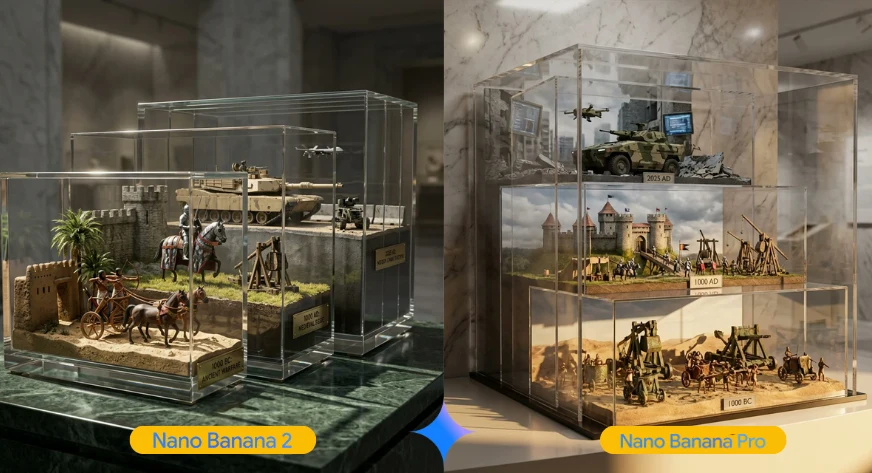
Nano Banana Pro has been my personal favorite tool for creating high-quality social media posts, infographics, project flows, and more. Now, Google has upgraded it with Nano Banana Pro 2, and it’s a serious step up. The new version is not only faster than the previous model but also more affordable. In this article, I’ll break down both versions and show you exactly what’s improved in this latest update.
Nano Banana 2 vs Nano Banana Pro: Overview
Feature
Nano Banana Pro (Gemini 3 Pro)
Nano Banana 2 (Gemini 3.1 Flash)
Release
Nov 20, 2025 (Gemini 3 Pro Image)
Feb 26, 2026 (Gemini 3.1 Flash Image)
Underlying Model
Gemini 3 Pro (advanced reasoning, world knowledge)
Gemini 3.1 Flash (Flash-optimized, high-speed)
Speed / Latency
High-quality generation (relatively slower inference)
Ultra-fast generation (Gemini Flash speed)
Max Resolution
Up to 4K (4096×4096)
Up to 4K (4096×4096)
Aspect Ratios
Multiple formats (e.g., 1:1, 16:9) up to 4K
Flexible AR (512px – 4K, all orientations)
Subject Consistency
Consistent likeness of up to 5 people (14 inputs)
Consistent likeness of up to 5 characters (14 objects)
Instruction Following
Advanced reasoning (context-rich output)
Enhanced strict adherence to complex prompts
Text Rendering
Accurate, legible multilingual text in-image
Accurate text + in-image translation/localization
Creative Controls
Full editing controls (lighting, focus, camera, color)
High visual fidelity (vibrant lighting, rich textures)
Image Quality
Studio-quality, photorealistic (4K) with consistent branding
High-fidelity visuals at Flash speed
Use Case Focus
Complex composites, infographics, mockups, branding
Rapid iteration, creative experimentation, quick edits
Availability
Gemini App (Pro mode), Ads, Workspace (Slides/Vids), NotebookLM, Gemini API/Studio (preview), Vertex AI (preview)
Gemini App (Fast/Thinking/Pro replaced by NB2), Google Search (AI Mode & Lens), Ads, Gemini API/Studio (preview), Vertex AI (preview), Flow (all users)
If you want to explore these models in detail, checkout:
Let’s Compare the Image Outputs of Nano Banana Pro and Nano Banana 2
Task 1: Generate High Resolution Images
Create a hyper-realistic image of an Indian superhero, standing on top of a tall building in Gurugram, looking down at the rest of the city. The superhero is wearing an Indian king’s attire with a Dhoti and a long flowing Kurta, in a bright and royal colour scheme of our choice. At the top of some of the surrounding buildings, we see boards of companies like Google, Microsoft, AT&T, and others.
Nano Banana 2 Output:
Nano Banana Pro Output:
My Take:
Evaluation Criteria
Nano Banana 2
Nano Banana Pro
Winner
Photorealism
Strong sunset lighting with cinematic depth
Strong night lighting with slightly stylized tone
Nano Banana 2
City Accuracy / Realism
Closer to Gurugram business district aesthetic
Slightly more AI-polished skyline
Nano Banana 2
Brand Logo Clarity
Google visible, others less prominent
Google, Microsoft, AT&T clearly readable
Nano Banana Pro
Instruction Following
Matches attire and rooftop positioning well
More precise multi-brand and detail adherence
Nano Banana Pro
Lighting Control
Cinematic golden-hour mood
Controlled night contrast lighting
Tie
Scene Composition
Wide cinematic perspective
Slightly tighter framing
Nano Banana 2
Winner: Nano Banana 2
Task 2: Annotated Diagrams
Nano Banana 2:
Nano Banana Pro:
My Take:
Evaluation Criteria
Nano Banana 2
Nano Banana Pro
Winner
Overall Blueprint Aesthetic
Strong vintage sepia tone with clean blueprint layout
More dramatic and slightly stylized composition
Nano Banana 2
Technical Linework Precision
Sharp, symmetrical white linework
Slightly thicker lines with softer edges
Nano Banana 2
Text Accuracy & Readability
Mostly accurate labels with minor inconsistencies
Clearer text alignment and spacing
Nano Banana Pro
Measurement Accuracy
Dimensions included and mostly correct
More structured and balanced dimension placement
Nano Banana Pro
Wing Warp Mechanics Schematic
Present and clearly boxed
Cleaner mini-diagram with improved clarity
Nano Banana Pro
Historical Information Box
Included and readable
Stronger visual hierarchy and formatting
Nano Banana Pro
Layout Structure & Balance
Slightly dense composition
Better spacing and visual flow
Nano Banana Pro
Visual Clarity at Scale
Good clarity but denser overall
More refined infographic clarity
Nano Banana Pro
Winner: Nano Banana Pro
Task 3: Study Material Images
High-quality, top-down flat lay infographic that clearly explains the concept of a Decision Tree in machine learning. The layout should be arranged on a clean, light neutral background with soft, even lighting to keep all details readable. Create a simple, step-by-step visual flow from top (root node) to bottom (leaf nodes), using clean black hand-drawn arrows to guide the viewer’s eye. Annotate each part of the tree with short labels: root node, feature split, decision rule, branch, leaf, prediction. Include a small example dataset and show how the tree splits the data. Keep the style educational, modern and easy to understand. Format 16:9
Nano Banana 2:
Nano Banana Pro:
My Take:
Evaluation Criteria
Nano Banana 2
Nano Banana Pro
Winner
Visual Simplicity
Minimal, friendly design with icons and soft layout
More formal and structured presentation
Nano Banana 2
Structural Hierarchy
Multiple labels but denser layout
Clear root emphasis and strong Yes/No branching
Nano Banana Pro
Readability & Flow
Informative but slightly visually busy
Cleaner vertical flow and node separation
Nano Banana Pro
Concept Explanation
Explains decision tree terminology clearly
Focuses more on applied example
Nano Banana 2
Practical Application Clarity
Conceptual demonstration
Real-world dataset and decision logic example
Nano Banana Pro
Overall Technical Presentation
Visually engaging educational diagram
More structured and professional diagram output
Nano Banana Pro
Winner: Nano Banana Pro
Task 4: Storyboard
Using the photo I’ve uploaded, create a short 6–8 frame storyboard featuring me as the main character. Keep the style fun, cinematic, and easy to follow. Use my appearance accurately in each frame and place me in different everyday scenes that flow together as a simple visual story. Add brief captions for each frame to describe what’s happening.
Nano Banana Pro:
Nano Banana 2:
My Take:
Evaluation Criteria
Nano Banana 2
Nano Banana Pro
Winner
Facial Structure Accuracy
Stylized and slightly altered
Closer resemblance to original photo
Nano Banana Pro
Hairstyle Accuracy
Changed to tied bun
Keeps open hair similar to original
Nano Banana Pro
Glasses Preservation
Maintained
Maintained
Tie
Outfit Similarity
Changed color and styling significantly
Closer to maroon top and dark jeans
Nano Banana Pro
Narrative Flow
Sequential and cohesive storyboard
Scenes feel slightly more independent
Nano Banana 2
Overall Identity Preservation
Noticeable stylistic deviation
Stronger visual fidelity to original
Nano Banana Pro
Winner: Nano Banana Pro
Task 5: Infographics
Create an Ultra HD image of the solar system and add the key features of each planet.
Nano Banana 2:
Nano Banana Pro:
My Take:
Evaluation Criteria
Nano Banana 2
Nano Banana Pro
Winner
Visual Realism
Highly detailed planetary textures and lighting
Clean but less detailed rendering
Nano Banana 2
System Completeness
Includes asteroid belt, Kuiper belt, dwarf planets
Focuses mainly on major planets
Nano Banana 2
Text Readability
Smaller, denser text blocks
Larger and clearer feature labels
Nano Banana Pro
Educational Clarity
Scientifically rich but visually dense
Simplified and easier for quick learning
Nano Banana Pro
Ultra HD Detail
More cinematic depth and texture resolution
Sharp but more diagrammatic
Nano Banana 2
Layout Cleanliness
Information-heavy layout
Balanced spacing and callout bubbles
Nano Banana Pro
Overall Informational Depth
More scientifically comprehensive
More simplified summary style
Nano Banana 2
Winner: Nano Banana 2
Task 6: Blog to Image
Give me an infographics that explains the difference between JSON and TOON. Reference the article: https://www.analyticsvidhya.com/blog/2025/11/toon-token-oriented-object-notation/
Nano Banana 2:
Nano Banan Pro:
My Take:
Evaluation Criteria
Nano Banana 2
Nano Banana Pro
Winner
Concept Clarity
Simple token-heavy vs token-efficient framing
Detailed side-by-side structured explanation
Nano Banana Pro
Alignment with Article
Highlights token savings visually
Explains AI optimization and key definition logic
Nano Banana Pro
Technical Depth
Basic structural example
Shows repeated keys vs defined-once schema
Nano Banana Pro
Visual Simplicity
Clean and minimal
More detailed and information-rich
Nano Banana 2
Blog-Ready Design
Explainer-style visual
Polished infographic layout with headings
Nano Banana Pro
Educational Usability
Good quick comparison
Stronger teaching and presentation clarity
Nano Banana Pro
Winner: Nano Banana Pro
When to Use Which Nano Banana Model?
After testing both models across different tasks, the difference becomes clear. Nano Banana 2 is better when you need speed, large-scale image generation, and visually rich scenes. It works well for detailed environments, complex visuals, and fast content creation. Nano Banana Pro is better when accuracy matters more. It handles identity, clean layouts, and structured educational graphics more carefully. In simple terms, use Nano Banana 2 for speed and scale, and use Nano Banana Pro when you need better control and clearer, more precise results.
Also Read: Top 10 Free AI Image Generation Tools
Nano Banana Pro vs Nano Banana 2: Cost Difference
From a pricing standpoint, Nano Banana Pro carries a clear premium over Nano Banana 2 across most workloads. Input and text output tokens are 8× more expensive on Pro, while image generation is roughly 2× more expensive. Even at the 4K level, Pro remains about 1.6× costlier per image. In short, Pro is positioned as a high-fidelity, premium-tier model, whereas Nano Banana 2 is significantly more cost-efficient for large-scale or iterative generation workflows.
Find more information on cost of both the models here.
Conclusion
After testing both models across so many different use cases, one thing is clear: this isn’t about which model is “better,” it’s about which one fits your workflow. Nano Banana 2 genuinely impressed me with its speed, scale, and visual richness. For quick social posts, iterations, and high-volume creative work, it’s incredibly efficient and cost-effective.
That said, when I need tighter control, cleaner structure, accurate identity preservation, or detailed educational graphics, I’ll still reach for Nano Banana Pro. It simply handles precision tasks more reliably.
Personally, I loved exploring Nano Banana 2 and will definitely use it for faster tasks, but for detailed, high-stakes visuals, I’m sticking with Pro.
Which image generation tool is your favorite right now? Let me know in the comments.
Hello, I am Nitika, a tech-savvy Content Creator and Marketer. Creativity and learning new things come naturally to me. I have expertise in creating result-driven content strategies. I am well versed in SEO Management, Keyword Operations, Web Content Writing, Communication, Content Strategy, Editing, and Writing.
Login to continue reading and enjoy expert-curated content.
Keep Reading for Free
