

Eye tracking has long meant expensive hardware, infrared sensors, and controlled setups. That may not last, as a new smart contact lens system aims to deliver precise tracking using cameras you already use every day.
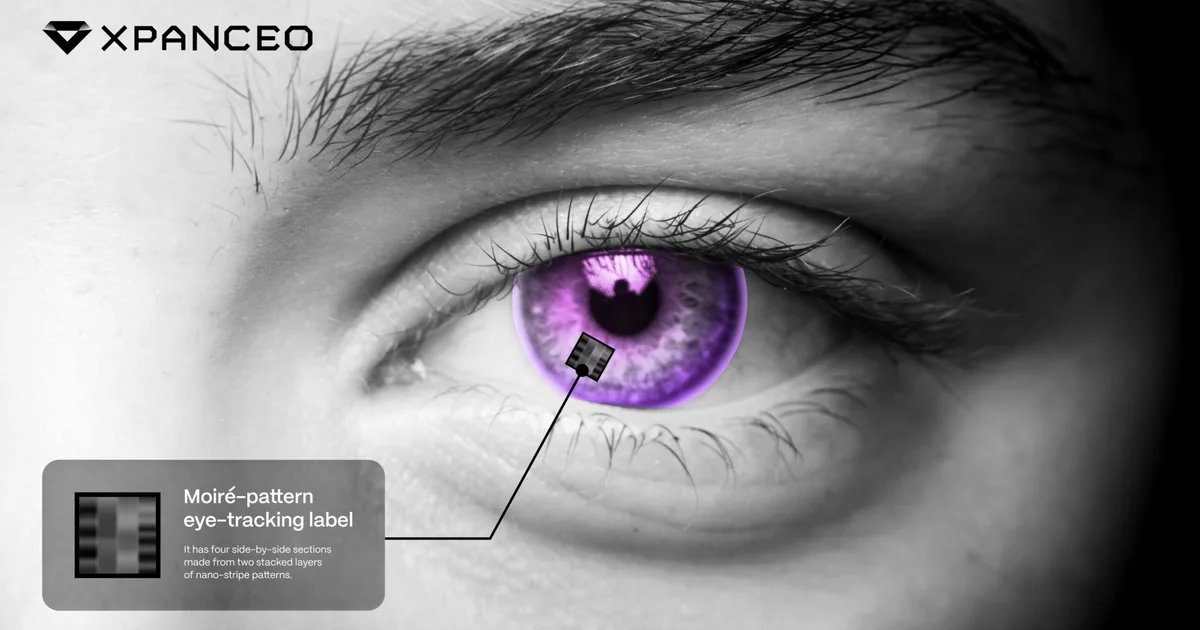
XPANCEO is developing a passive design that embeds microscopic patterns into contact lenses, turning them into optical markers readable by built-in cameras across laptops, phones, cars, and helmets. The shift is straightforward. You don’t need extra hardware or power to make it work.
Instead of active electronics, the lens relies on nano-patterns that move with your eye. External cameras detect those shifts and translate them into gaze direction, with reported accuracy around 0.3 degrees.
How the passive tracking actually works
Each lens contains two ultra-thin optical gratings separated by a microscopic gap. As your eye rotates, the layers shift and create changing moiré patterns that cameras can detect and interpret.
Advanced Functional Materials (2026). DOI: 10.1002/adfm.202522757
The tracking element is tiny, about 2.5 by 2.5 millimeters, and sits inside a soft material compatible with standard lens production. That suggests it could scale without reinventing manufacturing.
Most current systems rely on infrared illumination and constant processing, which increases power use and can struggle in bright conditions. This method avoids that by relying on optical geometry instead of active sensing.
Why this could matter beyond gadgets
If it works reliably, eye tracking could expand into everyday devices without adding cost or bulk. Built-in cameras could handle gaze detection, enabling more natural interaction with screens.
You could navigate interfaces by looking instead of tapping. In cars or industrial settings, existing cameras could monitor attention in real time without specialized equipment.
CNBC
There’s also a medical angle. Subtle eye movements are used as indicators for conditions like Parkinson’s and Alzheimer’s, and making that tracking more accessible could expand early monitoring, though real-world validation is still needed.
What to watch next
The next step is proving this works outside controlled environments. Performance will depend on how consistently different devices can read those patterns across lighting and daily use.
If it scales, manufacturers can skip adding new sensors, lowering costs and simplifying design. That could make gaze tracking a standard feature across personal devices and vehicles.
For now, this remains early-stage research with no clear timeline or pricing. The key signals to watch are real-world testing, manufacturing readiness, and whether the lenses can deliver consistent performance without sacrificing comfort or safety.
