

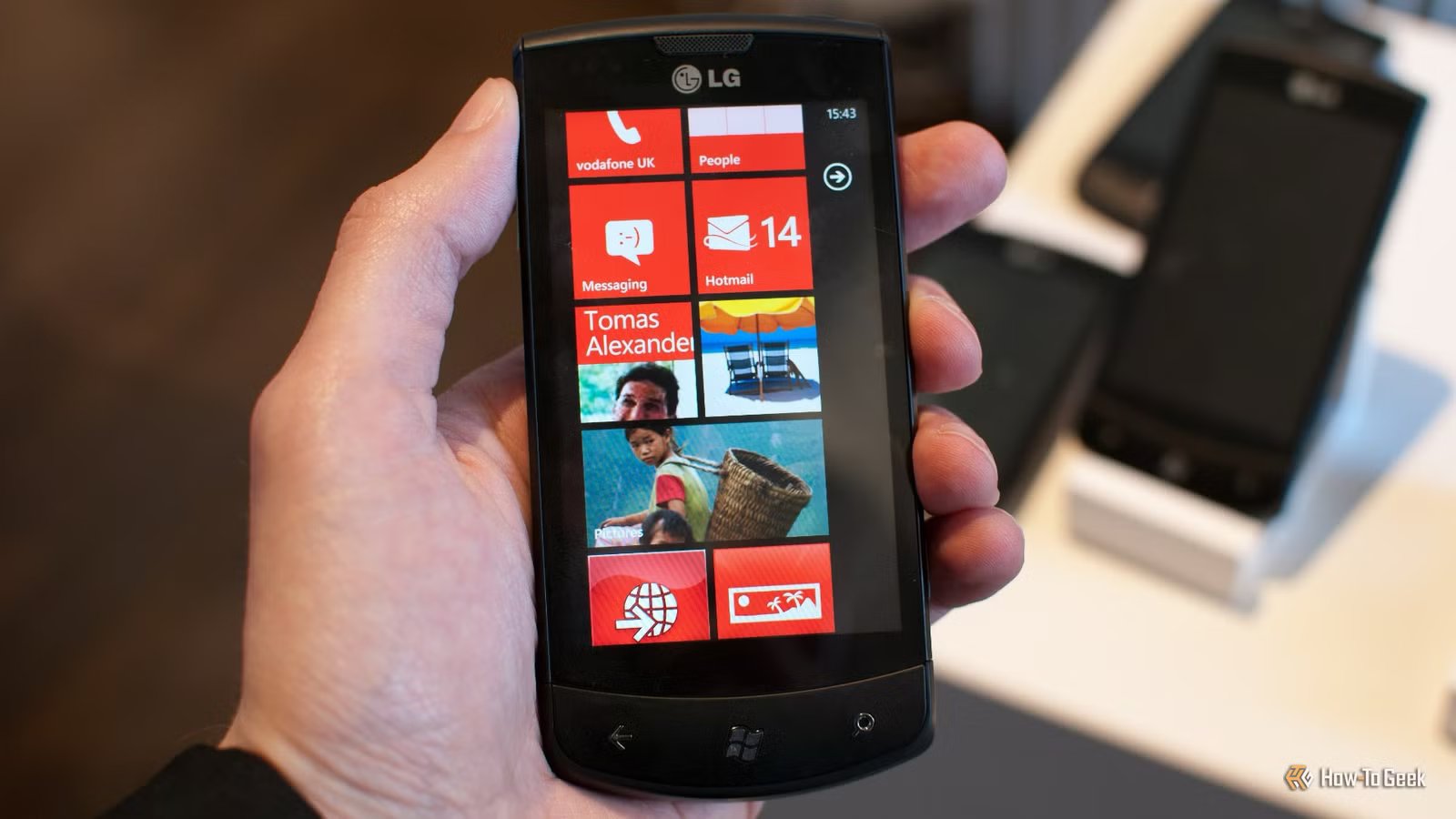
Every failed gadget eventually gets rebranded as being “ahead of its time,” and Windows Phone is no exception. Its bold design and fluid performance helped it to stand out at the time, but in truth, it wasn’t the big leap forward that many try to claim.
It was fresh and different, but not better
A lot of how Windows Phone is thought of today is driven by nostalgia. When it first launched in 2010, it was fresh and new. iOS was still heavily influenced by the skeuomorphic design it had had since day one, while Android was, let’s say, rough around the edges. It was frequently made worse by some truly terrible software skins like Samsung’s notorious TouchWiz.
In this landscape, the flat, clean look of Microsoft’s Metro UI felt genuinely modern and forward-looking. The interface had a clear identity, and many people welcomed the idea of something that wasn’t just the same home-screen-with-a-static-grid-of-icons that all other devices had.
Credit: Roman Pyshchyk / Shutterstock.com
But different doesn’t automatically mean better. The Live Tiles were an interesting idea and useful for delivering glanceable information, but they were actually less useful than a well-designed widget. The rigid design language meant that customization options were strictly limited as well, to the point where you couldn’t even change the wallpaper at first.
Some of it was good. The light and dark modes and adaptive themes it introduced are common on other platforms today, and the keyboard was famously great. But the bigger ideas, like Hubs, which grouped together content such as contacts, photos, and music, didn’t work so well. They were inconsistently supported and quickly overshadowed as individual apps grew more complex.
The Metro UI debuted on Microsoft’s Zune media players and was later pushed onto Windows 8, where it didn’t last very long. It was fresh and new, but lots of people just didn’t like it.
Good hardware couldn’t save a weak platform
On the hardware side, Windows Phone had real strengths. The biggest was how well it ran on more modest hardware, certainly much more smoothly than on comparable Android phones of the time.
In isolation, many of the devices were easy to like. Higher-end models from Nokia and HTC were well-built and distinctive, with colorful polycarbonate bodies and thoughtful industrial design.
Credit: Joe Fedewa / How-To Geek
The platform also raised the bar for mobile photography. Nokia’s Lumia line, in particular, earned a reputation for camera quality. Devices like the Lumia 1020 used large sensors and oversampling techniques that foreshadowed today’s computational photography trends. Yet much of that innovation came from Nokia’s imaging expertise rather than from anything inherent to Windows Phone itself.
And in any case, nice phones can’t make up for a weak platform. There just wasn’t room for a third mobile OS.
There weren’t enough apps, and developers had already committed to iOS and Android, where the user bases were larger and the returns clearer. Most users had picked a side, too, and it needed something truly special to make them switch.
Standing out wasn’t a strong reason to switch
I wanted to love Windows Phone, and I bought a Nokia Lumia 800 and then an HTC 8X in the hope that they would win me over. But as much as I enjoyed using the OS, it never got me to give up on Android.
People liked Windows Phone because it was different. At a time when phones are even more similar now than they were 15 years ago, many have come to remember it with even more fondness. Perhaps more than it deserves.
Credit: Andy Betts / How-To Geek
The reality is that while people insist that they want and like things that are different, most don’t actually buy them. They say they want something new and then end up getting what everyone else has. Recent Android history is littered with unusual devices that no one bought.
Even now, a vocal minority insists that they want small phones. Yet manufacturers don’t make them because they know that very few people actually go out and buy them.
And when it comes to being ahead of its time, another forward-looking platform that debuted a year before Windows Phone is far more deserving of the title: Palm’s webOS. Its card-based interface, fluid navigation gestures, and cloud integration have all been co-opted by iOS and Android in a way that nothing in Windows Phone really has.
Use a Windows Phone today, and it would still feel “different.” Use a Palm Pre, and it would be far more familiar.
It was good, but that’s all
Windows Phone deserves credit for daring to look different at a time when it felt like the future of smartphones was still up for grabs.
But nostalgia has a way of turning “interesting” into “important.” Windows Phone wasn’t a missed future classic. It was a good-looking idea that ultimately never did enough to give it a chance to succeed.
