

A sleek watch that nails the basics
The OnePlus Watch Lite is a sleek, long-lasting smartwatch that nails the basics for a very attractive price. Its premium stainless steel design and bright AMOLED display punch well above its weight, while the battery life (even with heavy use) is a significant improvement over other OnePlus smartwatches. However, the trade-off is a lack of advanced smarts—no payments, no app store, and no Google Assistant. If you want a stylish notification hub and capable fitness tracker without the daily charge, it’s a great pick. Yet, power users should look elsewhere.
Slim design with a mega-bright AMOLED screen
Surprisingly slick watch software
Solid mix of smartwatch, fitness and wellbeing features
No Wear OS means it misses out on big smartwatch features
OHealth app isn’t the most user-friendly or insightful
No external sensor support for sports tracking
OnePlus is now capable of making very good smartwatches, even if it didn’t start out that way. Each iterative release since the cursed OG OnePlus Watch has added something genuinely worth considering for fans—and the broader Wear OS ecosystem.
That’s what makes the brand’s first budget-friendly smartwatch—the OnePlus Watch Lite—an intriguing new entry.
Unlike its brethren, this is a smartwatch that, regrettably, foregoes Google’s smartwatch platform in favour of something that helps the Lite last longer.
That means you don’t get the features that truly make a smartwatch ‘smart’; the third-party apps and faces, cellular connectivity, and contactless payment support.
Yet, given its friendly price, it might just offer enough to satisfy those who want a tracker with a nice design—and, crucially, don’t want to pay out for a OnePlus Watch 3 to get it. Here’s our full verdict.
Advertisement
Price and competition
If you want to buy the OnePlus Watch Lite in the US, well, the bad news is that you can’t. At least, you won’t be able to get it directly from OnePlus, as things stand. If you’re in Europe or the UK, you’ll have much better luck.
The Watch Lite currently costs £179, making it a considerably cheaper buy than the OnePlus Watch 3 (£319) and the 43mm Watch 3 (£269).
That sub-£200 price puts it up against smartwatches like the Huawei Watch Fit 4 and the Amazfit Active 2. It’s a cheaper option than the Apple Watch SE 3 and the most affordable version of the Samsung Galaxy Watch 8.
Design and display
(Image credit: Wareable)
If you’ve been put off by OnePlus devices that are a bit bulky, that’s not something to worry about with the Lite. It’s both slimmer and lighter than the Watch 3. The single 45mm case size means it sits between the 43mm and 46mm Watch 3 models.
The watch’s slim build is what truly catches the eye. Noticeably thinner than even the latest Apple Watch (which itself feels perfectly slim), it combines this with glossy, curved 2.5D glass, resulting in a sleek and appealing profile.
Advertisement
The watch case is made from stainless steel and comes in either black or silver. It might look like there are two physical buttons, but there’s actually only one. The crown is on the top right-hand corner of the steel case.
The crown can be twisted to scroll through screens or double-pressed to quickly take you to the workout-tracking screen. Further down that side is the electrode used to take 60-second health-check measurements.
(Image credit: Wareable)
The 22mm strap is a very comfortable fluororubber one that thankfully uses a traditional watch buckle and is removable if you want to swap in another 22mm strap.
In terms of connectivity, it’s not surprising that it only supports Bluetooth and Wi-Fi. There is no LTE, but the Bluetooth connection allows you to make and manage calls as long as your phone is within range.
A delight to look at on the wrist
You’ll be looking at a 1.46-inch AMOLED touchscreen with a resolution of 464 x 464 pixels. It’s a sharp display that delivers accurate colors and has a maximum brightness of 3,000 nits. That’s pretty astounding for the price.
Advertisement
For reference, the $799 Apple Watch Ultra 3 (Wareable’s top-rated smartwatch in 2026), offers the same max brightness. Impressive, then, even if you likely won’t need to use that peak brightness in most conditions.
The 5ATM waterproof rating means it can be submerged in water up to 50 meters deep. Combined with an IP68 rating for extra dust protection, the Lite ensures this smartwatch meets key durability standards.
Battery life
(Image credit: Wareable)
The best way to describe the battery life on the Watch Lite is that it never feels like a smartwatch that shortchanges you in that area, even with heavier usage.
The lack of a more demanding operating system like Wear OS does play a part in getting the Lite to go further than the OnePlus Watch 3. The brand suggests you’ll get around a week of typical usage, which comfortably outlasts the Watch 3 (about 5 days even with the always-on display disabled).
The Lite’s maximum quoted battery life is actually shorter, at 10 days, compared to the 16 days available if you eke out everything you can from the Watch 3’s power-saving modes. However, in heavy usage, the Lite performs better. We found it was able to easily last for four days with the AOD enabled, whereas the Watch 3 can only muster around three.
Advertisement
So, if you want a smartwatch that can last a week, even when you take it to bed or use features like GPS, the Lite can keep you away from its proprietary charger.
We found during testing that using the GPS for an hour knocks the battery down by 5%, which is very solid. For context, this is similar to the battery efficiency we’ve consistently found in the best running watches.
The charging rate is also quite good, especially for a mid-range smartwatch. It takes about 90 minutes to fully charge from a completely empty state. And just ten minutes on the charger can provide enough power for a full day’s use (though this depends on whether you keep the screen on constantly).
Smartwatch features
(Image credit: Wareable)
Unlike the Watch 3, Google’s Wear OS is not the underpinning software platform. Instead, you have OnePlus’ own Oxygen OS Watch 7.1 operating system, powered by a BES2800BP processor and 4GB of RAM.
Away from the watch, you have the OHealth app, which we wouldn’t consider top-tier among companion apps. If you need a place to view your daily health and activity tracking stats or download more watch faces, it serves its purpose without being particularly standout. There’s just a real lack of cutting-edge insights, and an inability to surface the day’s most relevant metrics.
Advertisement
Still, using it to grab more watch faces is definitely a reason to spend some time in OHealth, as OnePlus offers a nice mix of analog, digital, and themed faces for the Watch Lite. Plus, they’re free to download.
(Image credit: Wareable)
The barebones experience
The lack of WearOS does mean some obvious shortcomings. You can’t use the Lite to pay for things, and you can’t access Google Maps, Google’s useful Gemini assistant, or the Google Play Store to download apps.
That doesn’t make the Lite useless as a smartwatch; it’s just one that focuses mainly on the absolute basics, and does them well. We were happy to just view notifications, even if we had to go to our phone to see more information. The music controller is also compatible with streaming services like Spotify, and it’s nice and straightforward to make a call over Bluetooth.
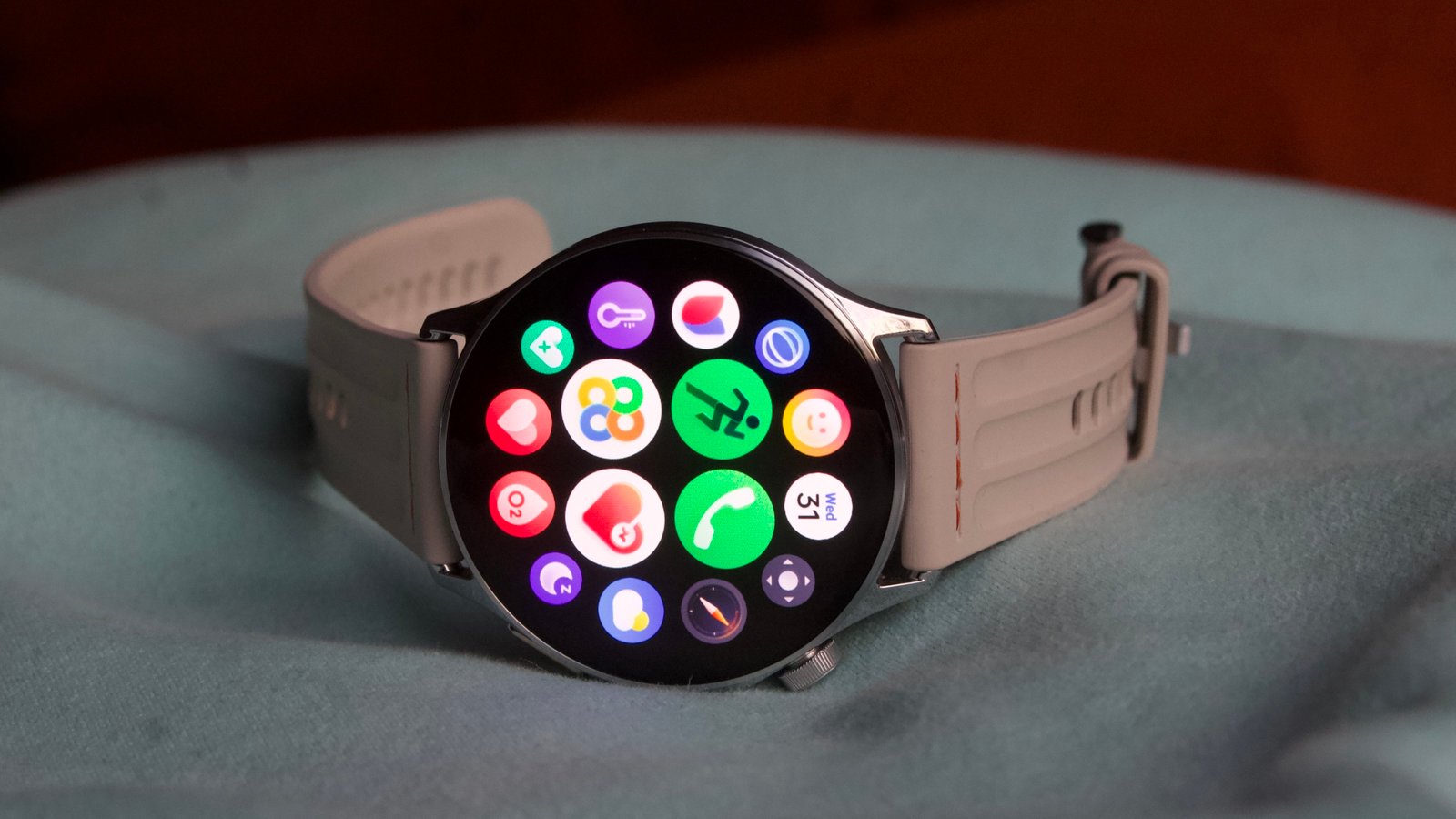
The user interface on the watch is easy to get to grips with, too. We like that the app home screen uses the rotating watch crown to expand and reveal the app names, instead of leaving you guessing what lies behind the icons.
(Image credit: Wareable)
Advertisement
Playing both sides—but not yet
Certainly, we need to mention one of the main features that OnePlus has highlighted for the Watch Lite: Cross-OS dual phone pairing.
This feature enables you to connect the Watch Lite to two Android phones or an Android and an iPhone simultaneously. It allows for syncing calls, notifications, and messages across both devices.
This sounds great, in theory—especially since OnePlus’ other smartwatches are Android-only. What’s not so great is that this feature isn’t ready yet, so we don’t know how it works or whether it works at all. When it’s ready, it’ll be issued as an over-the-air software update. OnePlus hasn’t confirmed when that will be, however.
Health and fitness tracking
(Image credit: Wareable)
Like most smartwatch brands, OnePlus claims that the Lite provides features typically found in sports watches and fitness trackers. It also monitors your overall health and wellbeing.
However, the Lite doesn’t provide ‘proper’ medical-grade health monitoring, so any mention of health shouldn’t be interpreted as reliable data for diagnosing serious health problems. Like many cheaper devices, this is really to be used more as a reference point.
Advertisement
(Image credit: Wareable)
As a fitness and sleep tracker, it will track steps, calories, workout times, and the hours in the day you’ve managed to stay active. A look at our daily step counts, recorded by the Watch Lite and two other trackers worn simultaneously, shows differences ranging from a few hundred steps to 1,000.
Calorie-burn estimates were generally much lower on the Watch Lite, as well. Viewing progress on the watch is handled well, with four colored rings offering a glanceable snapshot of your day’s progress.
(Image credit: Wareable)
The sleep-tracking test
As a sleep tracker, it’s a comfortable, lightweight smartwatch to take to bed. After you’ve captured your sleep, you’ll get a breakdown on the watch, led by a sleep-stage breakdown with explanations of what your sleep breakdown is telling you about your sleep.
Venture into the app and you’ll see additional features like the ability to assess breathing problems or capture vital signs like respiratory rate.
Advertisement
Core sleep stats like sleep duration, times fallen asleep and woken up, and sleep stages like REM and deep sleep told a similar story to the other sleep trackers we also strapped on. Overall sleep scores tended to trend lower, often suggesting we didn’t always have great nights of sleep, even on nights when we felt we’d slept well.
Daily heart rate features
If you’re paying attention to data like heart rate, wrist temperature, and SpO2, we’d say the Watch Lite does a pretty reliable job.
A good way to assess this is through the 60-second health check-ins you can perform by placing your finger on the electrode on the side of the watch case. This uses both ECG and PPG sensors to capture heart rate, SpO2 levels, and health metrics such as arterial stiffness and vascular age.
(Image credit: Wareable)
If you just take the PPG-based readings throughout the day, the data graphs tend to tell a similar story about how heart rate spiked or dropped, even if the numbers didn’t always match up.
Advertisement
The ‘Mind and Body’ measurements actively assess fatigue by analyzing heart rate variability, resting heart rate, and tracked activity. The resulting fatigue level is then visible on the watch with a color gauge and a small face icon that indicates whether your well-being is good or somewhat off.
(Image credit: Wareable)
On a particularly stressful day of moving house and meeting deadlines, the watch indicated our wellbeing was good. Garmin’s stress tracking, in comparison, pinpointed the more stressful periods of the day, though it suggested we’d handle those periods well.
It feels like this has legs. As we’ve said in other OnePlus smartwatch reviews since this arrived, it’s well-designed, but just needs the data underpinning those insights to be a bit more reliable.
Sports tracking
(Image credit: Wareable)
On the sports-tracking front, there’s pretty much all the good stuff you’d hope to see. Dual-band GPS to improve outdoor tracking accuracy, a feature now common in many other smartwatches and sports watches.
Advertisement
There’s a host of sports modes covering the key indoor and outdoor sports, with a freestyle workout mode to cover sports not specifically catered for. OnePlus also includes a workout assistant to let you follow training programs once set up in the OHealth app. If you care about Strava, you can link the Lite to the popular fitness app to share data and earn some Kudos.
(Image credit: Wareable)
We’d say the Watch Lite performs like a pretty competent sports tracker. When we tested it alongside one of the best dual-band GPS watches, it didn’t always match up for distance tracking or metrics like pace, but it was never worryingly off.
For runners, there are modes such as interval training, running against a pacer, and recording advanced metrics like cadence and stride length. These metrics align quite well with those from dedicated devices. Indoor workouts like rowing also provide activity-specific metrics like strokes, with automatic tracking available if manual entry isn’t preferred.
(Image credit: Wareable)
The heart rate comparison
Heart rate data during exercise was quite close to that from a chest strap heart rate monitor, even during steady yet more intense sessions. For metrics like active calories and total calories, the Lite provided data comparable to that of the heart rate monitor.
Advertisement
However, the presentation of some of this data, especially in the companion app, could be improved to make it more user-friendly and easier to grasp.
As a smartwatch offering some training insights and analysis, it falls short compared to similarly priced Huawei and Amazfit models, which often provide more comprehensive features.
This also includes the inability to connect external sensors, such as heart rate monitors, to enhance tracking accuracy.
