

For anyone who believes smartphone innovation has stalled, the Samsung Galaxy S26 Ultra is here to dispel that notion. Samsung’s latest flagship packs a truly new display technology — the Flex Magic Pixel OLED. It includes narrow and wide pixels that can be individually managed at the subpixel level, limiting viewing angles. The display architecture powers the Galaxy S26 Ultra’s Privacy Display feature, which disables the wide pixels to prevent others from seeing what’s on your screen.
Perhaps the best part of Privacy Display is that it can be turned on or off with the press of a button. A privacy screen protector, by comparison, isn’t as easy to remove. However, if you’re only using the on/off toggle to control Privacy Display on your Galaxy S26 Ultra, you’re not making the most of your phone’s best display feature. The tool really comes in handy when you make it your own by using Max privacy protection or configuring when Privacy Display activates automatically.
Article continues below
You may like
Today’s best Samsung Galaxy S26 Ultra deals
Privacy Display is like a privacy screen protector, but better
(Image credit: Derrek Lee / Android Central)
Samsung made a few trade-offs to offer the Privacy Display feature on the Galaxy S26 Ultra. Our display review of the smartphone confirmed that the screen isn’t as sharp or as bright as its predecessor, even with the feature disabled. Specifically, we found that the display is at least 300 nits dimmer at maximum brightness, which is not an insignificant difference. That said, it offers a few key advantages for privacy-conscious users compared to using a screen protector.
The idea behind the Privacy Display feature is simple. When the tool is enabled, and you tilt your phone, it becomes harder to see. This prevents someone from looking over your shoulder to see what you’re doing on your smartphone. Privacy screen protectors have the same goal, but they only work in portrait orientation. Privacy Display, on the other hand, limits all off-axis viewing angles, including both landscape and portrait orientations.
(Image credit: Nicholas Sutrich / Android Central)
I never use privacy screen protectors, mostly because I’d only need to hide my screen’s contents in very few situations. That’s what makes Privacy Display appealing — it can be enabled or disabled at will, so it’s only active when you truly need it. You will need to accept the display quality and brightness limitations that come with the Flex Magic Pixel OLED technology, though.
Maximum privacy protection isn’t always best
(Image credit: Nicholas Sutrich / Android Central)
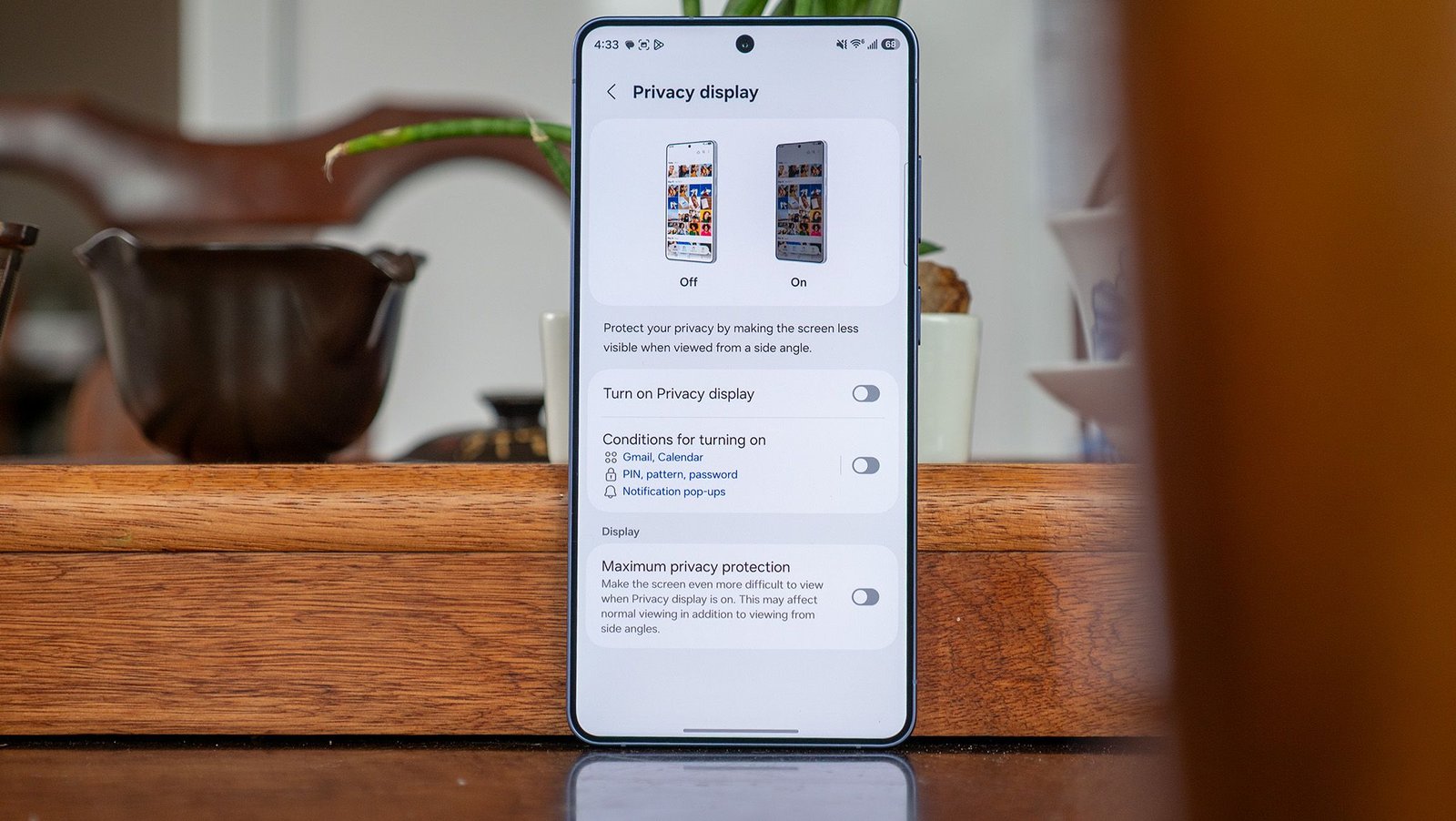
There are three main viewing modes for the Galaxy S26 Ultra: Privacy Display off, Privacy Display on, and Maximum privacy protection. With the feature turned off, the display functions as you’d expect and supports off-angle viewing. Turning on Privacy Display limits visibility at certain angles while preserving color accuracy and brightness while viewing the screen head-on.
For the most privacy, users can optionally enable Maximum privacy protection to make it virtually impossible to see the screen’s contents from other angles. There is a catch — this mode adds a metallic hue to your entire screen and severely washes out the colors, even when viewed straight-on. Here’s how to activate it:
1. Open the Settings app on your Galaxy S26 Ultra.
2. Tap the Display tab.
What to read next
3. Press Privacy display.
4. Flip the toggle beside Maximum privacy protection.
(Image credit: Future)
Now, when Privacy Display is active, it’ll default to maximum privacy protection until this mode is disabled. The question is, should you use it? In most cases, probably not. The privacy protection is the real deal, and when I tested the Galaxy S26 Ultra with this mode active, people around me couldn’t believe I was actually able to use the phone. To them, it looked like the screen was off, and only a reflective metallic glare was visible.
The downside is that maximum privacy protection eliminates the vibrant colors and crisp quality that make the Galaxy S26 Ultra’s QHD+ screen excellent in the first place. While I use it in very specific situations, like watching sporting events or in crowded airports, I don’t recommend it for daily use. Still, it’s a Privacy Display feature you should be aware of that’s buried in a settings menu.
How to configure Privacy Display to turn on automatically
(Image credit: Derrek Lee / Android Central)
Samsung makes it quite easy to turn Privacy Display on or off by offering a toggle in the quick settings panel on One UI 8.5. Regardless, there’s a better way to use the privacy feature, and that’s by pre-setting conditions for when it turns on automatically. For instance, you can tell One UI to automatically activate Privacy Display when entering a PIN, pattern, or password in the operating system. Or, you could only hide notification pop-ups and certain apps.
Here’s how you can do it:
1. Open the Settings app on your Galaxy S26 Ultra.
2. Tap the Display tab.
3. Press Privacy display.
4. Tap Conditions for turning on.
5. Select Apps, Pin, pattern, password, and/or Notification pop-ups. Tapping the Apps tab reveals a list of your installed apps with individual toggles for each.
6. Finally, flip the toggle beside Conditions for turning on to finalize your changes.
(Image credit: Future)
This is the smarter way to use Privacy Display. Let’s face it, no one really cares about our TikTok doomscrolling or text messages in public. There is a sensible case for hiding sensitive information like your passwords and banking apps, though. I set up my Galaxy S26 Ultra to only hide banking apps, payment platforms, and my password manager, giving me extra peace of mind when using them out in the open.
I can’t stop using Privacy Display to keep my phone use private
(Image credit: Derrek Lee / Android Central)
Over the last few weeks, I’ve spent more time flying and working from hotels than I’ve spent at home — and this is exactly the type of scenario where Privacy Display shines. Going through your day-to-day life, there’s little reason to use Privacy Display. However, when you need to coordinate with family members or coworkers on a vacation or work trip without nosy onlookers sneaking a peek, Privacy Display is a game-changer.
Flagship display
The Samsung Galaxy S26 Ultra is a flagship in more ways than one, but the 6.9-inch screen particularly stands out. It’s the first to use Samsung’s Flex Magic Pixel architecture to provide a Privacy Display feature that shields your screen’s contents from prying eyes.
