

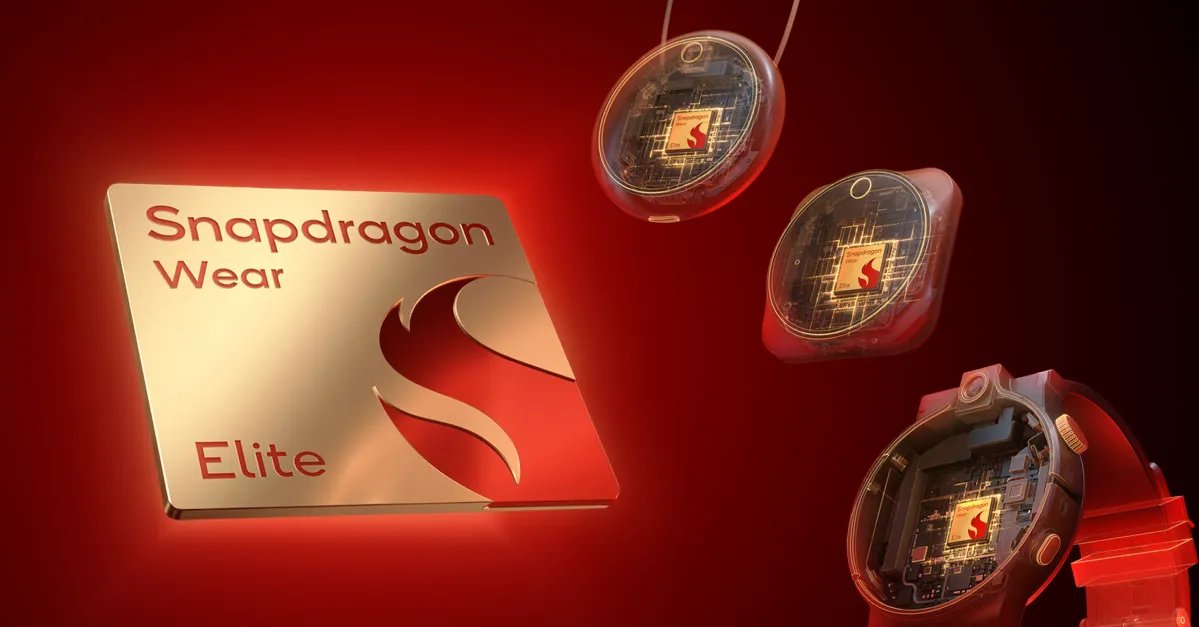
Like it or not, more AI wearables may be on the horizon – or at least Qualcomm seems to think so. Today the company announced its new Snapdragon Wear Elite chip.
At a press briefing, Qualcomm said it considers the Elite to be a “wrist plus” chip. Meaning, it won’t replace the previous W5 Plus, but exist alongside it. The company said it expects the Elite will appeal to gadget makers looking to create AI wearables such as pendants, pins, and potentially display-free smart glasses. (More powerful smart glasses will likely use its AR chip.)
On top of being upgraded to the 3nm process, the Elite chip will have an eNPU and a Hexagon NPU for AI processing. The former handles low-power AI functions like keyword recognition and activity detection, while the latter can handle more compute-heavy tasks. Qualcomm says the Hexagon NPU can handle two billion parameters on-device, and as many as 10 tokens per second.
While the Wear Elite has a similar co-processor architecture to the W5 Plus, Qualcomm says it’s improved power efficiency so that more functions can be handled by the main chip. For example, GPS tracking requires 40 percent less power. As far as battery, the Elite will support 9V quick charging, which means you should get an estimated 50 percent charge in about 10 minutes. Qualcomm also estimates 30 percent more “days of use” in overall battery life. That’s a nebulous metric as far as real-life use, but it roughly equates to “longer time between charges.”
The Elite also adds support for satellite connectivity, 5G, ultra-wide band, and Bluetooth 6.0. The CPU performance has increased by about five times, while the GPU now supports 1080p resolution at 60fps for animations. In addition to Android and Wear OS, the Elite will also support Linux to better support startups who may want to make AI pins or pendants on proprietary software.
All this suggests that device makers aren’t done with AI wearables, even though there hasn’t been a breakout hit in the pin or pendant categories. A major component maker like Qualcomm actively creating chips that cater to that device category is a sign that there’s some kind of demand. Google has spoken out about how it’s building toward an ecosystem of AI hardware, including wearables. Meanwhile, Apple is rumored to be mulling over an AI wearable, and, famously, Jony Ive and Sam Altman have teased that may be in the cards for Open AI as well.
