

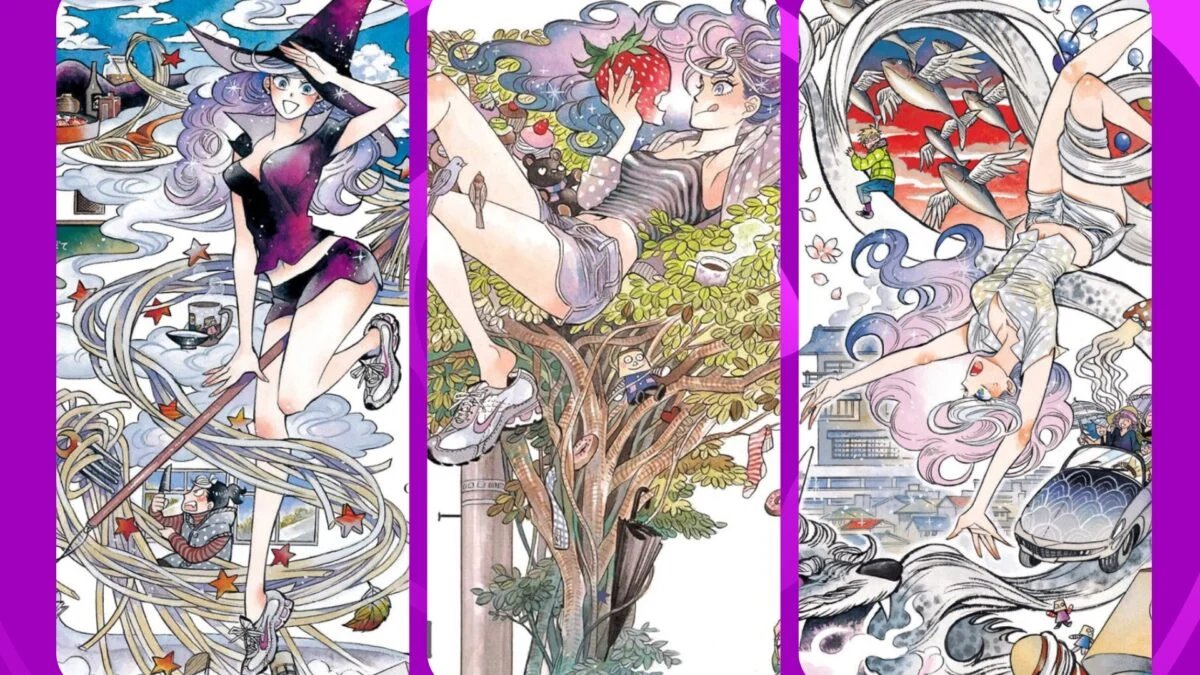
“Don’t judge a book by its cover” is advice that’s often hand-waved away whenever you frequent a bookstore, especially for manga. After all, a manga’s pretty artwork is the first thing that’ll make you go “ooh,” bend your poor, precious knees to grab the book off the bottom shelf (because the best books are always there), and buy it after the store clerk gives you a look for treating the store like a library. Such was the case when I picked up Ran and the Gray World, a manga that feels like a send-up from a bygone era, for better and, mostly, for worse.
Ran and the Gray World, created by Aki Irie, is a supernatural fantasy seinen manga whose cover immediately drew me in because it reminded me of Rumiko Takahashi’s art style blended with Kamome Shirahama‘s in Witch Hat Atelier. Translation: its art style was teeming with charm and whimsy. It also unabashedly had its titular character wearing a pair of Nike shoes—something that, funnily enough, became important to the story. In fact, I would’ve used it as a preface explaining why folks should read it before it quickly became a source of ire (we’ll get there).
It follows Ran Uruma, an elementary school kid and heir apparent to a family of powerful sorcerers. All Ran wants to do is get friends and grow up to become a powerful sorceress like her mother, Shizuka, who is both powerful and wildly irresponsible with her powers. As fate would have it, Ran has the means to expedite the growing pains of becoming an adult by putting on the aforementioned Nikes and transforming into a 20-year-old woman. Her magical misadventures also put her in the crosshairs of a rich, eccentric playboy, whose obvious intentions are pretty undersold on the back cover of the manga, questioning whether he’ll be a “friend or foe.”
© Aki Irie/Viz Media
Charitably, I read along. Not because of the pretty art that practically glitters off the page and evokes old shojo vibes, but because I found the characterization between Shizuka and her family interesting—using magic to love bomb them while also being an absentee mother, whether by choice or due to some higher calling as the world’s Satoru Gojo. That’s good, messy family drama. But mostly, I was hoping and praying that the obvious alarm bells ringing in my head about the little girl, who Shazam–Like Mike‘s her way into adulthood, would turn into a coming-of-age story about the dangers of growing up too fast, neatly framed as a metaphor for magic. Turns out, a pretty manga from a bygone era also comes with all the stink of that era wafting in, too.
Ran’s “growth” into an adult body is mostly played for fanservice-tinged comedy, with men virtually turning into cartoon wolves at the sight of her. Mind you, she’s still an elementary school kid, which makes the whole transformation sequence, at best, uncomfortable and narratively pointless. Even moments that should matter—like her learning how to use magic and it being better while she’s an adult—never feel like they serve the story in any meaningful way because you’re bracing yourself for it to turn into everyone ogling her.
It’s not helped that her transformation is kept a secret, like she’s Spider-Man, despite the existence of magic not being a well-kept secret, what with her and her mother summoning giant cakes, milk cartons, and chicks littering the city when they first linked up in the manga.
© Aki Irie/Viz Media
All of that sits on top of a narrative that feels aimless, constantly sidelining the potential for a thoughtful coming-of-age story early on by slipping into the illustrated version of the born-sexy-yesterday trope without much to say about it. Of course, that trope was tired at inception and cringeworthy to witness in a newer manga series that should know better. So when the story suddenly pivots into a cataclysmic crisis and rushes to the finish line, “disappointed” is as apt a word to pin on my reading experience, given an otherwise mixed-feeling recommendation for a promising manga.
Again, I can’t stress enough how unimaginably pretty Irie’s artwork is in Ran and the Gray World. I was just hoping the other half of its title would be more about the trials and tribulations of growing up too fast than the color manifestation of my disappointment after reading it. Guess it’s a reminder that you really can’t judge a book by its cover, especially if it’s a manga.
Want more io9 news? Check out when to expect the latest Marvel, Star Wars, and Star Trek releases, what’s next for the DC Universe on film and TV, and everything you need to know about the future of Doctor Who.
