

Our first impressions of the premium buds, as Samsung leans into AI and new smarts over biometric tracking
The TWS industry is punching pretty close to the ‘peak earbud’ ceiling at this stage, with more brands than ever able to offer good-sounding audio, a secure fit, and a long-lasting battery at a reasonable price.
It is, as a result, increasingly difficult for the industry’s biggest names to stand out from the crowd. But amid the hubbub at its Galaxy Unpacked 2026 event in San Francisco, Samsung unveiled its latest attempt to do just that: the Galaxy Buds 4 Pro.
To take on the waves of cheaper buds this time (and the market-leading Apple AirPods), the $249 / £219 buds focus on the lesser-spotted areas: premium materials, niche smart features, and deep AI integration. The Buds 4 Pro arrive with a striking ‘blade’ redesign, Gemini-powered smarts, and a new way to interact with your phone that doesn’t involve your hands.
After a few hours of testing in coffee shops, the gym, and walking around the streets of San Francisco, it’s clear these are Samsung’s best buds yet—but they perhaps also hint at a growing philosophical divide between it and other brands in the AI hardware race.
Here’s our hands-on impressions—stay tuned for the full review over the next few weeks, which will include deeper testing of the audio, smart features, and battery life.
Design and fit: Modelling the world
(Image credit: Wareable)
Advertisement
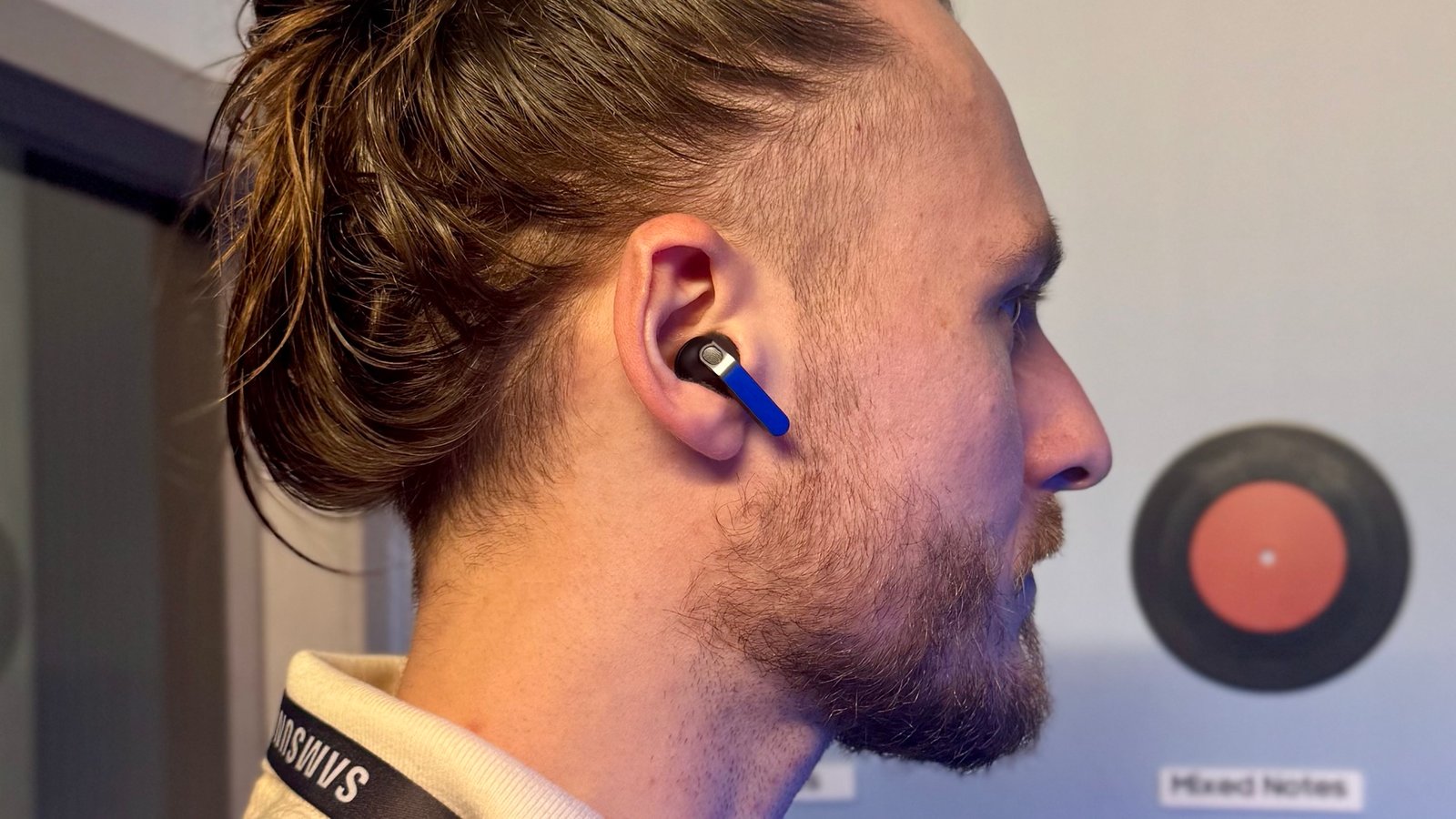
Samsung has been doing its homework—literally—ahead of the Buds 4 Pro unveiling. The brand claims it modeled over 10,000 anatomical simulations to perfect the fit for the Buds 4 Pro.
While we didn’t extensively test the previous generation, the result here is a canal-fit design that feels very stable.
Compared to the older AirPods Pro 2, the Samsung Fit feels superior; it’s more locked in and hasn’t really budged during our initial testing. Still, they don’t quite reach that instantly-noticeable floating rigidity of the AirPods Pro 3.
In my ears, the Buds 4 Pro still rest slightly against the ear lobes. It’s a minor point, but it makes interacting with the pinch-and-swipe volume controls on the stem feel ever-so-slightly less seamless than on Apple’s latest. But certainly no dealbreaker for anybody used to other buds.
I’m usually able to plug-and-play earbuds right out of the box, but I did have a play around with the silicon ear tips on the Buds 4 Pro and sized up to the larger option to get a proper seal for the noise cancelling.
Again, the seal here is comfortable even during long flights or taxi journeys, from my experience, but it’s worth fiddling with the three included sizes (less, we should note, than you get with AirPods Pro 3) to ensure you’re actually getting the best experience.
Advertisement
Blade winner
Visually, the blade design also feels like a big win. The white model I’ve been testing has a premium, brushed-metal look that stands out in an ocean of plastic buds. Even the white isn’t cheap-looking; instead, it’s a classy, pearlescent finish.
The case is also a highlight—it features a translucent lid and a dedicated button to trigger a “Find My Phone” chime—handy, particularly, for those who don’t have something like a Galaxy Watch 8 strapped to their wrist.
It also supports wireless charging and PowerShare, so you can juice them up on the back of your Galaxy phone.
Sound performance and profiles
(Image credit: Wareable)
At Wareable, we tend to focus more on the connected smarts and biometrics rather than the mids and tweeters, but, since we’re here, let’s get into some of our initial audio impressions.
Again, like with the designs themselves, the sound profiles in TWS buds have become increasingly sophisticated over the last half-decade, and the audio here is undeniably high-quality.
Advertisement
Samsung has squeezed in a new two-way speaker system with a wider woofer (up 20% in area), and it handles complex tracks with ease.
I tested them with Puma Blue’s ‘Croak Dream’ on a loop during a gym session, and the buds managed the falsetto vocals and deep, punchy bass at maximum volume without any issue.
I did the same with the artist’s softer ‘(Fool)’ during the red-eye flight home, and it delivered the track’s range equally flawlessly.
Setting the bass
Are they ‘better’ than the AirPods Pro 3? I don’t think so—although, as ever, a lot of this has to do with personal preference for sound profiles.
In my early listening, Apple still seems to have an edge in mid-range clarity—and can do it all at higher max volume—while the Buds 4 Pro’s pre-set tendency leans more toward emphasizing that bass (probably on account of that increased woofer). My initial feeling is that it does this in a slightly more balanced way than another bass-heavy bud, the Beats Powerbeats Pro 2, though.
I should also say that the AirPods Pro 3 are an unusually unfair comparison here, as they continue to rival even over-ears, in my mind, for their ability to pick out every level of audio almost perfectly.
Advertisement
Either way, as well, the Buds 4 Pro are certainly still elite in this department.
The Active Noise Cancellation (ANC) negotiated everything from a loud hotel gym speaker to the hum of a flight with surprising ease, while the ‘Ambient Sound’ mode—which I used while navigating San Francisco traffic and in one of the brand’s mindfulness workshops—feels natural rather than processed.
The Lossless support (24-bit/96kHz) is also a great future-proofing touch for audiophiles.
Smart features and AI: A glimpse of the future?
(Image credit: Wareable)
The headline feature in this area is the new ‘Head Gestures’, though the ‘Super Clear Call’ support (which uses super-wideband call tech and machine learning to reduce background noise and enhance voices) looks impressive in demos, and I’m keen to test it out in city environments.
In a quick hands-on, the gestures worked surprisingly well—even if they are as basic as nodding to accept a call and shaking your head to reject one. What stood out most was the low latency; usually, gesture controls feel like they’re a second behind your action, but these were nearly instant.
Advertisement
Then there’s the Google Gemini integration, which carries over from when the integration rolled out to the previous generation last summer. It’s crucial to help Samsung position these buds as an ambient computing portal and a key peripheral in its ever-growing Galaxy ecosystem.
And, again, while something like language translation (supporting 22+ languages) isn’t entirely novel, its integration into the ‘Interpreter’ mode feels seamless here.
The real question is where Samsung goes next with its smart features. It sits right at the forefront of AI hardware right now, alongside Meta (and its partner Google), and these buds feel ready to be integrated into the teased Android XR platform arriving in 2026.
Right now, the Buds 4 Pro feel like the start of a journey—a way to access an AI agent without pulling your phone out of your pocket. We suspect they will be an even smarter pair after a year of software updates, but it also feels likely that the next generation will have to feature something like the rumored Apple AirPods IR cameras to keep up.
Early verdict
The Galaxy Buds 4 Pro are a polished, premium, and highly capable set of earbuds. For $249, you’re getting some of the best ANC in the business and a fit that is secure and versatile.
However, I do have one initial regret: the lack of body-sensing tech. When Apple integrated heart rate monitoring into the AirPods Pro 3, they created a powerful synergy with the Apple Watch.
Advertisement
I’d have loved to see Samsung do the same here—creating a whole-body sensing network with the Galaxy Watch and the Galaxy Ring. In fact, with Samsung able to integrate with more devices, it would have made even more sense to do it.
Instead, Samsung is doubling down on the things people care about most in earbuds in 2026: sound and AI integration. It’s a different path than the one a brand like Apple—which has its own limitations with AI at present—is able to take. And it means for those already embedded in the Google/Samsung ecosystem, these are undoubtedly the best buds you can buy.
We’ll be living with them for the next few weeks to see whether the latest tools can work their way into our daily habits and whether any issues crop up with sound, fit, or battery life. But, for now, stay tuned.
