

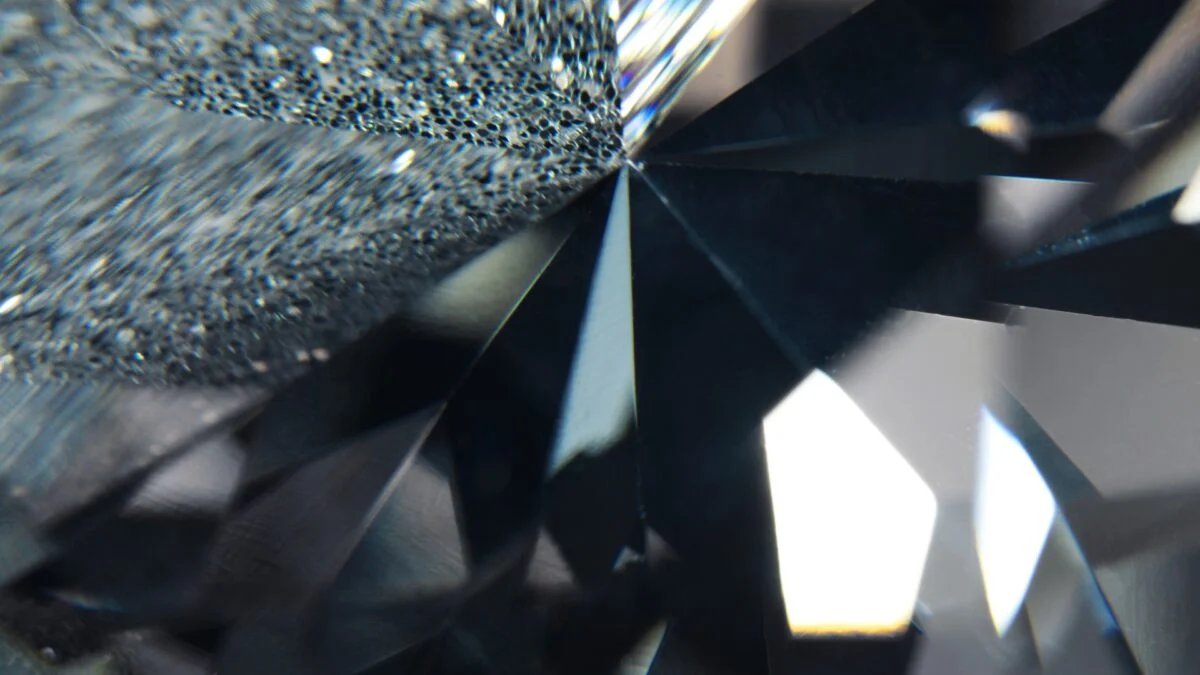
In 1962, researchers hypothesized that diamond’s known form—a mostly cubic crystal—wasn’t the coveted mineral at its greatest hardness. Ever since, researchers have strived to recreate a hexagonal diamond, claimed to be roughly 50% harder than a regular diamond. But a new finding by Chinese researchers may finally bring this race to an end.
A Nature paper published yesterday describes the synthesis of a “millimeter-sized, phase-pure hexagonal diamond,” made with a highly specific method of compressing graphite at elevated temperatures. The resulting diamond, roughly 0.04 inches (1 millimeter) in size, was slightly harder, stiffer, and more resistant to oxidation compared to cubic diamonds.
What’s more, the team scrutinized their product with X-rays and atomic-scale microscopes, confirming that the crystal’s structure was hexagonal with minimum defects. Overall, this result may provide the strongest evidence thus far that hexagonal diamonds can exist, the team says.
“There are hundreds of claims from people who believe they have seen it,” Oliver Tschauner, a crystallographer at the University of Nevada, Las Vegas, told Nature News. Tschauner, who peer-reviewed the study, added that the paper was the “first very accurate characterization of this elusive material.”
Alien? Defect? Real deal?
Just five years after hexagonal diamonds were first predicted, geologists claimed they’d found a naturally occurring hexagonal diamond—inside a meteorite, no less. The team named the unique structure lonsdaleite. Around the same time, another lab said it had produced hexagonal diamonds by compressing graphite.
Nearly 50 years later, however, two separate studies (headed by the same researcher) argued that, based on more modern investigations, neither lonsdaleite nor the lab-made crystal was a true hexagonal diamond. Rather, these structures were ordinary cubic diamonds with odd defects. In the early 2020s, other attempts did create some variations of “lonsdaleite,” although these iterations either were too tiny or lasted for a few nanoseconds.
“As a result, the existence of hexagonal diamonds remains controversial and elusive,” the researchers note in the paper, “mostly because of the challenges in producing bulk pure-phase [diamonds], which has hindered further understanding of its intrinsic properties.”
Finding the graphite recipe
To create their version of a hexagonal diamond, the team chose highly oriented graphite, a synthetic carbon material commonly used in advanced chemistry research. The graphite sheet was placed between tungsten carbide anvils, where it was subjected to a pressure of 20 gigapascals (200,000 times the atmospheric pressure), as well as temperatures between 2,372 and 3,452 degrees Fahrenheit (1,300 and 1,900 degrees Celsius).
The team also identified a specific angle for squishing the graphite, so the pressure came from the top as opposed to the sides. Doing so produced a pure hexagonal diamond—still tiny, around 0.04 inches (1 millimeter)—that atomic-scale microscopes confirmed consisted of carbon atoms stacked in a unique hexagonal configuration.
When the team tested the diamond’s properties, it found the hexagonal diamond was stiffer and more resistant to oxidation, which was expected. However, in terms of hardness, their hexagonal diamond was only slightly harder than regular diamonds, nowhere near the hypothesized difference of 50%.
An emerging pattern
Surprisingly, two other groups in 2025 had independently arrived at a similar result as the latest study, although the X-ray signals weren’t as clear as the most recent paper. At the same time, these repeated, yet separate, results demonstrate that lab-produced hexagonal diamonds are reproducible—a critical aspect of any technology with practical applications.
That “should be enough to convince hexagonal-diamond skeptics that the material exists and can be made in the lab,” Chongxin Shan, the study’s co-lead author and a physicist at Zhengzhou University in China, told Nature News.
The researchers claim their work “resolves the long-standing controversy on the existence of hexagonal crystals,” but we’ll have to wait for others to weigh in, since material scientists do seem to have a record of raising eyebrows at similar claims.
But if the work holds up, that’s big news; after all, regular diamonds are already extremely useful in industrial settings. So an even harder, sturdier version—the diamond at its best form—could do wonders for manufacturers.
