

Stuff from Mars often makes headlines for a variety of reasons, but here’s something that you’ve probably never heard of. One research team found traces of ink from a ballpoint pen in meteorite samples from Mars.
And no, these inklings have nothing to do with Martians. Rather, the ink was left over from the sample preparation processes of the meteorites, which the team received from NASA’s Johnson Space Center. This is surprising, as preventing unwanted contamination is something that many institutions, not just NASA, aim to do. The inky findings, recently published in Applied Geochemistry, suggest that, despite all our efforts, these rare samples love to pick up contaminants—some of which may be impossible to remove. The research was conducted by a group from the University of the Basque Country in Spain.
“As planetary sample return missions continue to advance, the challenge of designing contamination-aware preparation protocols becomes increasingly important,” the team wrote in the paper.
The space rock of Theseus
To be clear, it’s near impossible for samples—whether from Mars, the Moon, or elsewhere—to arrive on Earth completely unchanged. The mere act of traveling across space and entering Earth makes them, for all practical purposes, a changed rock.
“When [rock samples] pass through the Earth’s atmosphere… They undergo changes—usually caused by high temperatures and pressures—which generally result in a sort of crust forming on them,” explained Leire Coloma, one of the study’s co-authors and an analytical chemist, in a university statement. “This outer layer is therefore altered and means we cannot determine its original mineralogical composition with any certainty.”
As a result, scientists typically remove this crusty outer shell before studying what lies beneath. According to the study, these sample preparation protocols tend to be diverse and extensive: ultrasonic cleaning, cutting with diamond saws, soaking with solvents or polymer lubricants—the list goes on.
Of course, these cleaning methods differ by the type of sample researchers are working with. Still, the team noted in the paper that these variations “underscore the lack of standardized, contamination-aware preparation protocols.” As a result, they added, this subsequently complicates efforts to consolidate how best to identify whether an interesting chemical found on samples is legitimate.
Ballpoint ink and… polyester?
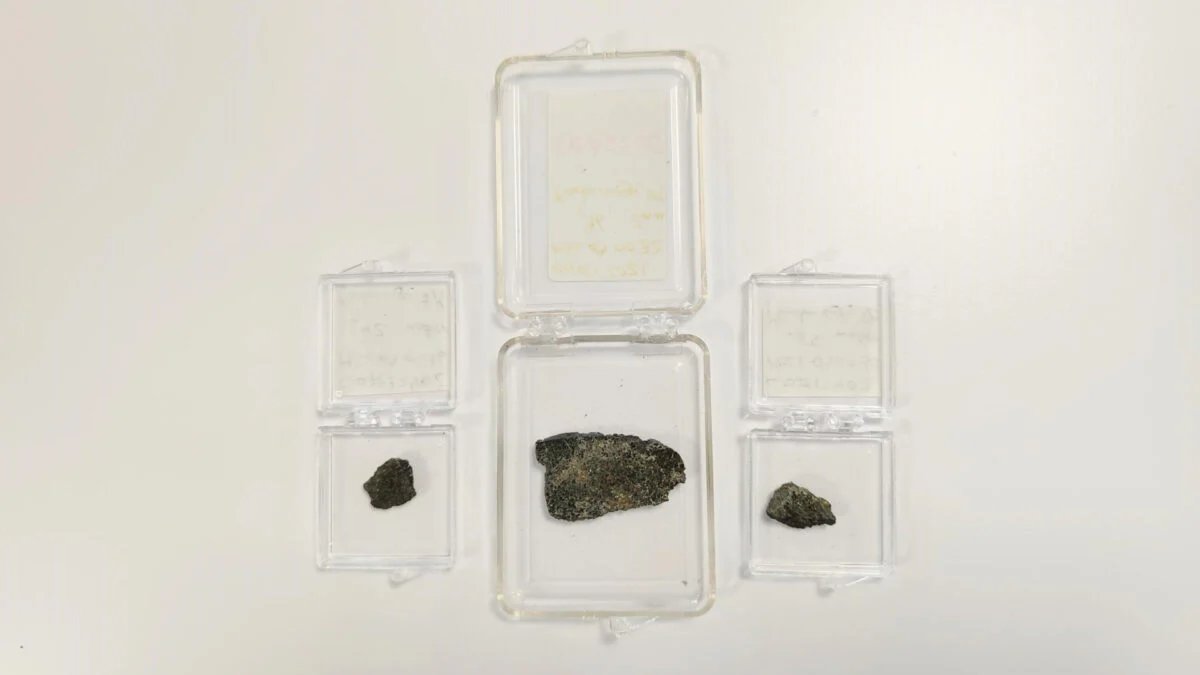
The new findings really drove this point home. For the analysis, the team studied six slices of post-processed Martian meteorites collected between 2001 and 2014. The researchers made note of how each sample had been processed for scientific review at the time. They also included one meteorite that never went through processing as a reference point.
Each sample was subjected to Raman spectroscopy, a common method used in analyzing the chemical composition of extraterrestrial objects. As expected, the team identified seven different contaminants under two categories, either those formed during processing or those coming from various handling processes. Some compounds, like diamond traces or ethyl alcohol, could be clearly traced back to specific processing methods.
But things started to get weirder from there. The team found a copper compound and a synthetic organic molecule used in inks for ballpoint pens and gel pens, respectively. There was also a tall oil rosin corresponding to a type of printer ink, in addition to blue polyester, probably from some kind of textile product.
No need to freak out
That said, the probability of scientists mistaking these contaminants as actually coming from Mars stuff is rather slim, the study emphasized. Generally speaking, analytic methods are reasonably good at sorting out contaminants. So there’s no cause for distrust when reading about what scientists have found in Martian meteorites.
However, the researchers do advise that extra caution—and hopefully some consolidation of cleaning protocols—could help minimize errors. The study proposed a couple of steps to reduce any leftovers from the sample preparation process but also added that procedures would need to be different for primitive meteorites and specific mineral groups.
In the statement, the team expressed its intentions to continue testing the best way to clean samples. The University of Basque Country researchers are one of the teams slated to receive new Martian samples once NASA’s Perseverance rover returns to Earth. And they want to be ready.
