

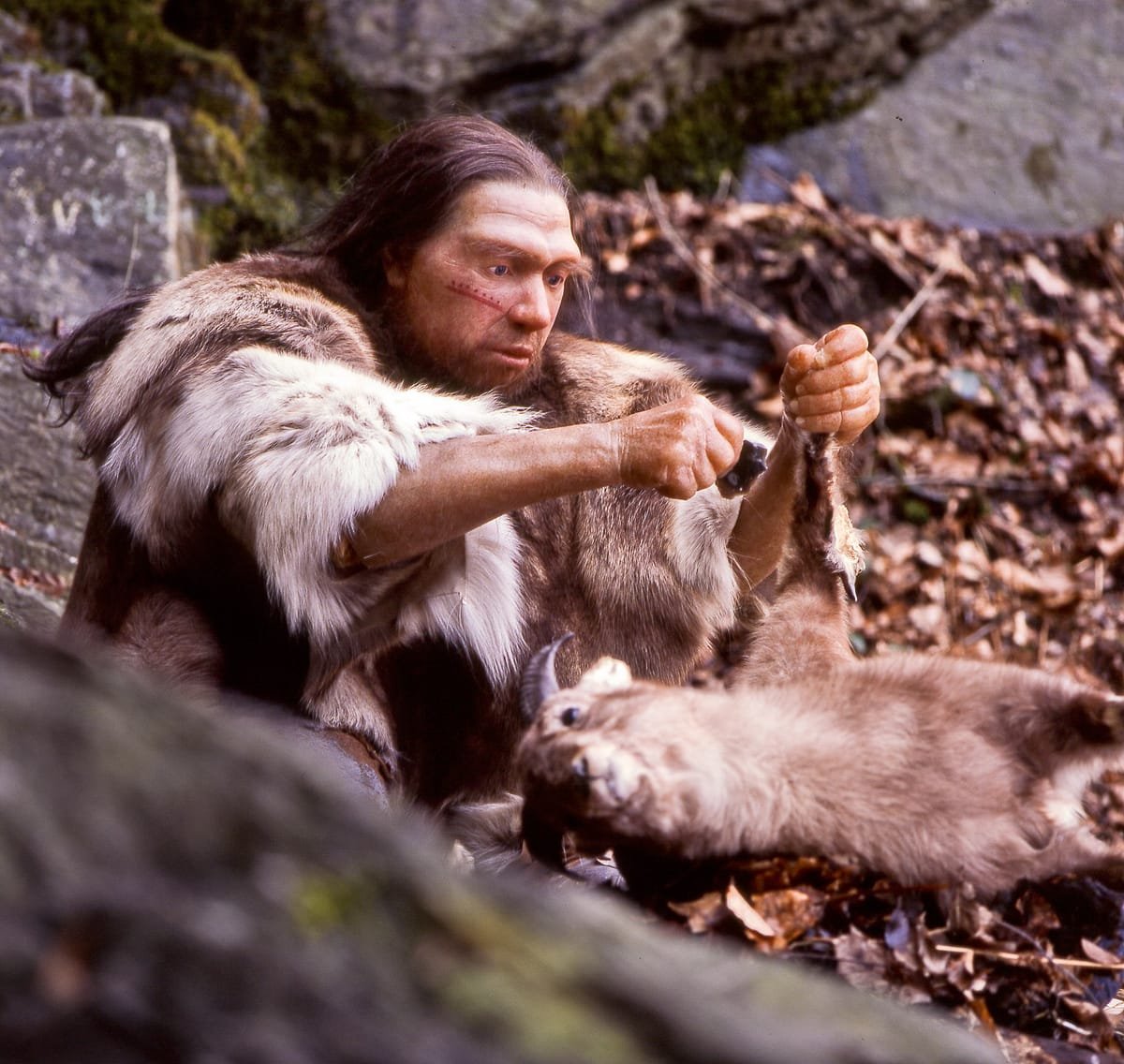
Welcome back to the Abstract! Here are the studies this week that exposed prehistoric hookups, marched toward death, feasted on their own bodies, and found a buried legend in the Sahara.
First, Neanderthal males had lots more babies with human females than human males had with Neanderthal females. What’s up with that?! Then, strap in for a stellar swan song, antlers for breakfast, and a timeless style icon from the Cretaceous.
As always, for more of my work, check out my book First Contact: The Story of Our Obsession with Aliens or subscribe to my personal newsletter the BeX Files.
Dad’s a Neanderthal, Mom’s a human, I’m in therapy
Platt, Alexander et al. “Interbreeding between Neanderthals and modern humans was strongly sex biased.” Science.
Humans and our close relatives, Neanderthals, produced children together many times before the latter went extinct about 40,000 years ago. As a result, the vast majority of people living today carry a pinch of Neanderthal DNA—the enduring proof of past copulations between our species.
Now, scientists have proposed that these prehistoric partnerships overwhelmingly occurred between Neanderthal males and females of our own species, Homo sapiens, with far fewer couplings between Neanderthal females and human males. This strong sexual bias provides the most “parsimonious” explanation for the uneven distribution of Neanderthal alleles (variants of specific genes) in modern human genomes, according to a new study.
“One of the notable features evident in alignments of Neanderthal genomes to those of modern humans is the presence of ‘Neanderthal deserts’ within modern human genomes: genomic regions where Neanderthal alleles are conspicuously rare in the modern human (and ancient modern human) gene pool,” said researchers led by Alexander Platt of the University of Pennsylvania.
This meme, provided by lead author Alexander Platt, is NOT part of the scientific study. But perhaps somebody should consider founding a journal where memes are acceptable figures.
In particular, the team noted that Neanderthal deserts show up on the human X chromosome, which they think hints at a strong sex bias toward breeding between Neanderthal males and human females.
The team compared Neanderthal genomes with genetic data from some sub-Saharan African populations that have no Neanderthal ancestry. This approach allowed them to track ancient gene flow from anatomically modern humans (AMHs)—in other words, our ancient Homo sapiens ancestors—into Neanderthal populations.
The results revealed that the Neanderthal X chromosomes had a 62 percent relative excess of DNA from AMHs. In other words, not only are there Neanderthal deserts on human X chromosomes, there are corollary “floods” or “oases” (whatever metaphor you like) of human DNA on Neanderthal X chromosomes.
This discovery is strong evidence that humans were contributing more alleles to the Neanderthal X chromosome, and Neanderthals were contributing less to the human X chromosome, due to an unexplained asymmetry in mate preference.
Overall, the genetic patterns the team observed “were likely colored by a persistent preference for pairings between males of predominantly Neanderthal ancestry and females of predominantly AMH ancestry over the reverse,” the researchers concluded. “The bias that we inferred seems to have remained consistent across admixture events separated by 200,000 years.”
Men prefer blondes; women prefer Neanderthals? I don’t know. This is just wildly interesting.
In other news…
A (hypergiant) star is born
Muñoz-Sanchez, Gonzalo et al. “The dramatic transition of the extreme red supergiant WOH G64 to a yellow hypergiant.” Nature Astronomy.
We’ve all been there: One day, you’re an extreme red supergiant, and the next, you’re a yellow hypergiant. A new study reports that WOH G64, one of the biggest known stars in the sky, went through this “dramatic transition” sometime in 2014 (or at least, that’s when astronomers first captured this spectral shift in the star, which is located about 163,000 light years from Earth).
Concept art of WOH G64, a cosmic eye of Sauron. Image: ESO / L. Calçada
If the Sun were as big as WOH G64, it would stretch to the orbit of Saturn. This late-stage stellar titan offers an ultra-rare opportunity to see how red supergiants (RSGs) end their lives, a process that is shrouded in mystery—often literally, as these stars tend to be obscured by a lot of circumstellar gas.
“The apparent lack of luminous RSGs detected as supernova progenitors has sparked an ongoing debate over the fate of these stars,” said researchers led by Gonzalo Muñoz-Sanchez of the National Observatory of Athens. “WOH G64 thus provides critical insight into post-RSG evolution and the formation of dense circumstellar environments seen in core-collapse supernovae.”
It could be that WOH G64 does detonate. In fact, this may have already happened, but the light show hasn’t reached us yet. It may also collapse directly into a black hole with no supernova to show for it. We’ll just have to keep watching this space! This has been Big Star News.
That’s deer-licious
Gaetano, Madison et al. “A Gnawing Question: How Do Caribou and Other Arctic Mammals Exploit Shared Bone Resources?” Ecology and Evolution.
Antlers in deer are usually a male ornamentation that allows females to judge potential mates based on the quality of their head-bling. Caribou females, however, buck this trend as the only female deer with antlers. So, as a folktale might ask: How did the caribou get her antlers?
One answer is that antlers make a great post-partum snack, according to a new study. In migratory populations, female caribou shed their antlers when they reach calving grounds, usually just days before they give birth, which may give nursing mothers a much-needed vitamin boost.
Percentages of antlers (light gray) and skeletal bones (dark gray) modified by caribou (ruminants), rodents, or carnivorans. Image: Gaetano, Madison et al.
“Pervasive antler consumption by caribou suggests that synchroneity between birthing and antler shedding evinces the importance of nutrient (calcium, phosphorus) transport for supporting calf survival,” said researchers led by Madison Gaetano of the University of Cincinnati. “Though intriguing, additional research will be important to more explicitly evaluate the dietary and fitness benefits (for both females and their calves) of antler-derived nutrients.”
Given that caribou also eat their placentas, it’s really impressive how these new mothers nourish themselves and their young with the fruits of their own bodies. Hardcore. Respect.
New spinosaur just dropped
Sereno, Paul C. et al. “Scimitar-crested Spinosaurus species from the Sahara caps stepwise spinosaurid radiation.” Science.
Speaking of animals with rad headgear, we’ll close with a shoutout to Spinosaurus mirabilis, a newly-discovered species of giant carnivorous dinosaur that rocked an epic scimitar-shaped skull crest. Move over, rock band T. Rex—this killer is the new wave of dinosaurian glam.
Spinosaurus mirabilis, pictured with a guinea fowl N. meleagris, a much smaller and less frightening modern analog. Scale bar, 20 cm for S. mirabilis and 3 cm for fowl. Image: Flesh rendering and layout by Dani Navarro; Adult skull cast by the Fossil Lab; helmeted guinea fowl images by Todd Green
“Spinosaurus mirabilis…discovered in the central Sahara alongside long-necked dinosaurs in a riparian habitat, is distinguished by a scimitar-shaped bony crest projecting far above its skull roof,” said researchers led by Paul C. Sereno of the University of Chicago.
Spinosaurus stock has gone through the roof in recent decades as new finds have confirmed that they were the biggest land predators of all time, dethroning T-rex from a tyrant king to a mere tyrant vassal. As the ultimate charismatic megafauna, spinosaurs are popular in dino-blockbusters. Indeed, one of my favorite gags in cinematic history is when a Spinosaurus swallows a satellite phone in Jurassic Park III, so you know it’s lurking when you hear the Nokia ring tone. Pure dinosaurian comedic gold.
In any case, the new study sheds new light into the semi-aquatic nature of this majestic hunter, suggesting that this particular species was “a wading, shoreline predator with visual display an important aspect of its biology.” While this animal was no doubt visually captivating, it’s best to view it from a safe distance of about 94 million years.
Thanks for reading! See you next week.
