

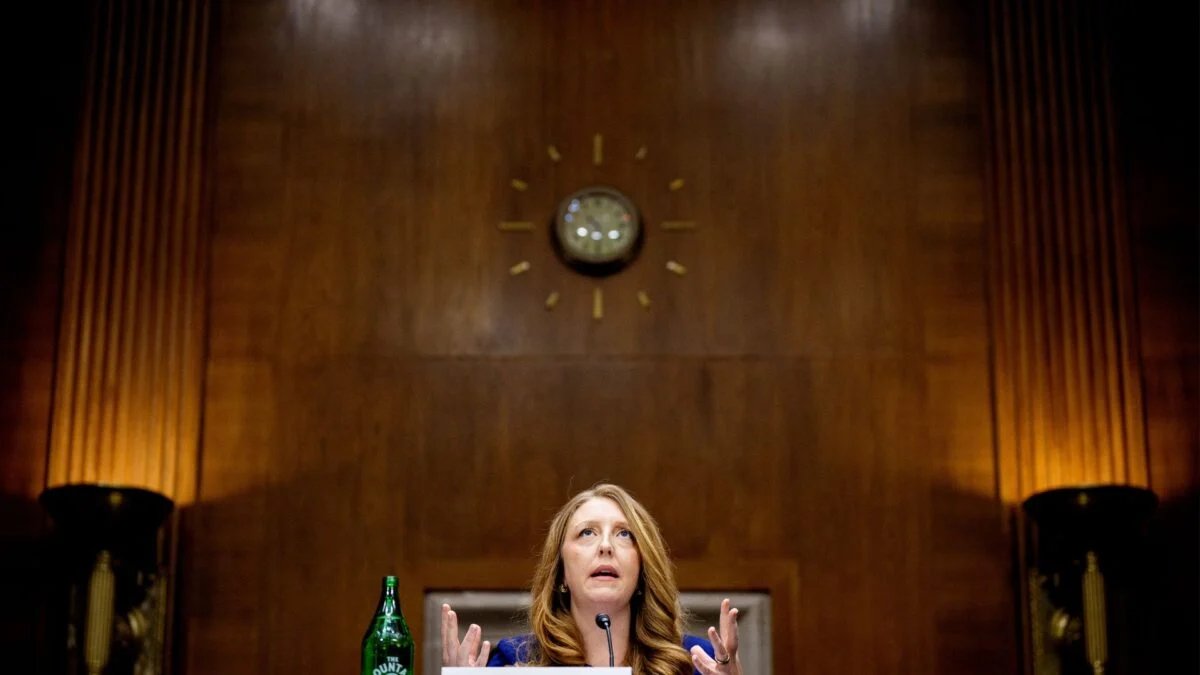
Speaking to senators earlier today, Casey Means, a licensed physician, wellness influencer, and staunch ally of Robert F. Kennedy Jr., made her case to become the country’s next top doctor.
On Wednesday morning, the Senate Committee on Health, Education, Labor and Pensions (HELP) held a hearing to consider President Donald Trump’s nomination of Means to U.S. surgeon general. Means has previously criticized the safety and value of several vaccines and espoused other controversial health-related beliefs, some of which she was questioned over by Senate members. For the most part, though, she stuck to her guns.
“I’ve been asked to help our nation get healthy and answer the call of millions, especially mothers who are begging for transparency and support. That is what I’m here to do,” said Means in her opening statement.
Unsure about autism and vaccines
Early on, Senators Bill Cassidy (R-Louisiana) and Bernie Sanders (I-Vermont) asked Means about her positions on vaccines, including whether they can cause autism—a long-debunked link still widely supported by the anti-vaccination movement.
Though Means stated that “vaccines save lives” and that she was supportive of measles vaccination, she balked at directly encouraging parents to vaccinate their children against measles, saying it was her belief that “each mother needs to have a conversation with their pediatrician about any medication they’re putting in their children’s bodies.”
She also claimed that she has never used anti-vaccine rhetoric before but pointedly refused to give her opinion on whether vaccines cause autism, stating that “we do not know as a medical community what causes autism” and that “we should not leave any stones unturned.”
Dozens of studies have refuted any causative connection between vaccination and autism. And while autism is a complex condition that often has more than one cause, it’s largely driven by our genetics. Many experts have also called into question the idea, popular among supporters of RFK Jr. and his Make America Healthy Again (MAHA) coalition, that increasing rates of autism represent a growing epidemic, rather than a rise in awareness and a broadening of the criteria used to diagnose it.
At another point, in response to Senator Tim Kaine (D-Virginia), Means refused to directly answer whether she believed the flu vaccine reduced the risk of severe illness and hospitalization in children (RFK Jr. claimed otherwise last month). She eventually stated that it may have a “population-level” effect. And in later questioning from Senator Cassidy, she seemed ambivalent about whether all Americans should be recommended to receive vaccination against hepatitis B (last December, the CDC revoked its recommendation that all children be vaccinated against hepatitis B at birth).
Defiant on birth control pills and conflicts of interest
Means had previously said that birth control pills were “a disrespect of life” and argued that these medications carry “horrifying health risks.”
When asked about these remarks by Senator Patty Murray (D-Washington), Means claimed she was being taken out of context and that she was talking specifically about women at higher risk for medication-related complications like blood clotting. However, she also appeared to suggest that most women do not receive proper information about the risks of oral birth control.
“We prescribe a huge amount of hormonal contraceptives, and I do not believe most of those conversations have informed consent because of the pressures their doctors are under because of our broken health care system,” she said at the end of her confrontation with Murray.
Senators Tammy Baldwin (D-Wisconsin) and Chris Murphy (D-Connecticut) questioned Means about her extensive history of promoting supplements and other wellness products, including from companies she had financial interests in.
Murphy alleged that Means has routinely failed to disclose payments she received from companies whose products she was endorsing, as required by the Federal Trade Commission. He highlighted a time when Means stated on social media that she was simply a fan of a prenatal vitamin product without allegedly revealing her partnership fees from the product’s makers.
“It seems that in the majority of instances in which you were, as a medical professional, recommending a product, you were hiding the fact that you had a financial partnership,” Murphy said. “You seem to be in regular, willful violation of the FTC rules.”
Means claimed that Murphy’s recounting of the prenatal vitamin incident was a “false representation” and that she would be in full compliance with the Office of Government Ethics before, during, and after taking the role of surgeon general.
Odds and ends
Means reaffirmed her firm support of the MAHA movement during the hearing, claiming that the federal government is now talking about health in a way that she had never seen before.
In response to a question from Senator Susan Collins (R-Maine) about her past support of psychedelic-assisted therapy, Means stated that while there is “exciting work” still being done in the field, she would not currently encourage its use to the public (though some psychedelic drugs are being evaluated as mental health treatments for regulatory approval, they remain federally illegal for the time being).
During questioning from Senator Andrew Kim (D-New Jersey), Means confirmed that, despite having a medical license in the state of Oregon, it is currently inactive and that she is unable to prescribe medications to patients. She stated that her decision to be inactive has been the subject of “severe misinformation by the media” and that she will not be seeking to reactivate her license for the foreseeable future.
Means has previously argued that agricultural chemicals are a major factor in the rise of chronic illness among Americans and specifically singled out glyphosate, the active ingredient in the Monsanto-owned herbicide Roundup. At various points during the hearing, however, she had to thread the needle on the Trump administration’s decision last week to expand the domestic production of glyphosate—a decision that has rankled many MAHA supporters.
“Eventually, we are going to need to move towards a more sustainable way of growing our food that decreases our reliance on toxic chemicals that are hurting human health,” she said. At the same time, she argued that “changing anything overnight would be devastating to the American farmer and the American consumer.”
