

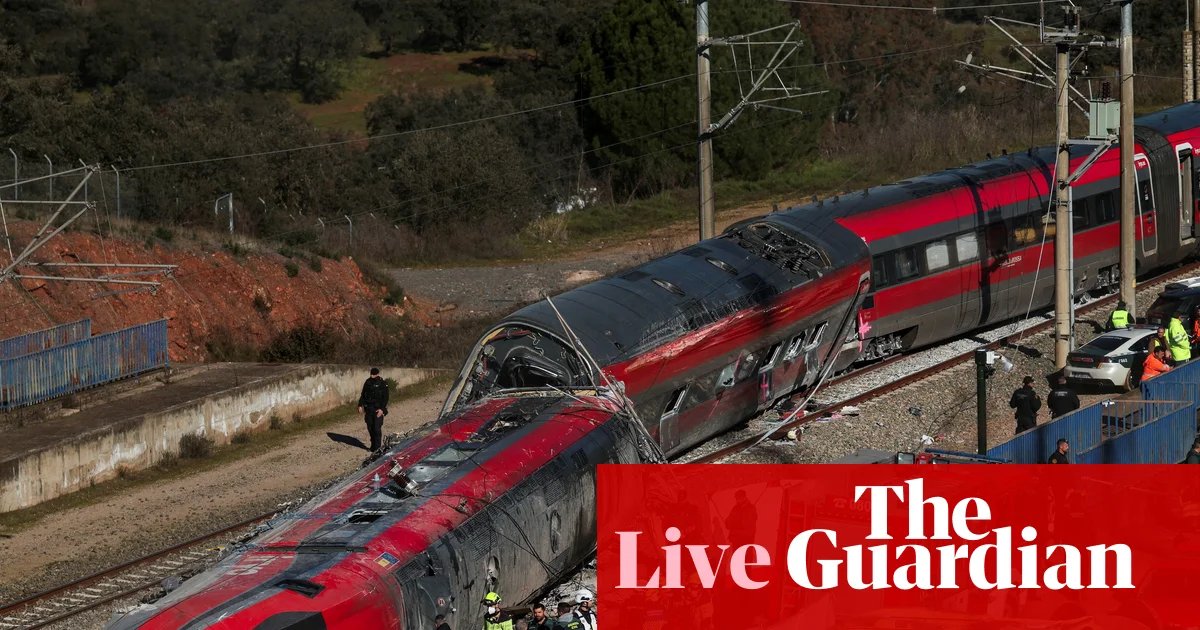
Report: train drivers union raised concerns about railway track
Spain’s train drivers union had written a letter to state-owned rail infrastructure administrator ADIF last August warning about the railway track where the two trains collided, Reuters reports.
According to a copy of the letter seen by Reuters, the train drivers union SEMAF said that along that stretch of track, potholes and imbalances in overhead power lines were causing frequent breakdowns and damaging the trains.
ADIF did not immediately respond to a request for comment from Reuters.
Share
Key events
Show key events only
Please turn on JavaScript to use this feature
Sánchez has vowed that a “thorough and absolutely transparent” investigation into the crash will take place.
“I can guarantee the victims that we will be protecting them and assisting them for as long as necessary,” he told journalists.
Share
Updated at 14.28 GMT
Spanish prime minister declares three days of mourning for deadly train collision
The Spanish prime minister, Pedro Sánchez, on Monday declared three days of mourning over the high-speed train collision that killed at least 39 and hospitalised dozens more, AFP reports.
Sánchez also vowed to launch a full investigation into the cause of the collision.
“We will uncover the answer, and once the cause of this tragedy is determined, we will present it with absolute transparency,” he told reporters in the town of Adamuz, near where the disaster occurred.
Pedro Sánchez speaks during a press conference after the deadly train crash in Adamuz, southern Spain. Photograph: Cristina Quicler/AFP/Getty ImagesShare
Updated at 14.14 GMT
The condition of the railway tracks where the two trains collided had caused a crew member to suffer an injury in July, El Mundo reports.
According to a report obtained by the newspaper, the condition of the tracks had caused enough rattling and shaking that a piece of equipment fell on the head of a crew member.
Rafael Escudero, the general secretary of the Spanish railway union, told El Mundo that the rattling and shaking happens because the tracks cannot absorb the weight and force of the trains. Escudero said they have often received complaints about the jolting.
The state-owned rail infrastructure administrator ADIF told El Mundo that it had recorded almost a dozen incidents on this particular section of railway in Adamuz.
Share
Spain’s prime minister, Pedro Sánchez, is speaking near the site of the crash in the municipality of Adamuz in Córdoba province.
Stay tuned for an update on his remarks.
Share
Report: train drivers union raised concerns about railway track
Spain’s train drivers union had written a letter to state-owned rail infrastructure administrator ADIF last August warning about the railway track where the two trains collided, Reuters reports.
According to a copy of the letter seen by Reuters, the train drivers union SEMAF said that along that stretch of track, potholes and imbalances in overhead power lines were causing frequent breakdowns and damaging the trains.
ADIF did not immediately respond to a request for comment from Reuters.
Share
Human error ‘practically ruled out’ as cause of the deadly collision, Renfe president says
Alvaro Fernandez Heredia, the president of Spain’s state-owned rail operator, Renfe, told Spanish public radio RNE that human error has “been practically ruled out”.
“It must be related to Iryo’s rolling stock or an infrastructure issue,” he added. Renfe is the operator of the second train travelling to the southern city of Huelva from Madrid.
An investigation has been launched into the crash but it is not expected to determine the causes for at least a month.
In a social media post about an hour ago, the Spanish transport minister, Óscar Puente, said the causes of the crash remain unknown. He said:
After more than 3 hours on the ground, we have been able to confirm the severity of what happened and the terrible consequences. But we do not know, nor does anyone know at this moment, the causes.
It will be the CIAF (Spain’s Railway Accident Investigation Committee) that determines them, so caution with hasty analyses based on mere speculation. Thanks to all the administrations for their collaboration and sensitivity.
A screen grab from a video shows agents gathering evidence at the site of the wreckage. Photograph: Guardia Civil Handout/EPAShare
Updated at 13.06 GMT
Helena Smith
Greece’s foreign ministry, meanwhile, has expressed its condolences in a message of support for Spain.
In a statement on X, it said:
We express our deepest condolences to the families of the victims. Our thoughts are with the injured and all those affected by this tragedy. At this moment of grief, Greece stands in solidarity with the people and the government of Spain.
Sunday’s crash is not without echoes in Greece where questions are still being asked, almost three years later, as to how a northbound passenger train could collide head-on with a freight train, leaving 57 dead. The 28 February crash was the worst rail disaster ever recorded in Greece.
ShareHelena Smith
More on Spanish monarch King Felipe who is in Athens, with his Greek-born mother, Sophia, to attend the funeral of her sister Irene (see post at 10.21).
The train crash has lent a particularly sombre tone to the funeral of Irene, whose body was brought back from Madrid where she had lived with her older and much beloved sister, Sophia, for years.
The entire Spanish royal family has flown in for the funeral of a woman who kept out of the spotlight but has been described as a quiet force who was also one of the most unconventional and interesting royal figures of modern times – she once flew a plane of cows to India as an act of charity.
King Felipe of Spain and his daughter, Infanta Sofía, look on during the funeral of Princess Irene of Greece and Denmark at the Metropolitan Cathedral of Athens on 19 January 2026. Photograph: Miloš Bičanski/Getty Images
Irene’s body had laid in state in Madrid before being flown to Athens where well-wishers paid their respects before a casket draped with the Greek flag in a chapel next to the cathedral where the funeral service is underway.
The Greek royal family was dethroned by popular vote in 1974 when democracy was restored and Greece became a republic. King Felipe had addressed the train crash as he arrived with his with family at the cathedral.
Share
Updated at 12.51 GMT
We have another update from Spain’s Guardia Civil, a military-style law enforcement agency, which said in a post on X that over 220 civil guard officers were involved in rescue operations at the crash site, including those in the air service.
The central forensic team is working on identifying victims, the Spanish law enforcement agency added.
Share
In comments to Spanish news broadcaster, La Sexta, Juanma Moreno said:
These kinds of accidents are surprising. The crash was very, very serious. A train carries society – grandparents, children, pregnant women … It’s a catastrophe.
Share
Bodies found ‘hundreds of metres away’ due to ‘incredibly violent’ impact of the crash, Andalucía regional president says
Andalucía regional president Juanma Moreno spoke to journalists this morning. Here is some of what he has said:
It is likely (that there will be more dead people found) when you look at the mass of metal that is there. The firefighters have done a great job, but unfortunately when they get the heavy machinery to lift the carriages it is probable we will find more victims …
Here at ground zero, when you look at this mass of twisted iron, you see the violence of the impact …
The impact was so incredibly violent that we have found bodies hundreds of meters away, which means that people were thrown through the windows.
Juanma Moreno speaks with an emergency responder at the Adamuz sports centre in Córdoba. Photograph: David Arjona/EPAShare
Updated at 11.56 GMT
Messages of condolences over the tragic train collision in southern Spain have poured in from numerous European leaders.
French President Emmanuel Macron said:
A railway tragedy strikes Andalusia. My thoughts are with the victims, their families and the entire Spanish people. France stands by your side.
Italy’s prime minister, Giorgia Meloni, said: “Italy stands close to Spain in its grief for this tragedy.”
The Dutch prime minister, Dick Schoof, said:
Horrific news from Spain, where a train accident has claimed dozens of lives. I have expressed my support and condolences to prime minister Sanchez. My thoughts are with all the victims and their families affected by this enormous disaster.
German Chancellor Friedrich Merz said:
The news of the tragic train accident in Adamuz has deeply shaken me. My thoughts are with the families and loved ones of the victims. I offer them my sincere condolences. To the injured, I wish strength and a speedy recovery. Germany stands with Spain at this time.
Share
Updated at 11.19 GMT
Spain’s Civil Guard has said in a post on X that it has set up several offices so that the families of those affected by the crash in Adamuz “can file reports and provide DNA samples for identification purposes”.
There were about 400 passengers on the two trains, operated by Iryo and Alvia, according to an earlier statement from state-owned rail operator Renfe.
Emergency workers said the twisted wreckage of the trains has made it hard to recover those trapped inside the carriages.
As we have mentioned in the blog already, officials have said at least 39 people were killed in the crash but this figure is expected to rise as rescue work continues throughout the day.
On Monday morning, emergency services in Andalucía said 122 people had been treated for their injuries and 48 people were still in hospital, of whom 12 were in intensive care units.
Share
Updated at 10.41 GMT
