

An ideal AMOLED companion during long outdoor adventures
Suunto waited more than two years to release a follow-up to the original Vertical adventure watch. While that seems like an age by modern standards, the brand put that time to good use. In the Suunto Vertical 2, the Finnish brand delivers its best watch yet for those whose adventures require a top-end battery. It masterfully balances a stunning 2,000-nit AMOLED display with a class-leading dual-band GPS battery life that puts its rivals to shame. While the software still lacks Garmin’s deep training ecosystem, the inclusion of a flashlight, offline maps, and premium titanium materials at a competitive price makes this a formidable, no-nonsense tool for the outdoors.
Outstanding battery life
LED flashlight (with red light)
Free offline maps
Excellent GPS and heart rate tracking
Updated charger design
Heavy design on the wrist
Maps don’t come pre-downloaded
Flashlight operation needs refinement
Fewer training insights than other brands
Landing just months after the release of the Suunto Race 2—and with virtually identical software and hardware—it’s easy to think that the release of the Vertical 2 was a quick attempt to capture some of the growing success of adventure-focused watches like the Garmin Fenix 8.
But a look at the details makes it clear that Suunto has been carefully biding its time, noting the growing market trend towards premium watches, listening to what users want, and eyeing up the best fit for the job.
The result? A highly capable watch with a big, bright AMOLED screen that’s easier to use than previous models and boasts a battery life that far outstrips the competition. The Vertical 2 comes with offline color maps, excellent navigation tools, and an LED flashlight for off-grid adventures.
It’s not perfect, and there are still odd quirks to be ironed out, but the good news is that most of the oddities lie in the software and can be resolved through future updates.
While it wouldn’t be accurate to say that Suunto is reinventing the wheel with the Vertical 2, what it has done really well is expertly hone in on what’s needed for a watch to be considered a serious adventure companion—and left out what’s superfluous.
Advertisement
Brighter in more ways than one, the Suunto Vertical 2 might finally tempt athletes to cross over from other brands. We put nearly 100k in on the trails while wearing this watch, and this review sums up everything we uncovered.
Price and competition
The Suunto Vertical 2 starts at $599 / £529 for the stainless steel bezel, while the titanium version will set you back and $699 / £629. With the exception of the highly specialist Suunto Ocean, it’s the most expensive release yet from the Finnish brand.
With Garmin really pushing the upper end of the price range for its GPS watches, though, the Vertical 2 can be considered mid-range (and for what is definitely a premium watch).
Assuming you’re in the market for one with an LED flashlight, the Vertical 2 stands at nearly half the price of the Garmin Fenix 8, which starts at $999 / £949, and it’s $200 cheaper than the Enduro 3. In fact, the only watch on the market right now with an LED flashlight that’s cheaper is the Amazfit T-Rex 3 Pro, which lands at an impressively low $399.99 / £399.90.
If you’re staying within the Suunto ecosystem, the real question is: why would you pay $100 / £100 more for this model than the similar Race 2? The answer is that you’re paying for better specs—a flashlight, longer battery, and more premium materials. But more on that below.
Advertisement
Suunto Vertical 2 key features
- 2,000 nit AMOLED display
- Built-in LED flashlight
- Offline global TOPO maps
- Sapphire crystal screen with choice of stainless steel or titanium aluminum alloy bezel
- Up to 65 hours of tracking in dual-band GPS mode; up to 250 hours in low-accuracy GPS mode (with heart tracking off); 20 days in daily use
- Touchscreen and button controls
- Size: 49mm x 49mm x 13.6mm
- Weight: 87g
- Waterproof up to 100m
- 115 sports modes
Design and controls
(Image credit: Wareable)
The Suunto Vertical 2 uses the same premium materials—sapphire crystal glass and a titanium or stainless steel bezel—as the Vertical 1, and is slightly higher in quality than the Race 2, which uses more plastic (though the differences are nominal).
On my wrist, this is a very, very big watch, but what stood out to me immediately was how the designers managed to reduce the bulk. It behaves more like a lower-profile watch, making it much more comfortable to wear than alternatives I’m used to testing.
Keeping things tidy
This is due, in part, to the silicone band. In general, I’ve found Suunto watch bands to be the most comfortable and the best at keeping my watch flush on my wrist without being too tight. It’s so comfortable that I’ve actually been able to sleep with it on for two weeks, which is practically unheard of for me.
A feature I love in Suunto watch bands (that other brands like Coros have borrowed) is the pin that secures the strap. Strangely, this is more fiddly in the Vertical 2 than in previous watches like the Run and Race, but it has gotten a little easier as I’ve used the watch more.
Advertisement
The watch is controlled by three buttons on one side—none of which is a digital crown—and a touchscreen. From the home screen, the top button takes you straight into activities, and the bottom button leads to what Suunto calls ‘widgets’.
(Image credit: Wareable)
Basically, this is where you find everything else, from the control panel (AKA settings) and heart rate to a logbook of your recent workouts, text messages, and weather forecasts. If you long-press the bottom button, it turns on the flashlight; long-pressing the middle button takes you straight to settings.
If you prefer to operate by touchscreen, swipe up from the homescreen to access widgets, down to start an activity and left to get straight to the control panel.
Don’t look back
Something I find a bit strange about this watch is that—as far as I can tell—there’s no back button. To get out of whatever screen you’re in, you need to swipe right. It works well enough, and perhaps I’m just accustomed to a back button, but it does seem like an unusual omission and one that would become a problem if the touchscreen stopped working for any reason.
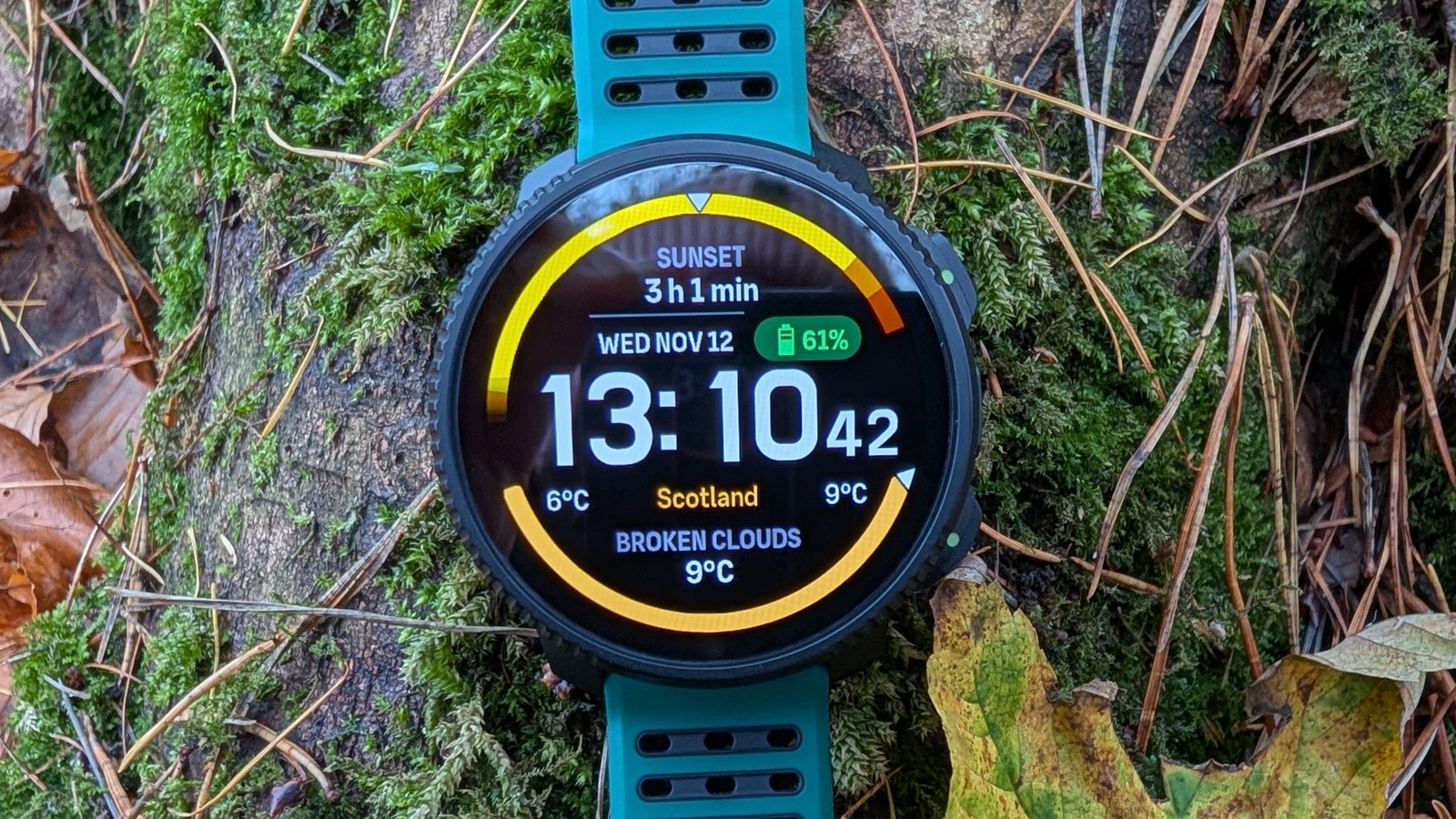
To customize the watch face, you need to download the Suunto Plus app. While a step too far for me, I fortunately really like the default watch face here. Not only is it big and clear, but it also has quite a lot of useful data if you spend a lot of time outdoors like me.
Advertisement
(Image credit: Wareable)
The weather forecast is at the bottom, and, at the top, you can see how many hours and minutes remain until sunset or sunrise, which is much more important to me than my step count or calories burned.
Overall, I find the interface of this watch to be more intuitive than earlier releases, like the Run, where I always seemed to end up in the same place no matter what I did. It’s not that Suunto has made big changes, just tidied things up, and I appreciate it.
Adventure and navigation features
(Image credit: Wareable)
Anyone who’s tested a GPS watch with an LED flashlight, myself included, will probably tell you there’s no going back. As someone who spends a lot of time in the wild, in a country where we have as little as six hours’ daylight in winter, I can’t think of anything more useful (except, of course, a decent battery life and maps).
This is the feature that sets the very best adventure watches apart from the rest, in my opinion, and since the technology exists, I’m starting to wonder why anyone bothers releasing a watch without one.
Advertisement
With all that said, I love that the Vertical 2 has an LED flashlight—but it needs a little work. It’s certainly bright enough for trail-finding in a pinch, and it has adjustable brightness and a red light mode, which I use at this time of year whenever I’m up early for a run or yoga class and don’t want to disturb my partner. It’s also easy to turn on from the home screen.
The only problem is that once I turn it off, it doesn’t return to the data screen. I have to do that manually, and, until I do, it just covers up everything I want to know. I’m guessing this is a software flaw that’s fixable, so I hope they address it soon.
The mapping experience
Offline maps are another essential for adventure watches—and, again, this watch has them, but doesn’t make it all quite as easy as, say, Garmin does.
For starters, they don’t come pre-downloaded, so you need to go into the app and download the area you want. In principle, this is straightforward, but I foolishly waited until I was on vacation to do it, and it turned out the Wi-Fi wasn’t strong enough. When I got home, I managed to download the Scotland map, which requires the watch to be in its charging cradle, connected to Wi-Fi, and near the router. It wasn’t lightning quick, but it didn’t take ages, either.
(Image credit: Wareable)
Once you’ve done that, you can create your own route in the app, make it up as you go along. Or send GPX files to your watch from third-party apps like AllTrails. I’ve tested all three, and they all work a charm, with the maps rendering quickly and showing up nicely on the bright screen, with tons of detail.
Advertisement
I followed a 12k mountain route, and it was really easy to follow, with alerts that let me know when a climb was ahead. The only slight hitch was that I discovered you need to manually toggle the turn-by-turn alerts on—whereas, in my experience, this would usually be the default. Again, fixable, but I can’t help but wonder why it needs to be fixed in the first place.
Lacking SOS smarts
One feature that’s useful for watches intended for outdoor use that’s lacking is any kind of SOS function (well, except for a flashing red light in the flashlight, which is useful if you have another means of calling mountain rescue).
This is no doubt one of the key factors that explains the price differential between a premium Suunto and a premium Garmin watch. In the recent past, we all just wore our favorite watch on our wrists and carried a satellite communicator for emergencies.
But now that Garmin has the Fenix 8 Pro with InReach capabilities, the stakes have been raised. It’s another place where, down the line, other brands might need to think bigger to keep up.
Training, health, and smart features
(Image credit: Wareable)
The Vertical 2 supports some 115 workout modes. While many of these are mostly to help the user accurately tag their activities, there is plenty of activity-specific tracking, such as stroke rate for swimming. There are also some cool features for runners in the Suunto Plus app, which you can access when you’re ready to start a workout—things such as Ghost Runner to pace you, hill training, and live weather updates.
Advertisement
It has the same optical heart rate sensor as the Race 2, which is a huge improvement over previous models. And basically, for what we’ve used it for, it’s great. I tested this watch on my right wrist with either the Fenix 8 or the Coros Pace 3 on my left wrist. And whether I was hiking or doing sprints, the heart rate tracking was beat-for-beat in sync with the other watch and even more accurate than my Pace 3 during pool swims. When I’m doing interval training, it’s extremely responsive to changes in heart rate, too.
As soon as you finish a workout, you get an instant report on the watch screen. And for hiking and trail running, it includes handy graphs showing total ascent and descent, along with the usual information like heart rate zones.
Enough insights for most adventurers
To dig deeper into the effects of your training, you can find details like your Training Stress Score (TSS), Chronic Training Load (CTL), HRV, and fatigue levels in widgets on the watch itself, with a clearer snapshot in the Suunto app, which, again, I think is improving every year.
The watch may not offer quite the level of training support and metrics as a Garmin, but, for almost any user, it’s still far more than you’d ever need (and any elite athlete I’ve interviewed on this point admits to using only two or three metrics at most, anyway).
(Image credit: Wareable)
I found the app’s assessment of my training and race predictor times to be pretty in line with what I was doing and how I was feeling, which isn’t always the case.
Advertisement
The GPS also relies on five satellites (four at any one time), and accuracy is clean as a whistle. If I’m following a route, it’s quick to alert me and never sluggish in identifying where I am.
Room to grow in sleep analysis
Because this watch is so comfortable to wear, I’ve been wearing it to sleep for two weeks—and I’d say the sleep tracking is decent, but has a few quirks. Over the course of a night, the readings of my deep, light, and REM sleep are similar to those of my Coros watch.
The assessment of my sleep quality was generally spot on compared to my experience, but there was one night where I got up to go to the toilet, and it didn’t register me as having been awake at all, and another night where it thought the 90 minutes before bed when I’d been watching a movie with family, I had been asleep.
(Image credit: Wareable)
So, it’s not perfect—certainly not up there with the performance we note in the very best sleep trackers. And I suppose I can see how that could skew recovery estimates, but, honestly, I know how I slept without a watch telling me—and I know how recovered I feel, so what you do with that information is really up to you.
A limited smart experience—with an annoying quirk
Like any Suunto watch—and most outdoor watches, really—smartwatch capabilities are limited here. While you can read a text message, don’t expect to be able to view images that are sent to you or to respond to a text or take a phone call.
Advertisement
This watch is all about using technology to help you get the most out of your time outdoors without being interrupted by said technology, and frankly, I respect and appreciate that.
If you like to run with music, you can control tunes or podcasts on Bluetooth headphones, but that’s the extent of it.
One other thing I learned the hard way is that Suunto’s app can run in the background of your phone—even when you’ve closed it. This clearly drains the battery, and actually left me in a tight spot with night approaching quickly on an unfamiliar trail and a dead phone.
Suunto claims that keeping the app always running in the background helps ensure the most accurate data, but, because it’s all about gathering information, make sure you go into your phone’s app settings and turn this off.
Battery life and charging
(Image credit: Wareable)
If GPS watch history has taught us anything, it’s that adding an AMOLED screen means sacrificing some battery life. But Suunto has defied the odds and seemingly written a new chapter with the Vertical 2.
Advertisement
Despite its commendably bright screen, which makes for easy viewing in all weather conditions, this watch has a motor that just keeps going—even surpassing the life of the original Vertical (non-solar) model with its MIP screen and solar charging capabilities.
On paper, you can get up to 65 hours out of this watch in GPS mode on its most accurate setting, while, in Tour mode (no heart rate tracking and low GPS), expect a whopping 250 hours. That easily holds off the competition from other AMOLED-screen adventure watches, including the Garmin Fenix 8 and Amazfit T-Rex 3 Pro.
Not having to charge your watch every few days isn’t just convenient; it could be a lifesaver when you’re exploring the backcountry for days on end and using your watch to navigate.
The Vertical 2 doesn’t come with a solar version like its predecessor, but, since sunlight here in the UK is in very short supply during the winter, that doesn’t really matter to me. And I think in a lot of environments, you wouldn’t get any more juice out of a solar version.
(Image credit: Wareable)
The other headline here, which will come as a relief to existing Suunto users, is that the brand seems to have resolved the problems with its previously terrible charging cradle.
Advertisement
Past Suunto watches would detach from their magnetic cradle if you so much as sneezed while it was charging, but now it clips in pretty well and stays put. Thank you, Suunto.
What we found from our real-world battery testing
Having regularly tested GPS watches for the past few years, I’ve grown accustomed to them not quite meeting advertised battery life claims. But the Vertical 2 might just be the exception to that disappointing rule.
I charged this watch fully a couple of days before leaving for a weeklong vacation in the Highlands, where I planned to get regular use out of it in GPS mode with daily hikes and runs. By the time I left, it had lost about 4% just sitting on my bedside table, so I packed the charging cradle and cable just in case.
During the seven days I was away, I used it in the default (and highest-energy-use) Performance GPS mode each day (for a total of around 32 hours). By the end of my trip, my battery was holding steady at 30%.
I was hoping to see how long it would take to run the watch down completely, but, unfortunately, I had to connect it to the charging cradle to download maps. By the time that process was complete, it was back to 100%.
However, by my calculations, it only burns about 2% per hour in GPS mode. And, if that’s right, it’s a terrific option for longer adventures (and will now take the place of my Fenix 8 for thru-hikes).
Advertisement
In addition to the extra-long battery life, one of the things I most appreciate about this watch is that when you go to start an activity, it’s easy to see how many hours you’ll get in each GPS mode before you start.
I tend to just use the default setting for everything, but this makes me stop and think whether I have the juice I need for what I’m about to do, and make different choices if I don’t.
