

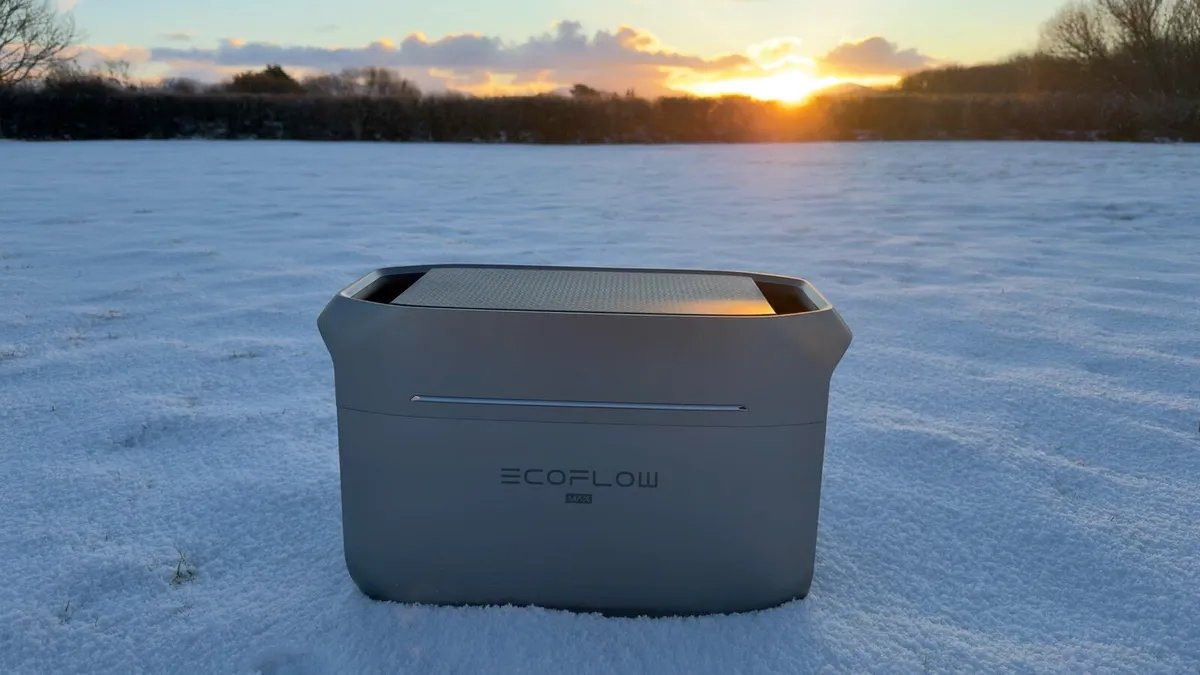
We are well into winter, which means lots of ice and snowstorms — a perfect time to think about buying a power station, if you haven’t already for spending time outdoors camping or in an RV, especially with blackouts on the rise.
Also: The best cheap portable power stations
Power stations store varying amounts of power depending on capacity. They can also be recharged using multiple power sources — from a standard AC outlet, a car’s 12V port, to eco-friendly solar panels. Unlike traditional generators, they require minimal maintenance and are safer to use indoors and outdoors as IP-rated water- and dust-resistant units. These machines are built to last for years with little hassle.
Get more in-depth ZDNET tech coverage: Add us as a preferred Google source on Chrome and Chromium browsers.
Best solar deals of the week
Deals are selected by the CNET Group commerce team, and may be unrelated to this article.
What is the best portable power station right now?
Over the past few years, I’ve tested over 100 different power stations from companies like Jackery, EcoFlow, Bluetti, and even DJI to find out which ones truly stand out. My top pick continues to be the Jackery Solar Generator Kit 2000. Not only did I find that in my testing this massive powerhouse holds an enormous amount of energy and can power your home for up to two weeks, but the price is often slashed by 20% to 40%, making it a total must have in my books.
Read on to discover the rest of the best portable power stations you can buy today.
Also: How I used this portable power station to bring electricity to a caveman
Sort by
All
AC outputs
Total capacity
Expansion ready
USB ports
Max output
The best power stations of 2026
Show less
Why we like it: Jackery, a familiar name in the power station game for over a decade now and was one of the first companies to come out with consumer systems. This is one of Jackery’s units that I’ve tested heavily, then I passed it on to primitive survival and Bronze Age expert Will Lord to give it an even longer, harder off-grid test — and it just kept on going. This system is highly modular, and you can scale it up from a single unit that’s good for a day or two of camping to an array of batteries and solar panels that can power your home for two weeks.
You read that right: two weeks.
But you might notice that something is sitting atop that Explorer 2000 Plus. That’s an add-on PackPlus E2000 Plus battery pack that adds an additional 2,042.8 Wh of electrical storage capacity to the system. A single PackPlus E2000 Plus weighs in at 41.9 lbs (19 kg), so the two units combined come in at over 100 lbs (46.9 kg). That’s quite a lot of weight, but in my experience, everything slots together well, and the unit is surprisingly portable.
Review: This portable battery station can power your home for 2 weeks
This is a really big setup, so while it’s not for everyone, it without a doubt represents the ultimate in portable power storage. And I remember when this was a $5,000 investment, but right now the price has been slashed by 40%, so you can pick one up for around $2,500.
Who it’s for: This is the setup for someone building a whole-home system for collecting solar power, feeding that into the system when needed, and holding a power reserve.
Who should look elsewhere: This is a big, heavy, and expensive setup that’s total overkill for anyone wanting to have a power station for camping or RVing, or just as a backup in case the lights go out.
Jackery Solar Generator Kit 2000 tech specs: Capacity: 4,085.6Wh | Power: 3,000 watts/6,000 watts surge | Weight: 61.5 pounds | Connectivity: 10 ports
Outputs
- 4x AC Output
- 2x USB-A
- 2x USB-C
- Car output
Read More
Show Expert Take Show less
Show less
Why we like it: The Elite 200 V2 is a 9-in-1 portable power solution that’s built to deliver a lot of power for extended periods. Bluetti has focused on durability and reliability, using automotive-grade LiFePO4 cells that have a 6,000-recharge cycle lifespan, allowing them to offer up to 17 years of continuous service.
The unit holds 2,073Wh of power, but packs this into a portable power station not much bigger than ones I’ve used that only have half. The Elite 200 V2 measures 13.8×9.8×12.7 inches.
Review: This 9-in-1 off-grid portable power station has a 17-year lifespan
The four AC ports can push out 2,600W, enough to handle most home appliances that you might want to run when off-grid or when the power is out, and it can also handle resistive loads — think heaters and kettles — up to a whopping 3,900W. For your gadgets, the unit has two 100W USB-C ports, two 15W USB-A ports, and a car auxiliary port that can output 120W.
I recently used this power station to run a completely off-grid “office” for a few days. Over a long weekend, it handled my satellite internet, laptop, and other gadgets with ease. I didn’t even bother with solar panels because the 2,073Wh of power reserve was more than enough for my needs. This oozes Bluetti quality and is a truly fantastic bit of gear that I expect will be providing me power for years to come.
Who it’s for: Need a power station that packs a lot of power but is still portable, then this is for you. This unit is also big enough to handle powering a home in the event of a blackout.
Who should look elsewhere: Want a power station that’s easy to transport, or something that you can tuck under a bed or in the back of a closet? Look elsewhere — maybe the .
Bluetti Elite 200 V2 tech specs: Capacity: 2073.6Wh | Power: 2,600 watts/3,900 watts surge | Weight: 54 pounds | Connectivity: Nine outlets
Outputs
- 4x AC Outputs
- 2x USB-C
- 2x USB-A
- 12V Output
Read More
Show Expert Take Show less
Show less
Why we like it: If fast charging is your priority, then the Ecoflow Delta 3 Plus has to be on your list as one of the fastest-charging home battery backups on the market. When charged from a standard wall outlet, you’ll get it from zero to 80% battery in just 40 minutes, and to a full charge in 56 minutes. I’ve found this particularly useful. I was using this along with another power station a few weeks ago to keep a bunch of my tech going, and I was taking this back to an AC port to charge up so it could power the other, much slower charging, power station, giving me continuous and uninterrupted power. Rather cumbersome, time intensive setup, but it was all I had and it worked just fine.
The batteries in the unit are lithium iron phosphate (LiFePO4) cells that are good for up to 4,000 recharge/discharge cycles. That’s a decade of daily charging and recharging before the cells fall blow that 80% capacity point and are considered spent.
Review: I tested a compact power station with a solar generator – and it’s my new travel essential
Also, when it comes to outdoor use, I was pleased to find out that the Delta 3 Plus features a 1,024Wh battery pack that’s IP65 rated for dust and water-resistance. This increases the life of the unit and dramatically decreases the risk of fires and short circuits.
Who it’s for: If you want a fast-charging, easy to move, yet power-packed and port-packed power station, this is the unit for you.
Who should look elsewhere: This is a Goldilocks unit, not too big, not too small, and while this fits in well with a lot of people’s needs, if you’re in the market for a super-small unit or big, do-everything unit, you need something else. (I’d also recommend checking out the Ecoflow Delta 3 Max Plus for more power.)
Ecoflow Delta 3 Plus tech specs: Capacity: 1,024Wh | Power: 1,800 watts/3,600 watts surge | Weight: 27.6 pounds | Connectivity: 13 outlets
Outputs
- 6x AC Outputs
- 2x USB-A
- 2x USB-C
- 12V Output
- 2x DC5521
Read More
Show Expert Take Show less
Show less
Why we like it: This is a power station that’s been designed and built to be taken out and about. Within moments of getting the Power 1000 out of the box, one aspect that stood out immediately to me was its solid construction. The outer shell is tough, effectively resisting knocks and bumps without flexing or bending, which is what a power station like this — something that’s been built to take out and about — really needs.
The interface of the Power 1000 is refreshingly simple, featuring just a few buttons and switches along with an LCD display. It avoids the confusion of tiny, difficult-to-identify buttons or needing an app for essential functions.
It’s up there as one of the easiest power stations to operate.
Review: DJI made a rugged power station that I can’t recommend enough to drone users
The SDC ports on the Power 1000, designed specifically for fast-charging DJI drone batteries, are indeed a thoughtful and useful addition for drone pilots. Each port can be used to charge one battery at a time, which works efficiently if you consistently recharge your batteries immediately after use rather than waiting until you have a pile of them.
However, to charge your drone batteries you will need bespoke cables, which are sold separately, adding to the cost. There are cables for the Air 3, Mavic 3, Matrice 30, and Inspire 3 drones.
Who it’s for: No doubt that the main thrust of this product is drone operators who want to have fast charging when out on location. However, I’ve seen plenty of people who’ve never flown a drone turn to these unit because of their quality and price.
Who should look elsewhere: For some, a 1,000Wh unit will be too big, for others it’s too small. While you can to this unit, that adds a layer of complexity (and cable management) that many can do without.
DJI Power 1000 tech specs: Capacity: 1,024Wh | Power: 2,200 watts | Weight: 28.5 pounds | Connectivity: Eight ports
Outputs
- 2x AC Output
- 2x USB-C
- 2x USB-A
- SDC
- SDC Lite
Read More
Show Expert Take Show less
Show less
Why we like it: Power stations are super useful, but one problem with them that manufactures have been reluctant to solve has been portability. While handles are great for carrying over a short distance, and wheels are good for flat terrain, longer distances over rough ground have been a challenge — until now.
Bluetti has come up with a solution in the form of the Handsfree 2, a power station that fits into its own backpack.
Review: One of the most portable power stations I’ve tested is $200 off right now
At the core of the Handsfree 2 is a 512Wh power station, but rather than being the usual box shape, this one has been constructed into an ultra-thin form factor. However, that ultra-thin design doesn’t mean that you have to compromise. In fact, I’m surprised that more manufacturers haven’t offered power stations in this thinner form factor.
You’re still getting a power station with an LCD panel to show you all the important information, an AC outlet good for 700W of continuous output (1,200W surge), two USB-C ports, a USB-A port, and even advanced features such as UPS-level switching and pass-through charging. The charge capacity is enough to recharge a smartphone about 15 to 20 times, a laptop or drone half a dozen times, and an action camera such as the GoPro about 30 times.
Then there’s the backpack. This 60-liter backpack (or 3,600 cu in) is designed to carry not only the power station but whatever else you need, up to a maximum of 30kg. If you’re not used to backpacking, let me tell you — that this is a fair load. The power station fits into the back of the backpack, close to the harness, keeping the weight against your body, in the most ergonomic position. There’s a side panel that enables the power station to be accessed and used without taking it out of the backpack.
Who it’s for: This is the perfect portable power station, and I’ve carried this for 10+ miles quite comfortably.
Who should look elsewhere: Never going to put the backpack on? Don’t need to carry your power station for a few miles? This is not for you!
Outputs
- 1x AC Output
- 2x USB-A
- 2x USB-C
Read More
Show Expert Take Show less
Show less
Portable power stations have gotten good. We’ve gotten to the point where there’s not much that sets one apart from another these days. That is, of course, until one manufacturer decides to shake things up. Anker did exactly that with the Solix C800 Plus, the first portable power station with detachable 3-mode camping lights.
The Solix C800 Plus, at its heart, is a power beast, stuffed with durable LiFePO4 batteries that can stash a whopping 768Wh of power. Plus, it has ten ports ready to charge up all your gadgets. It’s like the Goldilocks of power stations; it’s just the perfect size, packing plenty of punch without being a hassle to lug around.
Review: This portable power station has a standout feature that makes camping safer than ever
The unit is also incredibly well-built. Anker has housed the Solix C800 Plus’ industrial-grade components and advanced circuitry in a tough, drop-proof, unibody construction shell. I can stand and jump on this unit, and it doesn’t flex or creak, which is good.
But this is all pretty standard for a good-quality power station. Where the Solix C800 Plus shines are the accessories hidden inside a flip-top compartment on the top of the unit. Inside this compartment are two battery-powered LED lights and a telescopic pole. These are perfect for camping or for lighting up a work area once the sun goes down. I still rate this unit highly, and think it’s a great unit for families to have to take with them camping.
Who it’s for: This is a great camping, work area, or blackout unit because the innovative lights are some of the best I’ve used to illuminate a large area.
Who should look elsewhere: The lights definitely add bulk to this system, so if this isn’t a feature you need, move on.
Anker Solix C800 Plus tech specs: Capacity: 768Wh | Power: 1,200 watts/1,600 watts surge | Weight: 24 pounds | Connectivity: Eight outlets
Outputs
- 5x AC Output
- 2x USB-C
- 2x USB-A
- 12V Output
Read More
Show Expert Take Show less
Show less
Why we like it: Power stations don’t all spend their days in warm houses and dry garages. Some get taken out into the great outdoors where there are inconveniences like rain and mud and other forms of dampness.
When it comes to power stations, the AC60P — a follow-up to Bluetti’s earlier AC60 — is as close to perfection as you can get. As I would expect from a prestigious brand like Bluetti, the unit lives up to all the claims made on the spec sheet.
On the front of the unit are most of the ports, gently glowing buttons that turn the unit on and control the AC and DC outputs and a bright, feature-packed, yet easy-to-read display that shows all the important information at a glance.
The wireless charging mat on the top also offers added flexibility. Just pop your phone on the top to get an instant, no-fuss top-up. No cables are required. Oh, and it also has a built-in light for even more accessibility when you’re out in the field.
Review: The most durable power station I’ve tested dares Mother Nature to do her worst
As you might imagine, I was somewhat hesitant to test out this unit’s dust and water resistance — it is, after all, a box filled with electricity — but that didn’t stop me from taking it out in some of the dampest, dirtiest environments that I could find, and I was blown away by how well this unit shrugged off the elements. It’s certainly my first choice of portable power stations for use in inclement weather. It’s literally the only power station I’ve owned that I’ve forgotten outside for three days in winter, and it survived just fine.
Who it’s for: This is a wonderfully portable unit that doesn’t mine being outdoors exposed to the elements.
Who should look elsewhere: This isn’t a high-capacity unit, so those needing to run big gadgets or run them for extended periods need to choose something with more capacity.
The Bluetti AC60P is temporarily out of stock, but will return to shelves soon.
Bluetti AC60P tech specs: Capacity: 504Wh | Power: 600 watts/1,200 watts surge | Weight: 20.1 pounds | Connectivity: Seven outlets
Outputs
- 2x AC Outputs
- USB-C
- 2x USB-A
- 12V Output
Read More
Show Expert Take Show less
In my experience with power stations, I’ve identified three distinct groups of people who typically purchase these devices.
- Backup Power Seekers: The first group consists of individuals looking for backup power solutions in case of outages. These users often seek systems that can provide power for a few hours or even days, depending on the frequency of power interruptions in their area. Their options range from compact units that can easily slide under a bed or fit in a cupboard to larger systems that occupy more space but offer greater capacity.
- Off-Grid Enthusiasts: The second group includes those who aim to save money and gain a degree of off-grid capability by harnessing solar energy. By using one or more solar panels, they can generate power for their homes or electric vehicles (EVs). I’ve noticed a growing trend of people investing in these systems. While the financial savings may not be immediate, a well-designed solar setup can ensure long-term benefits and sustainability.
- Portable Power Pros: Finally, there are individuals who need portable power solutions for activities like camping, working remotely, or traveling in an RV. The versatility of being able to charge these units from solar panels, a vehicle’s electrical system, or any available AC outlet is a significant advantage.
These power stations can support a variety of devices, including home appliances, laptops, drones, cameras, and even medical equipment like CPAP machines.
Power stations represent a modern evolution of traditional gasoline generators, offering numerous benefits. They are typically smaller, quieter, and free from the unpleasant odors associated with gasoline. Additionally, they can be safely operated in confined spaces.
However, there are drawbacks to consider. One of the most significant challenges is the reliance on sunlight for recharging. Without ample sunlight, maintaining an off-grid lifestyle can become complicated. In contrast, it’s much easier to stockpile gasoline than to store sunlight. As a result, there are situations where, despite the drawbacks of gasoline generators-such as their fumes, maintenance needs, and safety risks-they still reign supreme in certain applications.
Understanding the different needs and preferences of power station users can help you choose the right solution for your specific requirements, whether for backup power, off-grid living, or portable energy needs.
Show more
Power stations represent a significant investment, both financially and in terms of the physical space they occupy. Therefore, it is crucial to ensure that you are selecting a model that meets your specific needs. This involves carefully considering several factors:
- Weight: In the realm of portable power stations, bigger isn’t always better. Consider how you will be using the unit. Will it be wheeled from room to room, or will you need to transport it from your vehicle to a campsite? If portability is a priority, you may want a model that can easily fit in a backpack for day trips.
- Battery Capacity: If your intention is to power a home, you will want to invest in a unit with substantial battery capacity. However, keep in mind that higher capacity often translates to a heavier device, which can be cumbersome during off-grid adventures.
- Cost: The price range for power stations can vary widely, with some units costing several thousand dollars while others are available for a couple of hundred. It’s essential to balance your budget with the features you require.
- Charging Options: Consider how you plan to recharge your power station. Will you primarily use AC power from an outlet, or do you prefer the independence that comes with solar charging? Understanding your charging needs will help you choose the right model.
- Battery Chemistry: Traditional lithium-ion (Li-ion) batteries are common, but newer lithium iron phosphate (LiFePO4) batteries offer enhanced safety and significantly longer lifespans. This can be an important factor in your decision-making process.
- Warranty: Given the expense of portable power stations, it is advisable to choose manufacturers that provide multi-year warranties. This not only protects your investment but also reflects the manufacturer’s confidence in their product.
- Safety: Every unit I have tested has undergone rigorous evaluations, including extended runtime tests for thermal management and overload tests to assess how they handle excessive loads. Safety should always be a top priority when selecting a power station.
In summary, understanding these key factors will empower you to make an informed decision when investing in a power station that aligns with your needs and lifestyle.
Show more
Over the past few years, I’ve tested nearly 200 portable power stations to determine which ones truly stand out as the best of the best. Testing these devices properly is no small feat-it takes days to evaluate each unit thoroughly. To streamline the process and ensure accuracy, I’ve developed a comprehensive testing structure.
This approach not only verifies that manufacturers are honest about their spec sheet claims but also ensures the units are safe, reliable, and capable of meeting real-world demands.
Here’s a summary of my testing process:
- Unboxing and Visual Inspection: I start by unboxing and inspecting the unit for build quality, design, and any potential flaws. This step sets the stage for understanding the device’s overall durability and usability.
- Battery Capacity Tests: I measure the actual battery capacity to confirm whether it matches the manufacturer’s claims. This is critical, as overstated capacity can lead to disappointment in real-world use.
- Load and Overload Testing: I test the power station’s ability to handle various loads, including pushing it to its limits to see how it performs under stress. This helps identify whether the unit can reliably power demanding devices.
- Thermal Testing: Heat management is a key safety factor. I run the power station for extended periods to evaluate how well it dissipates heat and whether it remains safe to use.
- Safety Tests: I subject the units to a variety of safety checks, including overload scenarios, to ensure they can handle unexpected conditions without failure.
- Real-World Testing: Finally, I use the power stations in real-life scenarios-whether for camping, working remotely, or during power outages-to assess their performance in practical applications.
Why I’m Uniquely Positioned to Test Power Stations
My extensive background in technology, with over 30 years of experience in the industry and more than 20 years dedicated to writing about it, gives me a deep understanding of these devices. I bring a wealth of technical knowledge to the table, allowing me to evaluate power stations with a critical and informed eye.
Additionally, my passion for the outdoors, whether for recreation or work, means I regularly rely on power stations to enhance my experiences away from traditional AC outlets. These devices have transformed how I work and play, enabling me to seamlessly blend productivity and leisure in any environment. This hands-on experience ensures that my testing process is grounded in real-world practicality, not just lab conditions.
Why This Matters
Portable power stations are a significant investment, and my goal is to help you make an informed decision. By rigorously testing these devices, I ensure that the recommendations I provide are based on performance, safety, and reliability. Whether you’re looking for a backup power solution, an off-grid companion, or a portable energy source for your adventures, my testing process ensures that you can trust the products I recommend.
More on Testing
For more detailed information on how these tests are carried out, check out this post, where I take a deeper dive into the process.
Show more
Latest info on portable power stations in 2025
I’ve been testing a new wave of power stations that are more efficient when powering lighter loads. So far, I’ve only reviewed smaller units, but this technology is coming to larger units, so expect longer runtimes for the larger units too.
The primary distinction between portable power stations and gasoline generators lies in their energy sources and operation. Portable power stations are equipped with batteries that are pre-charged with electricity before use. In contrast, gasoline generators rely on gasoline, which is burned in an engine to produce electricity.
Gasoline Generators:
Because they combust gasoline, these generators pose significant safety risks when used indoors. The burning process produces carbon monoxide, a colorless, odorless gas that can lead to suffocation. Additionally, gasoline generators create fire hazards, are often noisy, and emit unpleasant odors that can be disruptive in residential settings.
Portable Power Stations:
In contrast, portable power stations operate quietly, emit no fumes, and produce minimal heat. They require little to no maintenance beyond occasionally checking their charge levels. This makes them an ideal choice for a variety of settings, including indoor use and outdoor activities, without the concerns associated with gasoline generators.
Show more
Manufacturers typically offer different runtimes for lamps, refrigerators, CPAP machines, and so on, but if you want to work this out for yourself, you may need two figures.
First, you need the power rating of the device you plan on running, which can usually be found on a label on the device and is measured in Watts (W). You also need to know the capacity of the power station, measured in Watt hours (Wh), which should be printed somewhere on the device.
Let’s say you have a device that consumes 200W and a power station that has a capacity of 2,048Wh, you can get a ballpark runtime for the device using the following equation:
(2048 x 0.85)/200 = 8.7 hours
Note that the capacity of the power station is multiplied by 0.85 to account for efficiency losses.
Show more
These are cells that have been built to handle the high-stress rigors of being used in an EV, things such as frequent charge and discharge cycles, heavy loads, vibrations, and temperature fluctuations.
Thee batteries typically use the LiFePO4 chemistry, because this in safer and less prone to fires.
Show more
Latest Updates
- January 2026: Confirmed product picks and checked pricing. Added in a link to my Ecoflow Delta 3 Max Plus review.
- September 2025: Updated pricing for products. Expanded FAQs, including questions about automotive-grade batteries.
Other portable power stations we’ve tested
Show less
With a comprehensive array of output ports and a capacity of 1,548Wh, the FlashSpeed 1500 can power up to 11 devices at once.
Read More
Show Expert Take Show less
Show less
This unit has 3.84kWh to power your family’s needs for one day.
Read More
Show Expert Take Show less
Curious about how power stations are tested? Check out this piece where I go through the steps. If you’re looking for a more permanent, whole-home solution, check out our list of the best home battery backup systems.
