

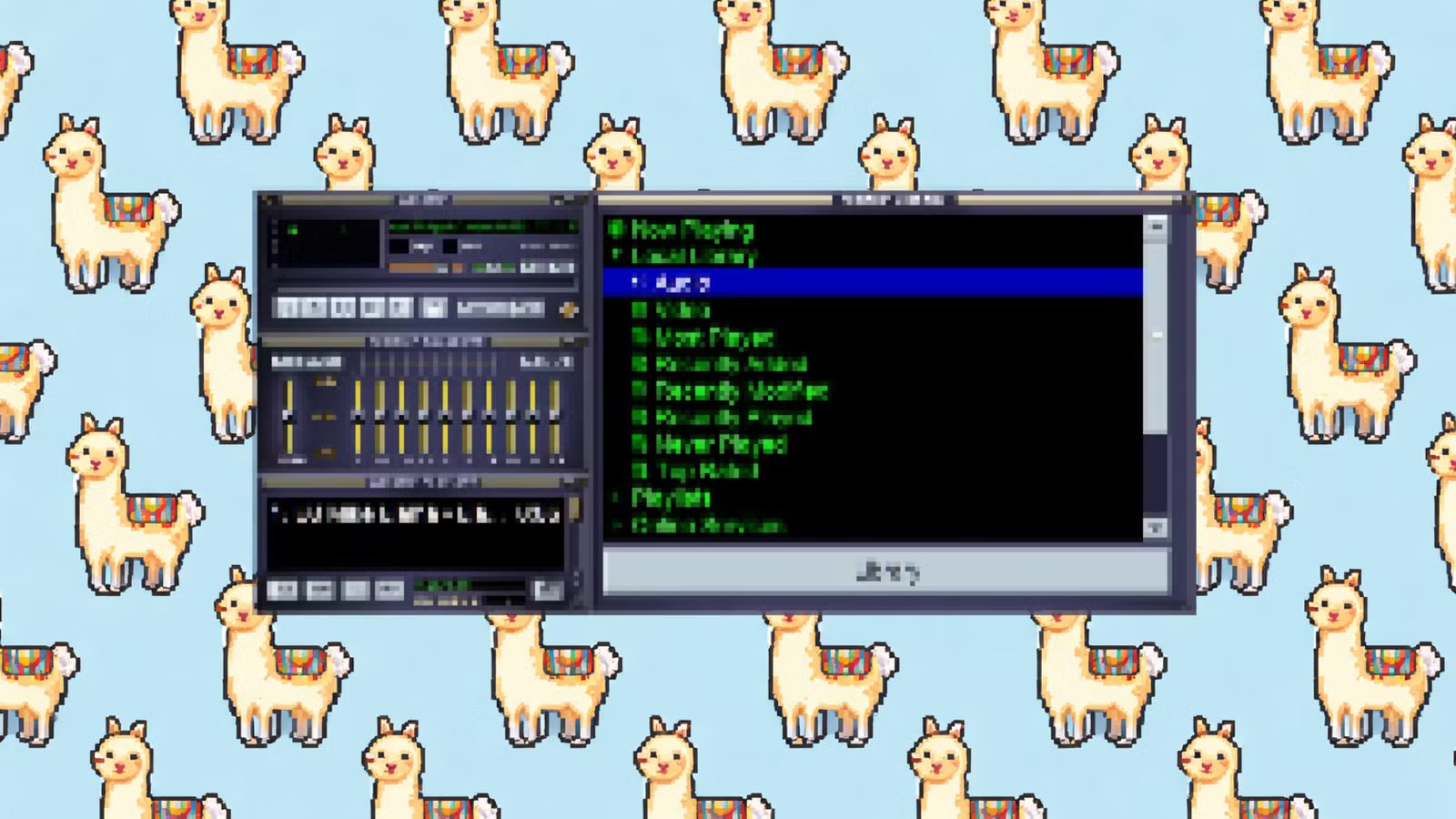
If you haven’t already figured it out, I’m talking about the one and only Winamp. For all of the 2000s and a good chunk of the 2010s, Winamp was one of the first apps that I installed on a fresh Windows installation or new computer. This one app was literally the soundtrack to my life for all those years. Whether I was studying or just chilling with my friends.
Like most people, I use streaming services like Spotify or local solutions like Plex Amp these days, but none of them come close to what made Winamp special.
It made music feel personal instead of disposable
Winamp was my first ever contact with MP3 music. It was the first time I ever saw my computer as an alternative to the family hi-fi or my CD player. Sure, we’d had MIDI and WAV audio for almost a decade at that point, but holding hundreds of songs on my meager 40GB hard drive with room to spare for games and homework? That was a game changer.
I guess for me, Winamp was what a CD or vinyl collection was for people of a slightly younger generation. In fact, as a teenager my CD buying patterns were almost entirely shaped by the music-sharing scene. I bought CDs after hearing music I liked that was being passed around as MP3 files.
Ironically, one of the first things I’d do with a new CD I bought was to rip it to MP3 at higher quality than an internet download would allow (192Kbps was a good balance for me), and then my actual discs would be stored safely.
Skins and plugins let you shape the player into anything
I actually quite like the default Winamp skin. It’s certainly iconic! However, one of the best parts of Winamp was that anyone could make a skin for it, as long as it conformed to the right format. For a long time I stuck with a skin that made my Winamp player look like a high-end Pioneer hi-fi stack, and my growing love of anime led me down a path of various anime Winamp skins, too.
Credit: Official Winamp skin museum.
There was no end to the variety (and silliness) of Winamp skins, and it meant that no two people necessarily had the same look to their players. This is something sorely missed in modern media players from streaming services. I’d like to do more than choose a profile picture. Above all, I loved that the interface was modular and that you could rearrange the parts of the player like actual hi-fi components.
Credit: Winamp skin museum
It was fast, lightweight, and didn’t try to manage your life
It might be hard to imagine now, but playing back MP3s wasn’t trivial at first. Certainly, my Pentium II at the time literally couldn’t handle some of the MP3 players (such as Sonique) without the music stuttering. In the meantime, I could play music on Winamp in the background while playing Diablo II in the foreground. As much as I love the music in Diablo II, it does start to grind after a few hundred hours!
Released
September 23, 2021
ESRB
M For Mature 17+ Due To Blood and Gore, Suggestive Themes, Violence
Developer(s)
Blizzard Entertainment, Vicarious Visions
Publisher(s)
Blizzard Entertainment
Engine
Unreal Engine 5
Multiplayer
Online Co-Op
Franchise
Diablo
While Winamp had online features, such as listening to internet radio, my computer didn’t even have an internet connection back then, and Winamp wasn’t designed around the idea that you’d be connected permanently. The idea that you’d see advertising or have some algorithm determine what music you played wasn’t a thing yet. I loved using the playlist feature to set up music for any mood or purpose.
Local files were a first-class citizen
Winamp arrived just in time for bigger storage to become the norm. I got my first 10GB hard drive (soon to be upgraded) and my first CD burner. This meant ripping my CDs or storing music other people shared with me was no issue to store and even preserve. This would come to serve me well later when I finally got my hands on a portable MP3 CD player and later a flash-based solution, but popping a CD into my PC and having hours and hours of music on it was great.
Some of those MP3 files followed me right up until I took my first streaming subscription and bought my first songs on iTunes. Come to think of it, I was using Winamp almost up to that point as well, but it was my smartphone becoming my main music player that really ended my personal use of this amazing application.
Winamp is still around—sort of
If you go to Winamp.com, you’ll see it’s no longer the plucky independent project it once was. It seems that the name and app were sold some time ago. According to what I’ve read, Winamp 5.6666 is the last “true” Winamp release, and you can find it at various mirror download sites. As always, be careful of files you download from the internet, and make sure your antivirus package is up to date before scanning and running the installation software.
That version of Winamp came out all the way back in 2013, though. There’s a clone called WACUP, which seems to be the spiritual successor of Winamp, but personally, I haven’t had much chance to try it out. Either way, Winamp was also about a time and a place, so I doubt anyone can really capture the magic again today.
