

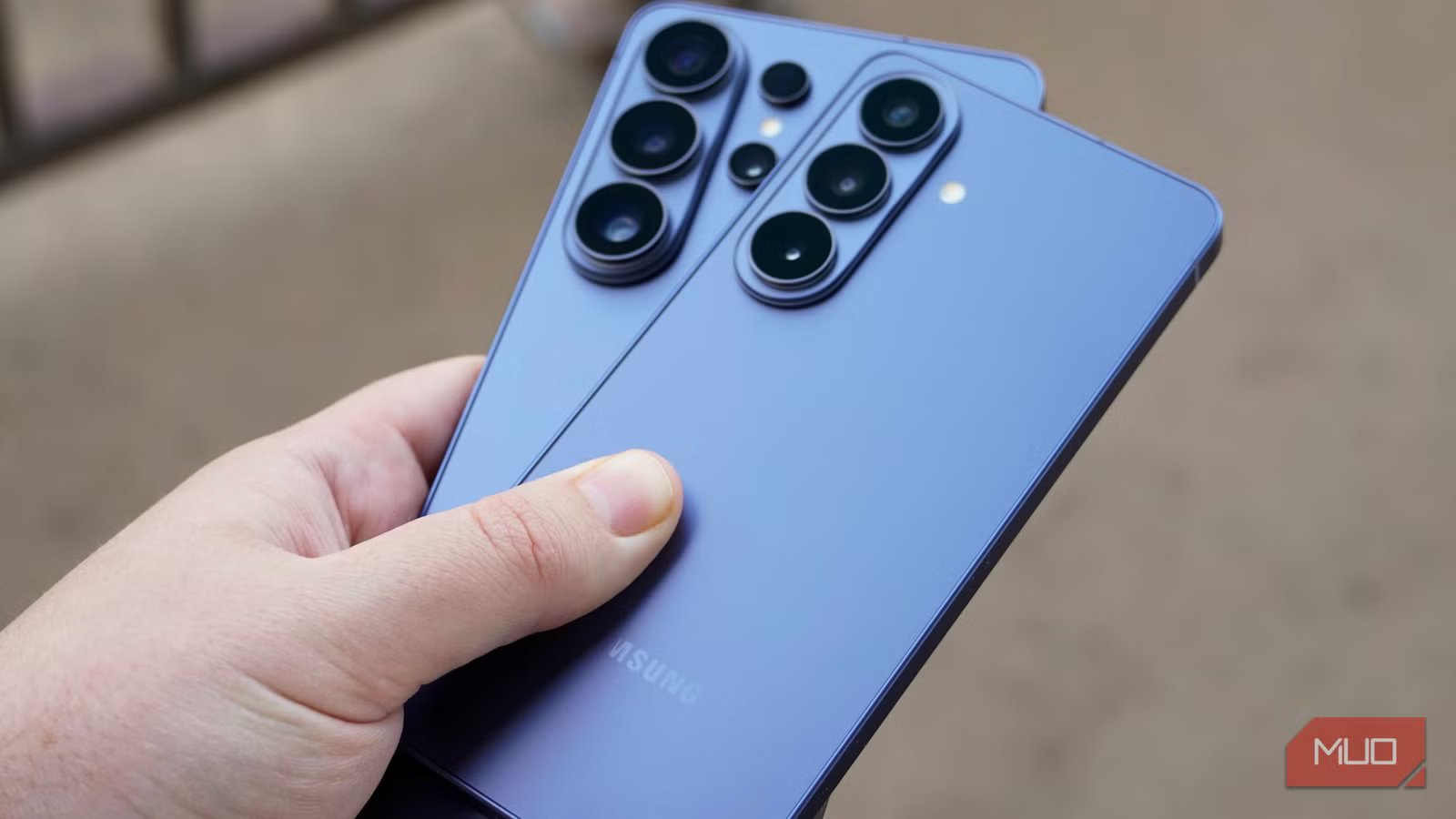
The Galaxy S26 Ultra is the kind of phone that makes you feel like you’re getting everything. And to be fair, you are. But after comparing it with the regular S26, I realized that most of the extra features didn’t really change how I use my phone.
And now that I’ve used the regular S26 for a couple of weeks, it honestly feels like it was the right decision. It does everything I need, and the differences that do exist don’t really justify the $400 extra for the Ultra. I’d argue that’s true for most people.
S26 hits the ergonomic sweet spot
It’s compact, comfortable, and lightweight
Pankil Shah / MakeUseOfCredit: Pankil Shah / MakeUseOf
The “bigger is better” philosophy has dominated the flagship smartphone space for a while now. But I personally feel bigger isn’t always better, at least not for everyone. There’s no point of using a 7-inch screen if you can’t comfortably reach every corner of the screen. At that point, the extra size feels like a burden rather than a benefit.
For me, the S26’s 6.3-inches feels just right compared to the Ultra’s 6.9-inches. It’s large enough to enjoy videos and browsing, yet compact enough to use comfortably with one hand. My previous device, which was an S22, was 6.1 inches, so switching to the S26 felt familiar from day one.
And it’s not just about dimensions. The weight makes a bigger difference too. The S26 comes in at just 167g, while the Ultra pushes to 214g. The 47g difference doesn’t seem much, but if you love using your phone for long hours like me, that certainly plays a role.
Hardware matches, cameras nearly do too
The Ultra doesn’t pull that far ahead
When it comes to the hardware, the Galaxy S26 and the S26 Ultra are almost identical. You get the same aluminum body, the same premium in-hand feel, and even the similar color options. Apart from the obvious difference between the triple and quad camera setups, it’s actually quite hard to tell them apart. On the inside, every S26 model is powered by the same Snapdragon 8 Elite Gen 5 chip. They also share the same IP68 water and dust resistance, so there’s no compromise in durability either.
Cameras are where the Ultra flexes the most. There’s no doubt about that. The S26 features a 50MP main camera with an f/1.8 aperture, while the Ultra has a massive 200MP sensor with a wider f/1.4 aperture. It also brings a 50MP ultrawide compared to 12MP on the regular S26, along with an additional 5x, 50MP telephoto lens.
But even here, the S26 holds its ground really well. After all, it’s still a flagship device and benefits from the same image processing. Most importantly, both phones have the same 12MP front camera, which is the lens I use the most. So yes, unless you’re specifically looking for extreme zoom or maximum detail, the difference isn’t as dramatic as the specs might suggest.
Related
The Galaxy S26 did something no phone has done in years — it made me doubt my iPhone
I never thought I’d say this, but the iPhone can wait.
It benefits from the same software features
You still get the full Galaxy experience
Pankil Shah / MakeUseOfCredit: Pankil Shah / MakeUseOf
One of the biggest reasons the regular S26 never feels like a “lesser” device is that, on the software side, Samsung hasn’t held back features for the Ultra. You get the same multitasking tools, Galaxy AI features, and Good Lock modules. And since they both share the same processor and RAM, there’s no difference in performance either.
Finally, the S26 will get the same number of software updates as the Ultra, so both devices will get the new features and will age at the same pace. You’re not buying into a shorter lifecycle by choosing the smaller model.
The value gap is hard to justify
The S26 Ultra does come with a few extra features that are missing from the regular model. The most obvious one is the S Pen, which is great for anyone who loves taking note or sketching. Then there’s the headline-grabbing Privacy Display, which is exclusive to the Ultra models. It’s quite handy if you often use your phone in public and worry about someone peeking at your screen.
The Ultra also packs a slightly bigger battery, but it has to power a larger display too. That bigger screen, of course, requires more power, so the difference in screen on time isn’t that huge.
When you put it all together, the Ultra offers more features, but not necessarily $400 worth of extra value for most people. I mean, for the difference amount, you could get the new Pixel 9a.
My only regret is missing out on fast charging
If there’s one thing I genuinely feel the S26 misses out on, it’s the charging speed. It supports 25W wired charging, compared to 60W on the Ultra. And for wireless charging, the S26 is capped at 15W, while the Ultra goes up to 25W. Since charging our phones is something that you need to do daily, this does affect everyday use more than anything.
But other than that, I’m still happy I picked the S26 over the Ultra or even the Plus model. Of course, those two also have their place, but for most people, the regular variant is just as good and saves a significant amount of money.
SoC
Snapdragon 8 Elite Gen 5
Display
6.3-inch Dynamic AMOLED 2x
RAM
12 GB
Storage
256 or 512 GB
8.5/10
SoC
Snapdragon 8 Elite Gen 5
Display
6.9-inch Dynamic Super AMOLED 2X
RAM
12 or 16 GB
Storage
256GB, 512GB, or 1TB
