

Why you can trust Android Central
Our expert reviewers spend hours testing and comparing products and services so you can choose the best for you. Find out more about how we test.
Over the past two weeks, I had the Motorola Razr Plus 2026 folded up in my pocket. Its diminutive form factor felt comfortable and reassuring, but also like déjà vu. I’ve used this phone before — twice, in fact — and while I love using it, there was nothing fundamentally different from my previous experience with the 2024 and 2025 Razr Plus.
So I performed a little experiment. During my review, I swapped my wife’s Razr Plus 2024 for the 2026 model to see what she thinks. While I use dozens of different phones all year long, she’s been faithfully using the Razr Plus 2024 for nearly two years now, and used two Samsung Z Flip models before that. She’s an avid flip phone fan, and the seemingly minuscule upgrades on this year’s Razr Plus were exactly what she was looking for.
Looking at Motorola’s marketing and the even more anemic spec sheet, you might wonder why. This year’s phone has identical dimensions and weight to the previous two years of Razrs, and it even shares the same processor as the Razr Plus 2024 that I upgraded her from. For $100 more, it doesn’t seem like you’re exactly getting much from this model, but usage has proven that feeling wrong.
Latest Videos From
Today’s best Motorola Razr Plus 2026 deals
While I used it to snap pictures of the annual Bonsai festival in town over the weekend, or went on a local version of a Spartan race the next day, I never ran into battery life problems, something that can’t be said of some previous Razr models. That part was my wife’s favorite upgrade on the phone as well, and we both noticed the camera upgrades right off the bat.
And the phone wasn’t done surprising me. While “the same look at last year’s phone” is often a negative point, it’s not just because of a lack of excitement; it’s because you also have to buy new cases and other accessories to work with your phone. The Pixel 10a is a perfect example of this annoying design tweaking. With the Razr Plus 2026, you don’t have to get new cases. They all fit perfectly, and that’s exactly how it should be in these iterative upgrade years.
Swipe to scroll horizontallyMotorola Razr Plus 2026 specs
Category
Motorola Razr Plus 2026
OS
Android 16 (Hello UX)
Display (internal)
6.9-inch, Extreme AMOLED, 1080 x 2620, LTPO 165Hz, 10-bit, Dolby Vision, 3,000 nits peak brightness
Display (external)
4.0-inch, Extreme AMOLED, 1272 x 1080 LTPO 165Hz, 10-bit, Dolby Vision, 2,400 nits peak brightness
Chipset
Qualcomm Snapdragon 8s Gen 3
RAM
12GB LPDDR5X
Storage
256GB
Rear Camera 1
50MP (1.6μm Quad Pixel), OIS, f/1.8
Rear Camera 2
50MP ultrawide (1.28μm Quad Pixel), f/2.0, 122-degree FoV, Autofocus with macro support
Selfie Camera
32MP(1.4μm Quad Pixel), f/2.4
Audio
3 mics, dual stereo speakers, Dolby Atmos
Connectivity
5G, Wi-Fi 7, Bluetooth, NFC
Security
Fingerprint sensor, Face unlock
Protection
IP48, MIL-STD 810H titanium hinge, Gorilla Glass Victus
Battery
4,500mAh, 45W wired charging, 15W wireless charging, 5W reverse charging
Dimensions (open)
73.99 x 171.42 x 7.09mm
Dimensions (closed)
73.99 x 88.09x 15.32mm
Weight
189g
Colors
PANTONE Mountain View
(Image credit: Nicholas Sutrich / Android Central)
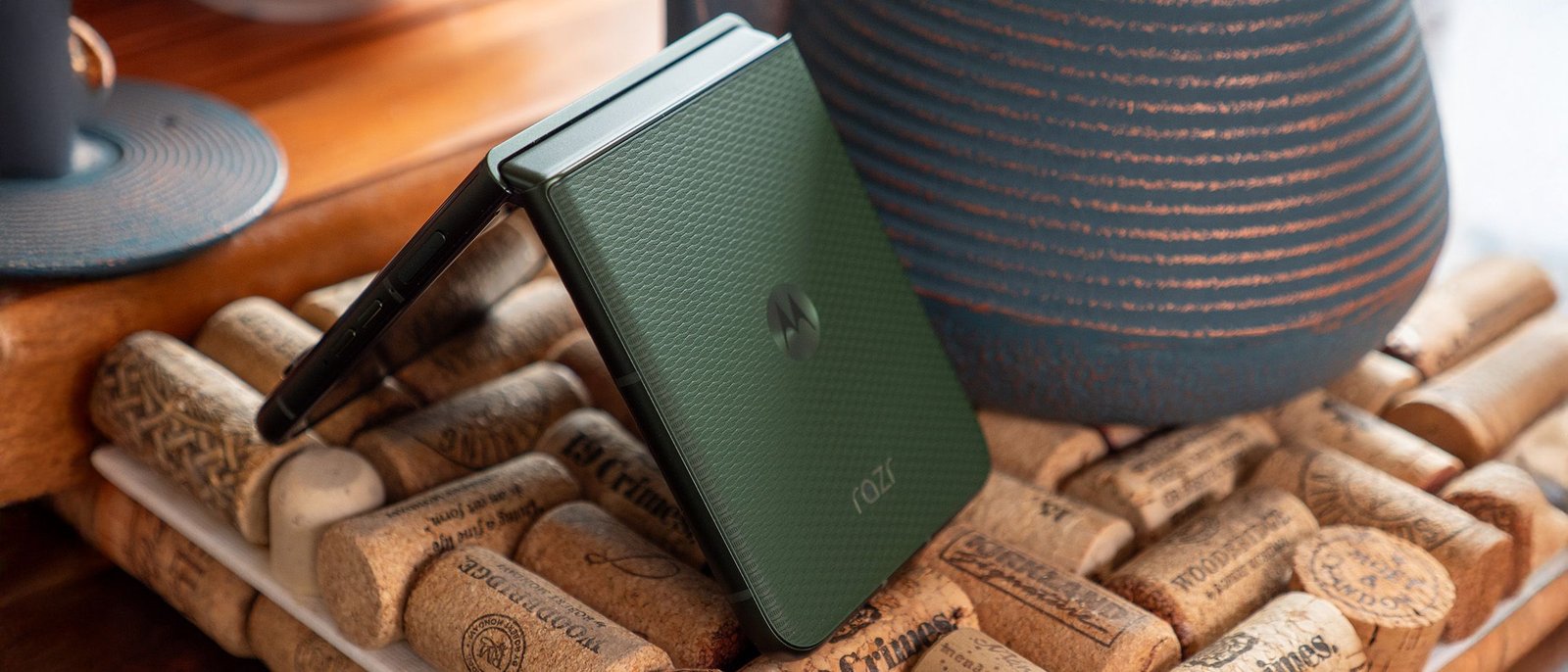
The Motorola Razr Plus 2026 is available in a single color — Pantone Mountain View, a soft-textured green vegan leather — as of May 21. You can get it at Best Buy, Amazon, and Motorola’s website, as well as AT&T, Verizon, and T-Mobile for $1,099.
Most Razr 2026 deals will get you the phone for a lot less, and some even include freebies like a case or something else. Motorola is selling the phone with a free pair of Moto Buds Loop, for instance, and some carriers may even have lower-priced phone configurations with more or less storage.
(Image credit: Nicholas Sutrich / Android Central)
There’s something strangely cathartic about flipping a phone open and closed. It’s a feeling that disappeared during the decade and a half that candybar phones took over the scene, but Motorola resurrected the Razr form factor in 2019 and has been improving it ever since.
Sure, the Snapdragon 8s Gen 3 processor inside doesn’t exactly feel like it belongs in an $1,100 phone, but it’s still plenty capable and has better thermal management than the “true” flagship processors. In daily use, you simply will not notice a difference between this processor and the more powerful one found on the Razr Ultra, and I’d be willing to bet the crowd that prefers the Razr’s style doesn’t care about hardcore 3D gaming, the only real place a more powerful processor might make a difference.
Instead of spending money upgrading that, Motorola chose the real pain points: battery life, camera quality, and durability. RAM and storage issues this year mean basically all phones are getting a price increase, and the only ones that don’t are even more recycled versions of last year’s phones than this one.
Image 1 of 6
(Image credit: Nicholas Sutrich / Android Central)(Image credit: Nicholas Sutrich / Android Central)(Image credit: Nicholas Sutrich / Android Central)(Image credit: Nicholas Sutrich / Android Central)(Image credit: Nicholas Sutrich / Android Central)(Image credit: Nicholas Sutrich / Android Central)
The 500mAh battery increase for this phone compared to the 2024 and 2025 models doesn’t sound like much, but in practice, it means a few more hours of use. That’s just enough to properly get through a full day on a single charge. That’s even the case if you play a lot of mobile games, something both my wife and I find ourselves doing in our downtime.
I do need to applaud Motorola for its engineering excellence on this phone, too. The aluminum hinge was swapped out for a titanium one, which not only increases durability quite a bit, but it’s also lighter than aluminum.
(Image credit: Nicholas Sutrich / Android Central)
That means the 500mAh silicon-carbon battery magically adds no weight to the phone since the hinge is lighter. I noticed that my wife’s 2024 model, which has shiny sides all around, has some very obvious scuffing on the hinge, which is the only place often uncovered with flip phone cases. Hopefully, the titanium keeps this from happening with the 2026 model.
And again, I need to stress the importance of Motorola not changing the design at all. While it would have been nice to get an AI key like the Razr Ultra Fold has, it would have been the only change in the design and would have been an annoyance. I wish more companies would follow this act during the iterative years between big design changes, as my wife simply took the case she loved off her 2024 model, slid it onto the 2026 model, and moved on with her life.
(Image credit: Nicholas Sutrich / Android Central)
I’m also blown away by Motorola’s complete lack of marketing on the camera upgrades here. When Android Central was briefed on the Razr family ahead of the launch, camera changes or upgrades were basically unmentioned. Even the spec sheets look nearly identical, except that Motorola swapped the useless 2x telephoto camera for an ultrawide this year.
The ultrawide camera isn’t just a great addition for practical purposes; it also adds Horizon Lock capability to the phone, which is a massive upgrade to video recording stability when you need it.
Given the removal of the telephoto camera, you might think this phone has worse zoom capability. I’m happy to say that you and I were both wrong in that regard, and I’m quite frankly puzzled by it. Again, based on the specs, this year’s phone should have worse zoom detail at any zoom level, but it doesn’t. In fact, even at 4x and beyond, the 2026 model — that’s the one with no telephoto camera — sports far superior zoom detail. A genuine WTF moment, for sure.
Image 1 of 3
(Image credit: Nicholas Sutrich / Android Central)(Image credit: Nicholas Sutrich / Android Central)(Image credit: Nicholas Sutrich / Android Central)
Of course, you might be wondering how this phone compares to the Z Flip 7, or even the upcoming Galaxy Z Flip 8. Samsung packs a faster processor in that phone (though it’s not much faster), and its software is more feature-rich in some ways, but it falls behind Motorola in several key areas.
First and foremost is the cover screen, an area that Motorola has consistently beaten Samsung in since the big redesign of the Razr line in 2023. Samsung somehow made the Z Flip 7’s cover screen less functional than previous models, too, which left us scratching our heads in our Z Flip 7 review.
The displays and cameras are also notably worse than Motorola’s efforts, and that’s even more true this year than ever. Samsung’s foldables have often had worse cameras than the competition, and the company doesn’t seem to be changing that with this year’s releases, if rumors are true. Plus, Samsung’s AMOLED displays are unusable for anyone sensitive to PWM dimming, while Motorola offers a way to swap out PWM dimming for something more comfortable.
(Image credit: Nicholas Sutrich / Android Central)
And while the Razr Plus 2026’s battery is only 200mAh bigger than the Z Flip 7, Motorola offers nearly double the charging speed as Samsung, so you can quickly top up in a pinch before heading out the door.
All this to say that while the Razr Plus 2026 isn’t the most impressive year-over-year upgrade by any means — a fact made worse by the $100 price increase — Motorola clearly focused on fixing the real problems its users had.
Realistically, Razr Plus 2024 and 2025 users shouldn’t bother unless they get a killer deal, but if you’re coming from a standard Razr (Razr Minus?), this will be a substantial upgrade in every way. It’s also a terrific buy if you’re looking to get a flip phone for the first time, especially with this year’s enhanced durability and the improved five-year software update promise.
Motorola Razr Plus 2026: Price Comparison
