

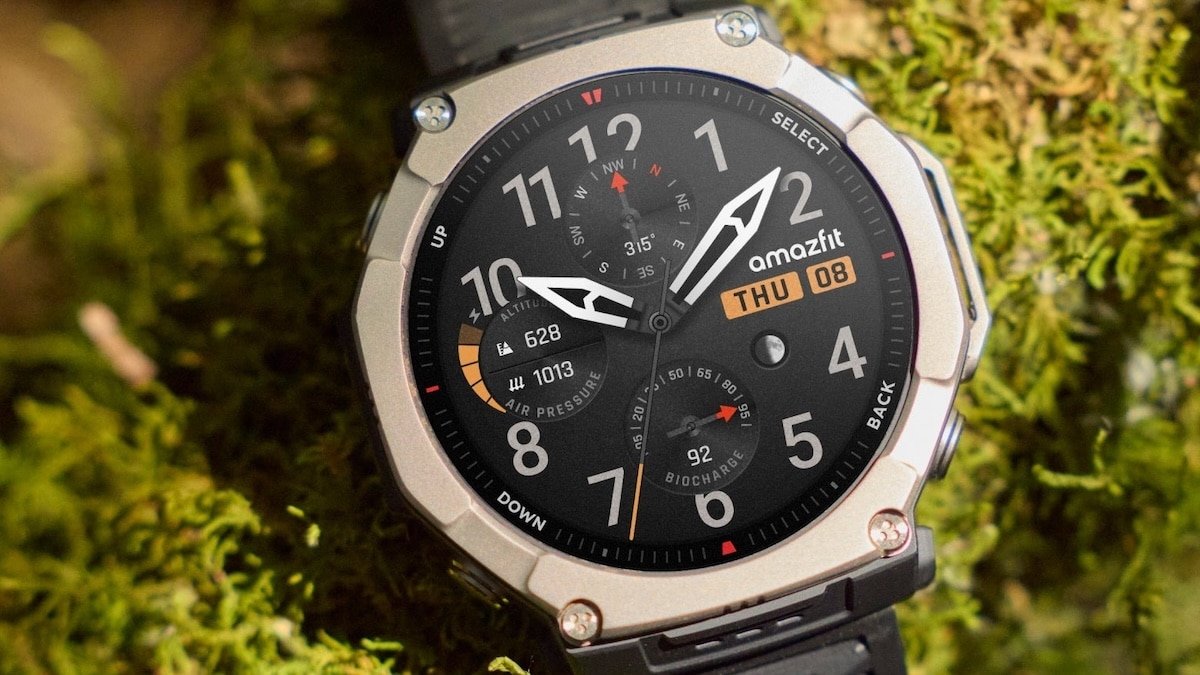
The Amazfit T Rex Ultra 2 has only just launched and several reviewers have flagged heart rate accuracy issues during running. This is not coming from a broken sensor, it is coming from the reality of strapping a thick 90 gram watch to your wrist and asking it to stay perfectly still at high intensity.
Weight matters more than most people think
Wrist based heart rate is all about one thing, keeping the sensor pressed cleanly against your skin. As soon as that contact starts to shift, the data gets messy or starts lagging behind what your body is actually doing. With a heavy watch, especially a thick one, that becomes harder to control.
When you pick up the pace, your arm swing gets sharper and more abrupt. A 90 gram watch does not want to change direction as quickly as your wrist does, so it keeps moving for a split second longer. Those tiny movements are enough to let light creep under the sensor, and that is when accuracy starts to fall apart. This is why heavier watches tend to struggle more during intervals or hard efforts than they do on steady, easy runs.
You can tighten the strap, and that definitely helps, but there is a limit. Cinch it too much and comfort goes out the window. Even then, the weight is still there, doing what weight does.
Another option is to just sidestep the whole wrist issue. Pairing the watch with a chest strap takes movement out of the equation completely. And the good news is, Ultra 2 has this feature. Once the sensor is on your chest, it does not care how heavy the watch is or how much your wrist is flailing around.
This is not new, and it is not unique to Ultra 2
We have reviewed a number of heavy watches over the years, and the pattern is consistent. The heart rate sensor itself is usually fine. At rest and during steady exercise it behaves as expected. Problems show up when running intensity increases and wrist movement becomes more aggressive.
This is a general trade off with rugged watches. Extra casing, thicker backs, larger batteries, and metal components all add weight. That weight improves durability and battery life, but it works against clean optical heart rate data when you are moving fast.
Ultra 2 sits in that category. It is built to survive harsh conditions, not to disappear on your wrist during track repeats.
Firmware tweaks can improve filtering and data handling, but they cannot change physics. When a heavy watch moves on the wrist, the signal degrades. That is true across brands and models.
Our takeaway
Ultra 2 (view on Zepp Health and Amazon), makes sense for people who want a single watch that can handle hiking, climbing, diving, long adventures and rough environments. It is designed for users who value durability, offline maps, navigation tools, along with features like recreational scuba diving.
If your main focus is high intensity running or interval training, lighter options simply make more sense. Watches like Amazfit Active Max or models in the Balance range sit lower on the wrist and move less during fast efforts.
This does not make Ultra 2 a bad watch. It just means it has a very specific audience.
Subscribe to our monthly newsletter! Check out our YouTube channel.
And of course, you can follow Gadgets & Wearables on Google News and add us as a preferred source to get our expert news, reviews, and opinion in your feeds.
