

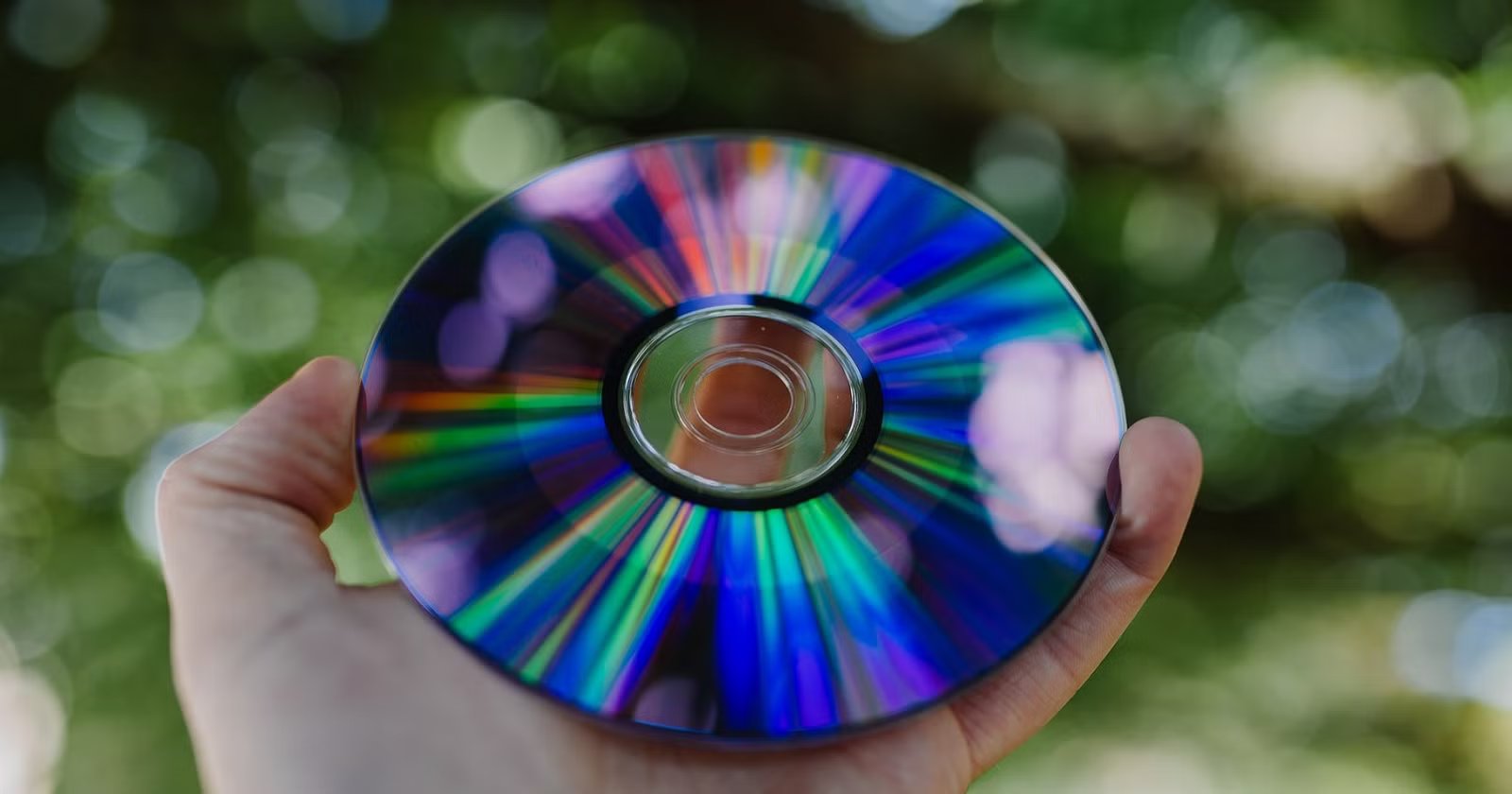
You can buy a disc rated to last 1,000 years, but the company that invented it survived for less than a decade. The Millennial Disc, or M-DISC, is a write-once optical format that physically engraves its data onto a synthetic, rock-like layer that avoids the disc rot of standard optical storage media (which stores data with organic dye that can degrade over time). Unfortunately, Millenniata, Inc. filed for bankruptcy in 2016. While Verbatim still sells M-DISCs today, questions remain about whether the Blu-ray variants still use the same recording layer as the original.
Related
Why Some of Your Old DVDs May No Longer Play (and What to Do About It)
Disc rot means that selected DVDs less than 20 years old are no longer playable.
What disc rot actually is
Why your burned DVDs are already dying
Credit: AlexanDior / Shutterstock
Standard recordable DVDs and Blu-rays store data using organic dye layers, and the disc writer’s laser darkens the dye to represent binary code. The drive then reads those dark and light patches as ones and zeros. The problem is that these dyes degrade, with heat, humidity, and ultraviolet light all accelerating the process. According to NIST, the life expectancy for CD/DVD media is as low as two to five years under typical conditions.
M-DISC works differently
A disc that engraves the data instead of dissolving it
M-DISC is a write-once optical disc tech introduced in 2009 by Millenniata, Inc, which was co-founded by Brigham Young University professors Barry Lunt and Matthew Linford. Instead of burning data into organic dye, M-DISC ablates pits into an inorganic, rock-like data layer made of glassy carbon. The resulting pits don’t rely on a chemical state to hold data, they’re physical structures, just like the words in a stone tablet. They’re not going anywhere, according to the company’s patents, which describe the material as substantially inert to oxidation, with a melting point between 200 and 1000˚C.
M-Discs look like standard optical discs; they’re 120mm across, almost transparent when they don’t have a label, and come in DVD (4.7 GB), Blu-ray BD-R (25 GB, 50 GB), and BDXL (100 GB) formats. They’re readable on any standard DVD or Blu-ray drive, but writing requires a compatible M-DISC burner, which most LG, Pioneer, Asus, and Verbatim optical drives made after 2011 support.
The DoD tested it
The US Navy put M-DISC through hell, and it passed
Credit: Shaun Cichacki/MUO
In 2009, the US Department of Defense’s Naval Air Warfare Center Weapons Division (NAWCWD) at China Lake, California, subjected M-DISC DVDs alongside five brands of archival-grade, gold dye-based recordable DVDs to accelerated aging tests involving 85°C heat and 85% relative humidity for 250 hours, conditions that project equivalent centuries of normal storage under ISO standards. Every conventional DVD failed with significant data degradation. The M-Disc showed no measurable data loss.
That’s not all, though. Between 2010 and 2012, the French National Laboratory of Metrology and Testing (LNE) ran additional ISO/IEC 10995 testing at 90°C and 85% humidity. The inorganic M-DISC media again survived conditions that rendered conventional discs unreadable. The claims of longevity come from extrapolating these accelerated aging results; real-world testing of 1,000 years is impossible to manage, understandably.
The company behind it went bankrupt
A typical corporate story
From Pixabay — no attribution needed
https://pixabay.com/photos/wallet-empty-poverty-bankrupt-3548021/
Sadly, even with an amazing product with tons of durability and the research validation, Millenniata ran into troubles that had nothing to do with disc rot. Cloud storage was getting cheaper, and SSDs were proliferating, so laptop makers started to skip optical drives altogether.
Millenniata filed for bankruptcy in December 2016 after defaulting on convertible debt. The debt holders took possession of all assets and started a new company called Yours.co to sell M-DISCs and related services. As of the 2020s, only two licensed manufacturers remain: Ritek and Verbatim. A planned 128 GB BDXL variant never made it to market before the bankruptcy.
In addition, the intellectual property moved through several hands, and the composition of current M-DISC Blu-ray media has become something of an active debate in archiving communities. Independent scans of media identification codes on current 25 GB and 50 GB M-DISC Blu-rays have found that some share the same media IDs as standard high-quality inorganic Blu-ray recordable discs and not the unique glassy carbon layer that defined the original format.
Verbatim says its M-DISC media uses a patented inorganic write layer and still says the discs will last several hundred years (if not the original 1,000-year claim). No manufacturer currently discloses the exact formulation, so there’s no way to independently verify what’s in the recording layer. It could be that modern Verbatim M-DISC Blu-rays are just premium inorganic Blu-ray discs with the M-DISC brand appended; no one seems to know for real.
The practical limitations
External media still has problems
Credit: Verbatim
Even if the longevity claims hold, M-DISC still faces some very real issues. Cost is likely the largest problem, with a single 100GB BDXL M-DISC will run you between $13-$20 at retail, which comes out to about 13 to 20 cents per gigabyte. A 2 TB external hard drive costs around $60, or about three cents per gigabyte. For large backups, it’s costly to go with M-DISC. Even worse, hardware obsolescence is a real thing. Optical drives are increasingly rare, and compatible drive might not even be around in 30 years, let alone 1,000. Burn times are pretty slow, too, with 100 GB taking four to six hours to complete.
M-DISC might make sense as one layer of an archival strategy (e.g., three copies, two media types, one off-site), but not the whole thing. It might work if you have smaller sized data (legal papers, archival family photos, etc) that you want to store for a long time. For most home users, though, cloud storage and encrypted external drives cover your practical needs more efficiently.
Is it worth buying?
M-DISC is still available from Verbatim and Ritek through Amazon and other retailers. The DoD-backed durability evidence for the DVD format is solid. The Blu-ray question is less clear: if you’re buying today, the 4.7 GB DVD variant has the clearest original-spec provenance, while the larger capacity Blu-ray formats carry more uncertainty about whether you’re getting the original glassy carbon layer or a premium standard inorganic disc.
Still, if you want a disc that might outlast us all, M-DISC might be a good choice.
