

Growing up, I assumed dark closets were just part of owning an older house. Turns out they’re part of owning just about any house — mine has six small closets without a light. For years I’d prop the door open and hope enough light spilled in from the hallway. Then I picked up a couple of packs of these rechargeable motion-sensor lights, installed them across all six, and wondered why I’d waited so long. They’re not a smart home solution — and honestly, that’s a big part of why they work so well.
Why dark closets are more annoying than they seem
The problem you’ve probably just accepted
Credit: Jonathon Jachura / MUO
Nobody thinks much about closet lighting until they’re running late and can’t find what they need in the dark. At 7 a.m. with kids to get out the door, digging through a coat closet blind stops being a minor inconvenience pretty fast. Builder-grade bulbs, when there even is one, usually sit so far back they light the ceiling more than the shelves. In utility rooms and basements, most builders don’t bother at all. So you use your phone flashlight and get on with your day — which works, but it’s a pretty low bar to clear.
What I bought, and why I got two sizes
The 10-inch and 14.7-inch bars each have a place
Credit: Jonathon Jachura / MUO
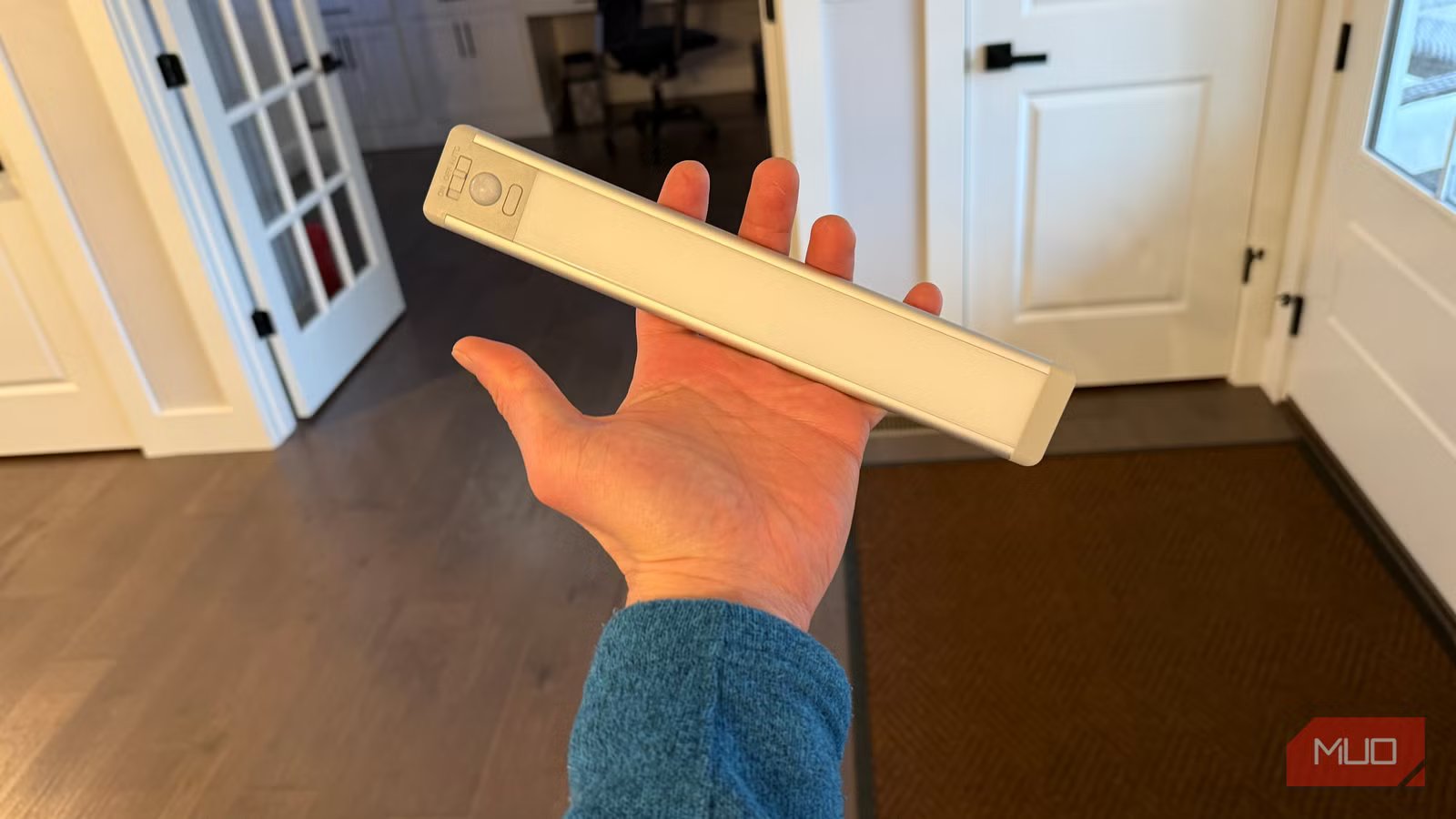
The MCGOR under-cabinet motion sensor bars come in 10-inch and 14.7-inch sizes, and I have several of each. Narrower shelves get the 10-inch so nothing overhangs; the 14.7-inch goes anywhere I want more coverage. Both are built the same way — 63 LEDs behind a frosted cover, five brightness levels, and a 2500mAh battery that charges over USB-C. The mounting system uses strong built-in magnets that snap onto adhesive metal plates you stick to the shelf. Peel the backing, press the plate in place, attach the light. That’s the whole install.
Six closets, six installs
Where they landed — and how each one performs
I have six closets without lighting and the lights handle all of them.
The coat closet by the front door gets heavy traffic when we have guests. It’s opened about a half dozen times each week, and the light comes on fast enough that I’ve never had to wait for it. The hallway linen closet near my kids’ rooms has become genuinely useful at night — I can grab a towel or extra blanket without turning on the hall light and waking everyone up. The guest bath linen closet and basement linen closet barely get opened compared to those two, and the batteries in both have lasted impressively long —for months—as a result.
The guest bedroom closet falls somewhere in between — occasional use, never any issues. The most satisfying install, though, was the utility closet that houses my well’s booster pump. No overhead light was ever wired into that space, so checking the pressure gauge or doing any maintenance meant holding a flashlight. Now I open the door, and there’s light — simple as that, and exactly the kind of low-effort automation I should have sorted out years ago.
Battery life is where things get interesting
Closed-door closets vs. open, high-traffic spaces
Credit: Jonathon Jachura / MUO
For closets with doors, battery life has been excellent. Even on the brightest setting, lights in closets I open once or twice a day hold a charge for months. Recharging is simple — pull the light off its magnetic mount, plug in a USB-C cable, and set it back in place. The whole process takes about as long as charging a phone.
Open areas are a different story. I tried the lights in my mudroom built-ins, which function like open lockers with no doors. The motion sensor doesn’t know the difference between someone actually using the space and someone just walking past — so in a high-traffic area, it triggers constantly. Under those conditions, I was getting about 1–1.5 weeks per charge. I had the same result when I tested them under the laundry room cabinets. Not a dealbreaker, but worth understanding before you buy. These lights are at their best in enclosed spaces. In open areas, you’re fighting the motion sensor as much as you’re benefiting from it.
Fill the gaps with budget smart devices
Where motion-sensor lights leave off, smart plugs and bulbs can pick up
For open spaces where these lights burned through battery too fast, I’ve found that pairing the concept with inexpensive smart home gear fills the gap nicely. A smart plug paired with a basic lamp, or a budget smart bulb on a schedule or motion-triggered routine, covers areas where a rechargeable bar just isn’t the right tool. There are some genuinely useful smart home devices available for under $20 that handle exactly this kind of scenario — and at that price point, you can cover a lot of ground without much investment.
Related
This $15 smart home gadget gives me more peace of mind than a security camera
I use it for a lot of reasons.
The best home upgrades are the ones you stop thinking about
After the initial install, you stop thinking about them entirely. Door opens, light’s on, done. There’s no app to check, no battery notification to dismiss, no schedule to configure. For under $12 a light — often less when you catch a sale — it’s one of the most straightforward improvements I’ve made to my home. If you’ve got dark closets you’ve been tolerating for years, these are worth every dollar.
