

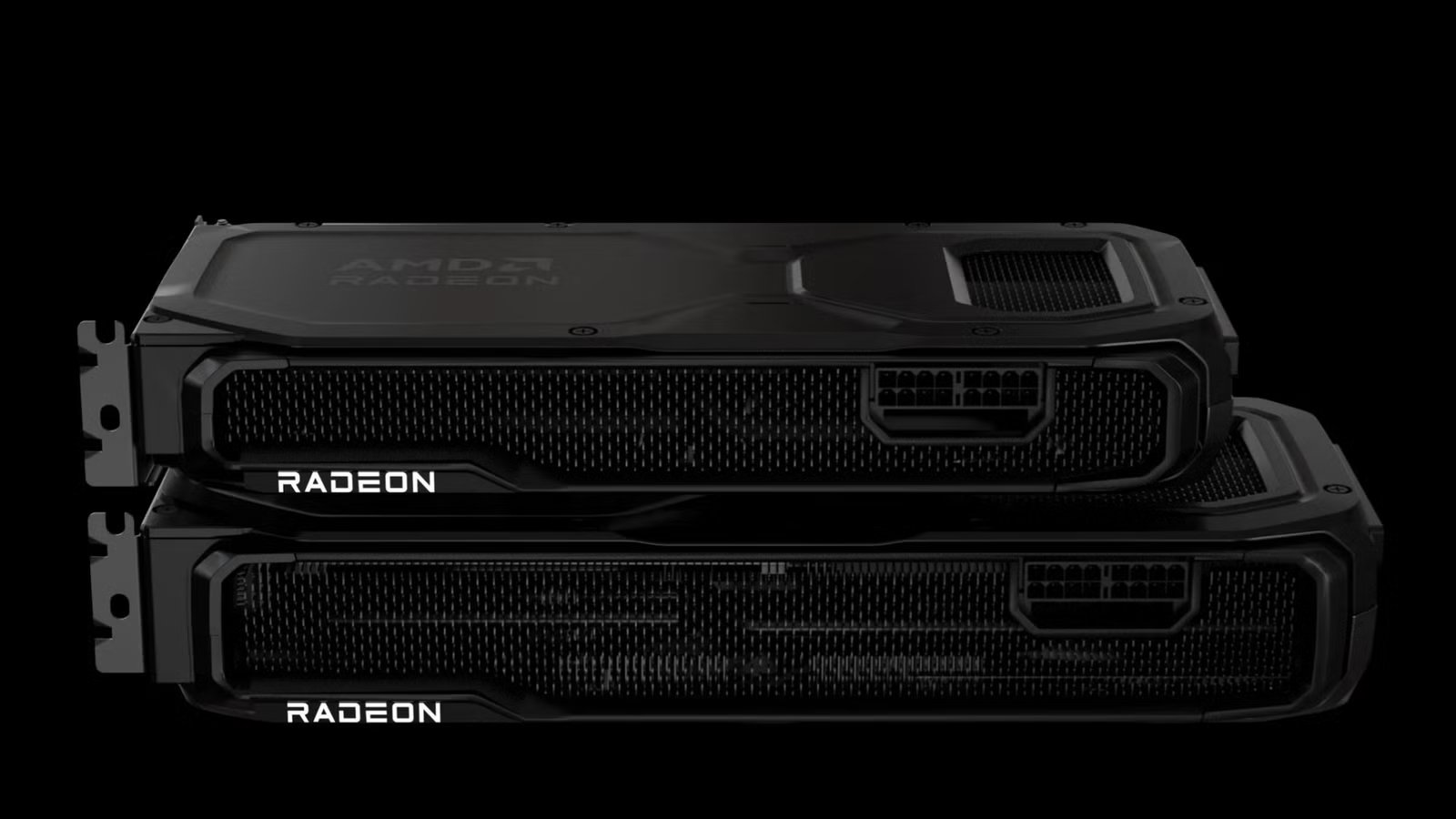
2025 has proven to be a strange year for PC hardware, with DRAM prices surging late in the year just as graphics cards released at the start of the year began to fall in price.
One of the biggest beneficiaries of that shift is the AMD RX 9070 XT, which remains widely available at reasonable prices. That rare combination of performance and value is what makes it the best graphics card of the year.
HTG Wrapped: Our favorite tech in 2025
24 days of our favorite hardware, gadgets, and tech
The RX 9070 XT isn’t a high-end card, but it has all the power you need
AMD has officially given up on high-end gaming graphics cards, but that isn’t really a huge loss for gamers. AMD hasn’t released anything to compete with NVIDIA’s top-of-the-line GPUs in years, but in the low- and mid-tier segments, AMD almost always outclasses NVIDIA’s cards in terms of performance per dollar.
The RX 9070 XT is no different. At its $599 MSRP, it sits a comfortable $50 above the RTX 5070’s $549 MSRP, but the AMD card destroys the RTX 5070 in raw rasterization and is often just as good with ray tracing enabled, depending on the game. In fact, the RX 9070 XT’s performance is much closer to the $150-more-expensive RTX 5070 Ti ($749 MSRP).
The RX 9070 XT is paired with 16GB of GDDR6 VRAM, which is all you really need for 1440p gaming and, more often than not, 4K gaming as well.
Credit: Capix Denan/Shutterstock.com
According to Tom’s Hardware’s 16-game rasterization geomean charts, the RX 9070 XT is capable of running nearly any modern AAA game at ultra settings, achieving 60 FPS at 4K or around 97 FPS at 1440p.
I know the $600–$650 price range the RX 9070 XT hovers in is a hard pill to swallow for many gamers, but that doesn’t mean it’s a bad value.
Regardless of whether you’re comparing it to another graphics card, a modern console, or a handheld, this card’s performance for the money is surprisingly great.
Credit: Lucas Gouveia / How-To Geek | charnsitr / Shutterstock
Honestly, unless you have money to burn, there’s no real need to step up to the more expensive RTX 5070 Ti, 5080, or 5090. The RX 9070 XT is a lot of graphics card for not a lot of money. Plus, it only requires a 750W power supply, so you’ll be saving some money on that front as well.
FSR 4 Redstone makes 4K even smoother and improves ray-tracing performance
Credit: AMD
One of the biggest improvements with the RX 9000 series comes in the form of FSR 4, which finally adds hardware-accelerated machine-learning upscaling to AMD’s cards. This makes it a genuine rival to NVIDIA’s dominant DLSS algorithm.
FSR 4 wasn’t as complete as many expected when the new generation launched, but with the FSR 4 Redstone update, RX 9070 XT owners can now enjoy machine-learning frame generation, ray generation, and radiance caching.
So, how good is it?
According to Digital Foundry, FSR 4 Redstone brings AMD’s upscaling much closer to NVIDIA’s DLSS, and more often than not, the difference is hard to notice. Our own tests also show significant improvements.
Gamers Nexus comparisons of FSR 4 Redstone against FSR 3.1 with frame generation highlight just how meaningful the upgrade is.
Gone are the ghosting artifacts and flickers that made certain games almost unplayable with frame generation enabled—I’ve experienced these issues on several games with my RX 6800 XT, to the point that I had to turn frame generation off.
Redstone finally makes FSR 4 a viable alternative to DLSS, allowing high FPS and ray-tracing at 4K on the RX 9070 XT.
The only current issue with Redstone is frame pacing. It will likely be addressed in a future update, but for now, limiting FPS and enabling V‑Sync seems to resolve the problem in most games, according to TechPowerUp.
Related
I tested FSR Redstone: It’s a huge upgrade, but you probably can’t use it
Incompatible with most AMD GPUs (sigh).
Current prices are as good as they’re going to get
Credit: Ascannio/Shutterstock.com
The RX 9070 XT can currently be found for a little over its $599 MSRP, with many models ranging from $620 to $700. Actually, since AMD never sold an OEM reference model of the 9070 XT, the slightly above-MSRP pricing makes sense, as AIB (add-in board) variants tend to go for a little higher anyway. Overclocked (OC) models with more powerful cooling and extra features like dual BIOS, RGB, and improved power delivery are usually worth spending a little extra on.
Unfortunately, due to the RAM-pocalypse spreading to other parts like storage, graphics cards will also be affected, and all rumors point to AMD increasing prices of the RX 9000 series cards sometime soon.
This effectively means that now could be your last chance to grab the RX 9070 XT close to its original MSRP. Next-gen RDNA 5 GPUs are nowhere close to launch, so even though there’s never really a “perfect” time to buy a GPU, today might be one of the rare exceptions.
Frankly, I’m strongly considering grabbing an RX 9070 XT myself because it’s such a phenomenal graphics card. I could sell my RX 6800 XT a few months down the line, as used card prices will likely increase as well.
