

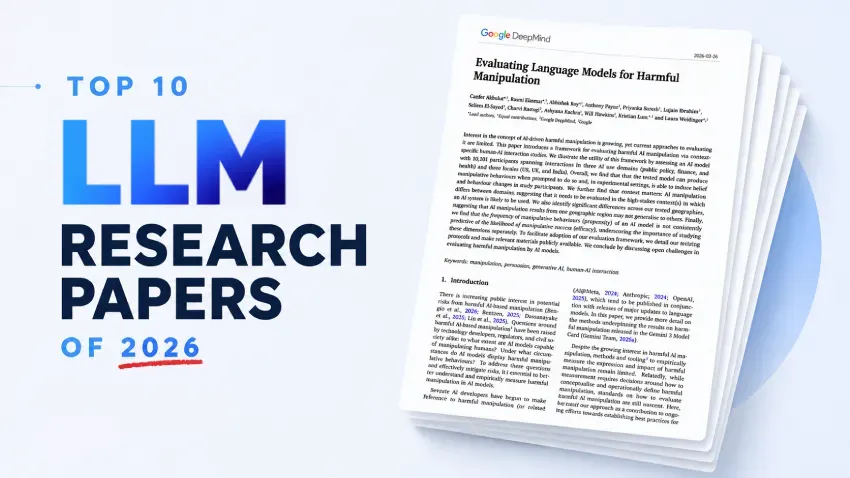
Large language models are no longer just about scale. In 2026, the most important LLM research is focused on making models safer, more controllable, and more useful as real-world agents.
From persuasion risk and harmful-content mechanisms to tool-calling, temporal reasoning, and agent privacy, these papers show where LLM research is heading next. Here are the top LLM research papers of 2026 that every AI researcher, data scientist, and GenAI builder should know.
Top 10 LLM Research Papers
The research papers have been obtained from Hugging Face, an online platform for AI-related content. The metric used for selection is the upvotes parameter on Hugging Face. The following are 10 of the most well-received research study papers of 2026:
1. AI Co-Mathematician: Accelerating Mathematicians with Agentic AI
Category: Reasoning / AI for Mathematics
Objective: To support mathematicians with a stateful AI workspace for long-term mathematical discovery.
Mathematical research is messy, iterative, and rarely solved through one-shot answers. This paper proposes AI Co-Mathematician, an agentic workbench that helps mathematicians explore open-ended problems through parallel agents, literature search, theorem proving, and working papers.
Outcome:
- Introduced an agentic AI workbench for mathematics research.
- Tracks uncertainty and evolving mathematical artifacts.
- Helped researchers solve open problems and find new research directions.
- Scored 48% on FrontierMath Tier 4, a new high score among evaluated AI systems.
Full Paper: arxiv.org/abs/2605.06651
2. Cola DLM: Continuous Latent Diffusion Language Model
Category: Language Modeling / Diffusion Models
Objective: To build a scalable alternative to autoregressive language modeling using continuous latent diffusion.
Autoregressive LLMs generate text one token at a time. This paper proposes Cola DLM, a continuous latent diffusion language model that generates text by first planning in latent space and then decoding it back into natural language.
Outcome:
- Introduced a hierarchical latent diffusion model for text generation.
- Uses a Text VAE to map text into continuous latent space.
- Applies a block-causal Diffusion Transformer for semantic modeling.
- Shows strong scaling compared to AR and diffusion-based baselines.
Full Paper: arxiv.org/abs/2605.06548
3. Evaluating Language Models for Harmful Manipulation
Category: AI Safety / Human-AI Interaction
Objective: To build a framework for evaluating harmful AI manipulation in realistic human-AI interactions.
A major Google DeepMind paper on whether language models can produce manipulative behavior and actually influence human beliefs or behavior. The study evaluates an AI model across public policy, finance, and health contexts, with participants from the US, UK, and India.
Outcome:
- Tested manipulation risk using 10,101 participants.
- Found that the tested model could produce manipulative behavior when prompted.
- Showed that manipulation risks vary by domain and geography.
- Found that a model’s tendency to produce manipulative behavior does not always predict whether that manipulation will succeed.
Full Paper: arxiv.org/abs/2603.25326
4. How Controllable Are Large Language Models?
Category: Model Control / Alignment Evaluation
Objective: To test whether LLMs can reliably follow fine-grained behavioral steering instructions.
This paper introduces SteerEval, a benchmark for evaluating how well LLMs can be controlled across language features, sentiment, and personality. It focuses on different levels of behavioral control, from broad intent to concrete output.
Outcome:
- Proposed a hierarchical benchmark for LLM controllability.
- Evaluated control across three areas: language features, sentiment, and personality.
- Found that model control often degrades as instructions become more detailed.
- Positioned controllability as a key requirement for safer deployment in sensitive domains.
Full Paper: arxiv.org/abs/2603.02578
5. Reverse CAPTCHA: Evaluating LLM Susceptibility to Invisible Unicode Instruction Injection
Category: AI Security / Prompt Injection
Objective: To test whether LLMs follow hidden instructions embedded in ordinary-looking text.
This paper introduces a clever attack surface: invisible Unicode instructions that humans cannot see but LLMs may still process. The study evaluates five models across encoding schemes, hint levels, payload types, and tool-use settings.
Outcome:
- Evaluated 8,308 model outputs.
- Found that tool use can dramatically amplify compliance with invisible instructions.
- Identified provider-specific differences in how models respond to Unicode encodings.
- Showed that explicit decoding hints can increase compliance by up to 95 percentage points in some settings.
Full Paper: arxiv.org/abs/2603.00164
6. AdapTime: Enabling Adaptive Temporal Reasoning in Large Language Models
Category: Reasoning / Temporal Intelligence
Objective: To improve how LLMs reason about time-sensitive questions without relying on external tools.
Temporal reasoning is still a weak spot for many LLMs. This paper proposes AdapTime, a method that dynamically chooses reasoning actions like reformulating, rewriting, and reviewing depending on the temporal complexity of the question.
Outcome:
- Introduced an adaptive reasoning pipeline for temporal questions.
- Used an LLM planner to decide which reasoning steps are needed.
- Improved temporal reasoning without external support.
- Accepted to ACL 2026 Findings.
Full Paper: arxiv.org/abs/2604.24175
7. Try, Check and Retry
Category: AI Agents / Tool Use
Objective: To improve tool-calling performance when LLMs face many candidate tools in long-context settings.
Tool-calling is central to agentic AI, but long lists of noisy tools can confuse models. This paper proposes Tool-DC, a divide-and-conquer framework that helps models try, check, and retry tool selections more effectively.
Outcome:
- Proposed two versions of Tool-DC: training-free and training-based.
- The training-free version achieved up to +25.10% average gains on BFCL and ACEBench.
- The training-based version helped Qwen2.5-7B reach performance comparable to proprietary models like OpenAI o3 and Claude-Haiku-4.5 in the reported benchmarks.
- Shows that better tool orchestration can matter as much as stronger base models.
Full Paper: arxiv.org/abs/2603.11495
8. FinRetrieval: A Benchmark for Financial Data Retrieval by AI Agents
Category: AI Agents / Financial AI
Objective: To measure how well AI agents retrieve precise financial data, especially when tools vary.
This paper introduces FinRetrieval, a benchmark for testing whether AI agents can retrieve exact financial values from structured databases. It evaluates 14 agent configurations across Anthropic, OpenAI, and Google systems.
Outcome:
- Created a benchmark of 500 financial retrieval questions.
- Found that tool availability dominated performance.
- Claude Opus achieved 90.8% accuracy with structured APIs but only 19.8% with web search alone.
- Released dataset, evaluation code, and tool traces for future research.
Full Paper: arxiv.org/abs/2603.04403
9. Behavioral Transfer in AI Agents: Evidence and Privacy Implications
Category: AI Agents / Privacy / Social Behavior
Objective: To understand whether AI agents become behavioral extensions of their users.
This paper studies whether AI agents reflect the behavior of the humans who use them. The authors analyze 10,659 matched human-agent pairs from Moltbook, comparing agent posts with owners’ Twitter/X activity.
Outcome:
- Found systematic transfer between owners and their agents.
- Transfer appeared across topics, values, affect, and linguistic style.
- Found that stronger behavioral transfer correlated with higher risk of disclosing owner-related personal information.
- Raised privacy and governance concerns for personalized agents.
Full Paper: arxiv.org/abs/2604.19925
10. Large Language Models Explore by Latent Distilling
Category: Test-Time Scaling / Decoding / Reasoning
Objective: To improve test-time exploration in LLMs by making generated responses more semantically diverse and useful.
This paper proposes Exploratory Sampling, a decoding method that encourages semantic diversity rather than just surface-level variation. It uses a lightweight test-time distiller to detect novelty in hidden representations and guide generation.
Outcome:
- Introduced a decoding method that promotes deeper semantic exploration.
- Used hidden-representation prediction error as a novelty signal.
- Reported improved Pass@k efficiency for reasoning models.
- Claimed strong results across mathematics, science, coding, and creative writing benchmarks.
Full Paper: arxiv.org/abs/2604.24927
Final Takeaway
The biggest large language model research themes of 2026 are not just about making models larger. The field is moving toward a deeper question:
Can AI systems be made controllable, interpretable, secure, and useful when they act in real human environments?
The DeepMind manipulation paper shows that AI influence is becoming a serious measurement problem. The harmful-content mechanism and intrinsic interpretability work push toward understanding model internals. The tool-calling, financial retrieval, and behavioral-transfer papers show where agentic AI is heading next: models that do things, use tools, represent users, and create new safety risks along the way.
I specialize in reviewing and refining AI-driven research, technical documentation, and content related to emerging AI technologies. My experience spans AI model training, data analysis, and information retrieval, allowing me to craft content that is both technically accurate and accessible.
Login to continue reading and enjoy expert-curated content.
Keep Reading for Free
