

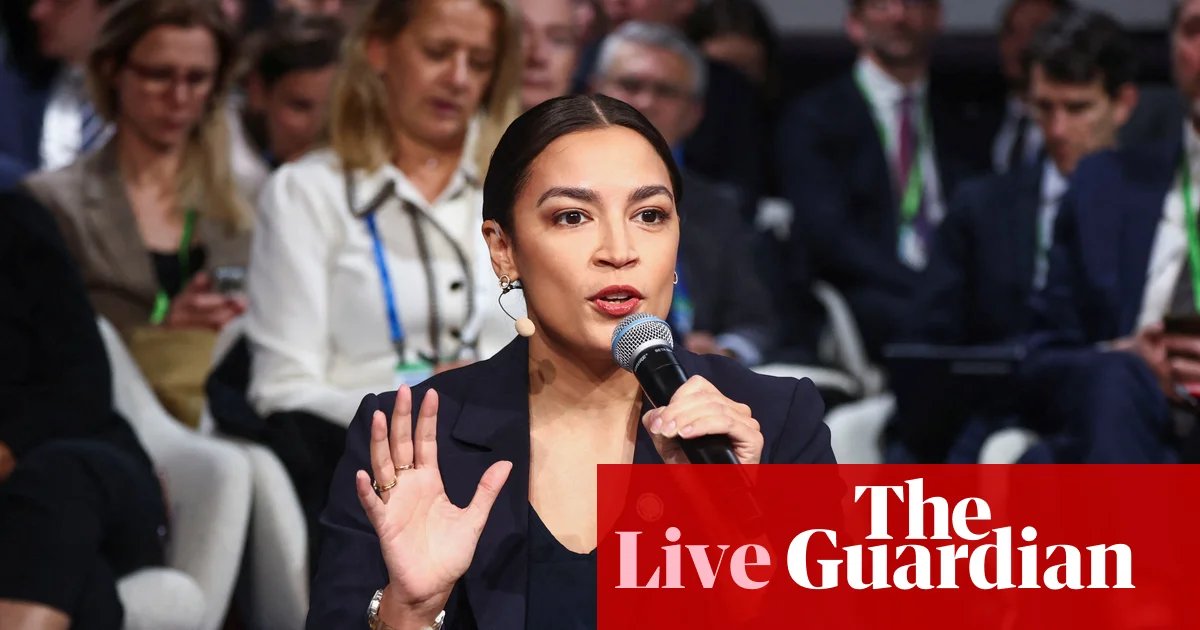
Trump is ‘tearing apart’ transatlantic partnership, ‘ripping up’ democratic norms, Ocasio-Cortez warns
In the Q&A, Ocasio-Cortez gets asked about her presence in Munich and the signal she wants to send by being involved in these discussions here.
She says:
“I think this is a moment where we are seeing our presidential administration tear apart the transatlantic partnership, rip up every democratic norm, and … really calling into question, as was mentioned by Mark Carney at the World Economic Forum, the rules based order that we have, or, question mark, do we have?”
She lays out her pitch for the need to address hypocrisies in the international order:
“But that does not mean that the majority of Americans are ready to walk away from a rules-based order and that we’re ready to walk away from our commitment to democracy.
I think what we identify is that in a rules-based order, hypocrisy is vulnerability.
And so I think what we are seeking is a return to a rules-based order that eliminates the hypocrisies … when, too often, in the West, we’d look the other way for inconvenient populations to act out these paradoxes, whether it is kidnapping a foreign head of state, whether it is threatening our allies to colonise Greenland, whether it is looking the other way in a genocide.
Hypocrisies are our vulnerabilities and they threaten democracies.
And so I think many of us are here to say we are here and we are ready for the next chapter, not to have the world turn to isolation, but to deepen our partnership on greater and increase commitment to integrity to our values.”
She gets good reception from the audience here with a round of applause.
Share
Updated at 17.32 GMT
Key events
15m ago
Trump is ‘tearing apart’ transatlantic partnership, ‘ripping up’ democratic norms, Ocasio-Cortez warns
36m ago
Trump repeats his endorsement of Hungary’s Orbán hours after Merz’s criticism
1h ago
MSC Townhall room packed as Ocasio-Cortez makes Munich debut
2h ago
Trump ‘most destructive president’ ever, Newsom says
2h ago
Watch out for Macron’s language on Europe and nuclear deterrence – snap analysis
3h ago
Europe needs strength to face new global ‘disorder,’ Denmark’s Frederiksen says in diplomacy push
3h ago
Palpable US-EU tension on how new world order could look like – snap analysis
4h ago
US under Trump ‘returning world from the brink,’ Waltz insists as he rejects criticism
4h ago
Trump will ‘do for UN what he’s done for Nato’ over last decade, US Waltz says
4h ago
Merz’s speech will set tone of Munich talks on reshaping US relations – snap analysis
4h ago
Merz’s Hungary comments will spark reaction – snap analysis
4h ago
‘I don’t want to lose you,’ Germany’s Merz tells EU candidate countries
4h ago
Russia not yet willing to talk seriously about Ukraine, Merz warns
4h ago
Europe needs to resolve its ‘self-inflicted’ dependency on US to rebalance transatlantic relations
4h ago
‘In era of great power rivalry, even US will not be powerful to go alone’, Merz says
4h ago
Merz rebukes US criticism of Europe
4h ago
‘If Europe is torn apart, we are torn apart,’ Merz talks on EU alliances
4h ago
Merz calls for discussion on EU’s ‘mutual assistance’ clause
4h ago
‘Big power politics’ in Europe is not an option for Germany, Merz says
5h ago
‘Turn switch in our minds’ to make Europe superpower and face chaos of new world order, Merz says
5h ago
World order as we know it ‘no longer exists,’ Germany’s Merz warns
5h ago
MSC’s Ischinger puts leaders on spot as he lists pointed ‘serious’ questions
5h ago
Munich Security Conference gets under way
5h ago
‘Ladies and gentlemen, please take your seats now’
5h ago
Nato’s Rutte expects Rubio to press Europeans to ‘take more leadership role’ in alliance
6h ago
Zelenskyy welcomes first joint Ukrainian-Germany drone manufacturing line
6h ago
Focus on Ukraine with Zelenskyy, foreign minister Sybiha attending side events
6h ago
German chancellor Merz arrives ahead of his Munich speech
6h ago
What does Europe’s future look like? – Q&A with Jon Henley
6h ago
‘No shah, no mullah’ Iran protest outside Munich conference
7h ago
US Rubio expected to speak with Danish, Greenlandic leaders on sidelines of Munich conference
7h ago
Key events of the day
7h ago
What to expect from 2026 Munich Security Conference? – video
8h ago
Nato’s Rutte talks up ‘shift in mindset’ among leaders as he warns against falling for Russian propaganda
8h ago
EU’s von der Leyen, Nato’s Rutte arrive for talks in Munich
8h ago
We only see tip of iceberg as Munich becomes place to do business this weekend – snap analysis
8h ago
Rubio lands at Munich airport ahead of key speech
8h ago
Europeans ‘want honesty, want to know where we are going’, Rubio says ahead of Munich speech
9h ago
Morning opening: World order ‘under destruction’
9h ago
Opening Summary
Show key events only
Please turn on JavaScript to use this feature
Trump repeats his endorsement of Hungary’s Orbán hours after Merz’s criticism
Speaking of populists, US president Donald Trump has repeated his endorsement of Viktor Orbán this afternoon – just hours after pointed criticism of the Hungarian leader from the German chancellor, Friedrich Merz (14:30, 14:34, 14:39).
In a post on Truth Social, Trump said Orbán is “a truly strong and powerful leader, with a proven track record of delivering phenomenal results.”
“Relations between Hungary and the United States have reached new heights of cooperation and spectacular achievement under my Administration, thanks largely to Prime Minister Orbán,” he said.
In a chaotically capitalised post, he concluded:
“I was proud to ENDORSE Viktor for Re-Election in 2022, and am honored to do so again. Viktor Orbán is a true friend, fighter, and WINNER, and has my Complete and Total Endorsement for Re-Election as Prime Minister of Hungary — HE WILL NEVER LET THE GREAT PEOPLE OF HUNGARY DOWN!”
The Hungarian election is scheduled for 12 April.
Share
Czech president Petr Pavel is next and he gives an interesting view on why populism has been spreading in central and eastern Europe.
He says:
“I believe that number of people in former communist countries believed that with the change of the system, they would achieve all the benefits of capitalism while keeping all the benefits of socialism.”
He said when they realised that “not everyone will get rich, there will always be people who will be better off … then that frustration … created a lot of tensions and frustration, taken forward by people offering short-term, nice solutions that they [would] never [have to] deliver on.”
He also says, without naming names, that “the experience [shows] that when these people, who used to be for a long time … on the critical side, … are put in a position where they have the responsibility to deliver, they suddenly understand the complexity of situation and they change a lot of their … extreme positions that they held before.”
Share
EPP’s Manfred Weber – one of the most powerful centre-right politicians in Europe – talks about the practical experience of centre-right parties taking on the far-right in Europe, specifically referencing Poland’s Donald Tusk and his 2024 win over the Law and Justice government.
He says as a general rule, EPP is not prepared to work with “parties which do not follow the three pros, so pro-Europe, pro-Ukraine, pro-rule of law.”
He quotes the EPP’s decision to kick Hungary’s Viktor Orbán out of the grouping as a proof of that commitment.
But he admits that it’s clear that the way to respond to populism and growing frustration among voters is to “give proper answer to their concerns and take it seriously,” as he attacks the socialists in the European Parliament for not supporting the EU’s controversial migration plans.
He says Europe “cannot continue to follow a … left-leaning political approach on migration,” which in his view is “feeding extremism and populism,” and needs to show its responding to people’s concerns.
He warns that “we have to solve problems; otherwise, the next European elections in 2029 will be a big festival for the far-right extreme [parties], and [we need] to avoid it.”
Share
Ocasio-Cortez says she sympathises with some of the working-class people who turn towards far-right parties in desperation, as she can relate to their frustration as it’s something she experienced too.
Alexandria Ocasio-Cortez (D-NY) speaks during the Munich Security Conference in Munich, Germany. Photograph: Liesa Johannssen/Reuters
But she says “what we are seeing over the last eight years has been a growing recognition that of those past errors,” and there is an “increased recognition that we have to have a working class centred, politics, if we are going to succeed and stave off the scourge of authoritarianism,” which is fuelled as people find “scapegoats to blame for rising economic inequality.”
She gets a question on whether she’s ready to pursue a wealth tax when she runs for US presidency – but she doesn’t take the bite.
“I don’t think that anyone and that we don’t have to wait for any one president to impose a wealth tax. I think that it needs to be done expeditiously,” she says.
Share
Updated at 16.57 GMT
MSC Townhall room packed as Ocasio-Cortez makes Munich debut
Jakub Krupa
in Munich
I have just had a quick walk around the hotel going to my next session. It’s absolutely packed and buzzing – and not always inside the actual meeting rooms.
As mentioned earlier, there is a lot of activity happening on the margins (10:53), and you can see ministers and officials meeting in small groups to chat on the corridors of the Bayerischer Hof.
But the room I am in now is packed as US congresswoman Alexandria Ocasio-Cortez makes her Munich debut in a panel on populism.
She is joined by European centre-right EPP grouping’s president Manfred Weber, Czech president Petr Pavel, and Argentinian lawmaker Daiana Fernández Molero.
Share
Trump ‘most destructive president’ ever, Newsom says
Meanwhile, California governor Gavin Newsom is blasting Donald Trump on the main stage, saying the US president is “doubling down on stupid.”
“Never in the history of the United States of America has there been a more destructive president than the current occupant in the White House in Washington, DC,” he says.
He says Trump “is trying to recreate the 19 century.”
“We’re proving at scale that we can implement, we can compete and we can dominate, but Donald Trump is trying to turn back the clock.”
He strongly says:
“I hope, if there’s nothing else I can communicate today, Donald Trump is temporary. He’ll be gone in three years,” he asserts.
He says the climate crisis is hitting Americans directly, as “people are burning up, choking up, heating up; we have simultaneous droughts and floods, historic wildfires.”
“In California, it’s a big blue state, but also has more Republicans than most Republican states, and we have long moved beyond the partisanship on this issue, because there is no Republican thermometer, there’s no democratic thermometer. There’s just reality.”
Remember: Newsom is talked about as a potential Democratic candidate in 2028.
Share
Watch out for Macron’s language on Europe and nuclear deterrence – snap analysis
Jakub Krupa
in Munich
Two things to look out for in Macron’s speech later tonight is how he talks about his big idea of advancing European sovereignty and what, if anything, he says on nuclear deterrence, mentioned by Merz (14:15).
The French president has just arrived here – although, presumably much to MSC’s Ischinger’s disappointment, he is no longer wearing his Davos aviator sunglasses (13:39).
French president Emmanuel Macron (C) arrives to attend the 62nd Munich Security Conference in Munich, Germany. Photograph: Thomas Kienzle/AFP/Getty ImagesShare
There is lots of smaller sessions coming up now, involving California governon Gavin Newsom, Sweden’s prime minister Ulf Kristersson, and EU tech commissioner’s Henna Virkunnen (11:32).
And then, obviously, Emmanuel Macron is on at 7pm local time (6pm UK).
ShareJakub Krupa
in Munich
Stubb is such a standout public speaker. You can feel that the room is following his contributions very closely (and that’s not always a given at this sort of conferences).
Finland’s president Alexander Stubb takes part in the 62nd Munich Security Conference in Munich, Germany. Photograph: Johannes Simon/Getty Images
Despite coming from a relatively small country, he has established in recent months as one of Europe’s key leaders on a number of issues, from trade to US ties.
It probably helps that he has genuinely deep understanding of the US as he completed part of his education there and, oh yes, he sometimes plays golf with Trump giving him the nickname of “Trump whisperer”.
In between giving serious, thoughtful answers on serious topics, he is effortlessly plugging in Finland’s Nokia as a potential replacement for Huawei and joking about his birthday in a way that is rare – and so refreshing – at this level of politics.
One has to wonder if there is a scenario in which he gets picked for a senior EU or international job in the future.
But his presidential term only ends in 2030, so let’s hope there will be some international organisations left by then.
Share
Back on the conference stage they are still broadly discussing trade issues, but Stubb has just been essentially asked by a Ukrainian journalist along the lines of “based on Finland’s experience, how to sort Russia out.”
He offers a strong answer as he says:
“I’m not going to give you advice, but I think you’re winning this war, and the reason I say this is that Putin has failed strategically.
He wanted to make Ukraine Russian; it became European. He wanted to prevent the enlargement of Nato; he got Finland and Sweden, and he wanted to keep our defence expenditure down, and it’s now going up to 5%.
Secondly, he’s losing on the military front. Remember that when the war began, Russia acquired 12% of Ukrainian territory. That’s 12 years ago. Since then, 8% in the past two years, 1% in December, Ukraine was able to kill 34,000 Russian soldiers they were not able to recruit back.
So my answer is, just keep on what you’re doing, and at the end of the day, you will prevail and win this war.”
He gets very good reception in the room with a round of applause from the attendees.
Share
Updated at 15.15 GMT
Europe needs strength to face new global ‘disorder,’ Denmark’s Frederiksen says in diplomacy push
Away from the conference hall, a lot of focus is on Denmark and their strong presence here in Munich.
It’s no coincidence that Merz pointedly mentioned the Danish PM Mette Frederiksen and the European support for her in his speech.
Frederiksen is here, joined by her foreign and defence ministers, and it’s their first big event of this sort where they can engage with the US and other partners since the Greenland crisis.
As mentioned earlier, she is due to host talks with Rubio over Greenland (11:41), among others.
Norway’s finance minister Jens Stoltenberg, Denmark’s prime minister Mette Frederiksen and Lithuania’s president Gitanas Nauseda speak prior to a panel discussion during the Munich Security Conference in Munich, Germany. Photograph: Michael Probst/AP
Remember: the Danes skipped Davos last month altogether, so they are now very active here – and hit very similar tones to those expressed by Merz earlier.
For her part, Frederiksen spoke with the FT earlier today (£), warning that Europe needs an “emergency mindset” to face the new world order focused on sheer power.
She warned that “a Europe that is not able and willing to protect itself is going to die at some point”.
“Unfortunately, strength is one of the weapons that is useful in this new world disorder and therefore Europe has to be strong enough.”
We will hear from her on the main stage tomorrow twice: once on transatlantic relations, and then on Arctic security.
Share
Discussing trade, Finland’s Stubb gets asked on his advice for other countries to secure their future in this new, emerging world order.
He semi-jokes saying “join the European Union, it gives you protection.”
He says that became even clearer after Trump’s threat on Greenland, as he couldn’t just impose tariffs on some EU countries, “because it’s then 25% for the European Union.”
He says smaller countries or middle powers should “lean in and support the multilateral trade organisations” to give them some protection.
Earlier, WTO’s chief Ngozi said that while she “may not agree with the US [on unilateral actions],” she agreed “with a lot of their criticism of the system.”
“I would like to say is that the system has not evolved, has not been quick to change and respond to the changing world, and some of those criticisms about it not functioning well, are good,” she said.
She said more needs to be done, but also stressed that “in spite of the massive disruption of the system, the biggest [undermining of global trade rules] we’ve seen in the past 80 years, … the system is proving resilient.”
Share
The next main stage conference is on “tariff-ying times” we are facing – eye-roll for that awfully cheesy pun – amid the weaponisation of trade for other purposes.
German finance minister Lars Klingbeil and Finnish president Alexander Stubb are among the panellists.
They are joined by WTO director general Ngozi Okonjo-Iweala and US senator Thomas Roland Tillis.
I will keep an eye out for main news lines for you.
Share
Palpable US-EU tension on how new world order could look like – snap analysis
Jakub Krupa
in Munich
It was a very interesting panel, and in a certain way it perfectly captured the key issue of the new world order emerging from chaos as you could genuinely feel some tension between Waltz and Kallas there.
It’s pretty rare too see that in public events at this level.
The key question is whether the Saudi minister’s optimistic prediction will come true or will things unravel first before they get better (or not).
Both Merz’s speech earlier and this panel will only raise the interest in Rubio’s speech tomorrow.
Share
Saudi foreign minister Faisal bin Farhan Al Saud seeks to put a positive spin on the debate so far as he says that “finally, we are being, all of us, honest with each other.”
“We don’t agree yet, but we’re actually having the conversation,” he says.
“Everybody is saying how they really feel about the system and how it didn’t work from their perspective,” he says.
He neatly (and optimistically) sums it up:
“It will take us some time to actually get to a point where we agree on what the future system is going to look like, and how the burden sharing is going to work, and how [to preserve] equality of states, even though there is a disparity in interests and in capacity, is going to be addressed.
But I think over time, with some pain – as I mentioned, there will be some pain in the process of getting there – I think we will be in a better world.”
And that ends this panel.
Share
In the Q&A, Waltz gets asked whether the US is still committed to European defence amid reports of possible US troop reductions.
Waltz says that’s “absolutely” the case.
But he says that “the American people have underwritten, with their hard earned dollar, the global multilateral rules based order since the second world war,” but growing issues caused by debt mean “it is fair on their behalf to ask 450 million Europeans with the same size economy as the United States to be more self sustaining in their own defence.”
He says:
“When I go to people in Indiana and Georgia and North Florida that I represented, and it is their money paying more than 180 countries combined into the UN system. I have to look at them honestly and say it’s being well spent, and it’s not.”
He then repeats the progress made on Nato’s funding arrangements in the last decade, and points to Trump’s expansive foreign policy agenda as a proof that the US still believes in multilateralism.
As he explains, “we’re asking the rest of the world to be there with us in a fair way financially, because there is a cost to the status quo, and the status quo was not sustainable any more.”
Kallas comes in and says that she rejects Europe is not doing its bit, as it massively contributes financially.
She then spells out another element of “multilateralism” means, stressing that difference between Russia and the US is that “when Russia goes to war, they go alone because they don’t have allies,” and “when America goes to wars, then a lot of us go with you and we lose our people on the way.”
“So, that means that you also need us in your you know to be this superpower,” she says.
Share
EU’s Kallas slightly pushes back on that brag from Waltz, as she says that “it is very good that you want to reform the international order,” but points out that international organisations should be operating based on equality of states.
She also points out that, despite what Waltz claimed, Trump’s Board of Peace is only UN-backed in its narrower, Gaza-focused and time-limited mission.
Waltz kind of takes some of these points, but expresses his frustration with the lack of action as “the US has historically paid more than 180 countries combined” when it comes to the UN, and “I have to look at mechanics, doctors, nurses, firefighters … struggling to get their kids to school, and yet I have UN officials flying business class around the world.”
He says “no one was doing it” when it comes to reforming international bodies, but “talked about it endlessly, [with] strongly worded letters.”
He repeats his earlier line saying that “what I’m hearing outside forums like this, privately, is thank you for American leadership.”
Share
