

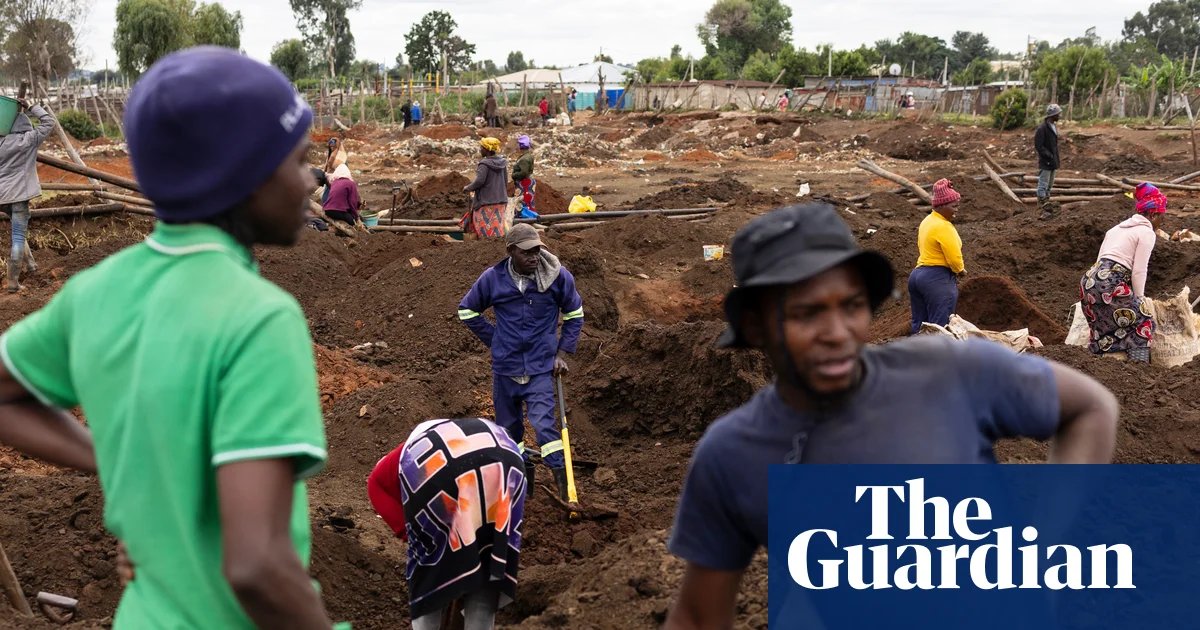
In a township 30 miles east of Johannesburg, a mechanical digger filled in holes in the dark brown earth, bringing to an end a brief but intense gold rush that saw dozens of fortune seekers descend on what was once a cattle field.
Less than two weeks ago, a rumour spread like wildfire on social media: someone had found gold while digging a hole for a fence post in a field on the edge of Gugulethu, an informal settlement of dirt roads and metal shacks on the outskirts of mining town Springs.
Many of Gugulethu’s jobless residents got to work digging. Prospectors also came from hundreds of miles away, from Limpopo province to the north and the city of Rustenberg to the north-west, said local councillor Dean Stone.
By Wednesday 18 February, authorities from the wider Ekurhuleni municipality had clamped down on what was deemed to be illegal mining. Three people were arrested, mining equipment was confiscated and diggers and dumper trucks were brought in to fill the trenches.
“Reports of gold being discovered remain unverified and are currently speculative,” the City of Ekurhuleni said in social media posts.
The frenzy contains echoes of the creation of Johannesburg, which mushroomed out of farmland when gold was discovered in 1886 and is now home to more than 6.5 million people. Springs was founded in 1904 after gold was struck there in 1899 and its centre is filled with faded art deco buildings that recall its prosperous past.
Gold rush miners clean soil in hope of finding gold deposits. Photograph: Kim Ludbrook/EPA
The lure of gold has become brighter again in the last year, with the price soaring above $5,000 (£3,710) an ounce as investors flocked to “safe haven” assets amid market volatility triggered by US president Donald Trump’s tariffs.
The short, sharp gold rush in Gugulethu, which has a population of about 11,500, also reflects the desperation of many South Africans. Unemployment is 42%, and almost 38% live below the official poverty line of about £65 a month.
“We are hungry, there are no jobs,” said Nomsa Jamangile, 19, who dug out 15 bags of soil from the township field, with her sister Thokozile and two of their friends.
The group did strike gold, said Thokozile, using the tip of her index finger to demonstrate the amount. They split their 2,000 rand (£92.12) takings four ways and bought food, while Thokozile also paid 260 rand for a month of transport for her five-year-old daughter to get to primary school.
A miner pans for gold. Photograph: Kim Ludbrook/EPA
“We are sad,” she said, when asked how she felt about the government stopping them from digging. “We want the government to help us, to give us a job so we don’t sell our bodies,” said her sister Nomsa.
“They’re in a dire situation,” said Stone. “There’s no employment, especially for the youth. Kids [aged] 10, 11, were digging [and] the parents. It’s tragic.”
The national mining ministry said on Monday that it “strongly condemns the recent illegal mining activities,” adding miners needed licences and “support and assistance are available to artisanal and small-scale miners who wish to operate within the legal framework.”
Dean Stone, a local councillor whose ward includes the informal settlement of Gugulethu. Photograph: Rachel Savage/The Guardian
“How do you expect someone from Gugulethu, who lives in a shack, who hasn’t got a vehicle, can go all the way there [to Johannesburg to apply for a licence]?” Stone said. “Surely the department can send somebody there?”
Not all of Gugulethu’s residents were sad that the gold rush had ended. Sandi Tshona, who had grazed his 18 cattle on the fenced field (known as a kraal), said he and his fellow farmers allowed people to start digging outside, but they soon forced their way into the field. “After that, it was uncontrollable,” the 48-year-old said.
South Africa’s gold production peaked in the 1970s, although it was the world’s top producer until 2007. The Witwatersrand region is now littered with mine dumps and abandoned shafts, many now mined by illegal miners known as ‘zama zamas’ (which loosely means ‘take a chance’ in Zulu). Analysts estimate there are 30,000 zama zamas, producing 10% of the country’s gold.
Beige ridges, the remains of abandoned goldmines, rise up either side of Gugulethu. On one side of the settlement, the flat earth before the mine dump is bleached white from chemicals used to separate gold from soil and water.
The old mines are now controlled by foreign zama zamas armed with guns, said a city official, who was not authorised to speak to the press. South Africa’s president, Cyril Ramaphosa, said in his annual state of the nation address earlier this month that the military would be deployed to crack down on gangs, organised crime and illegal mining.
Police have periodically cracked down on zama zamas, sometimes with fatal consequences. In January 2025, more than 90 bodies were pulled from a 1.2 mile-deep gold shaft in Stilfontein, 100 miles south-west of Johannesburg, after police blocked supplies being sent down to the men.
