

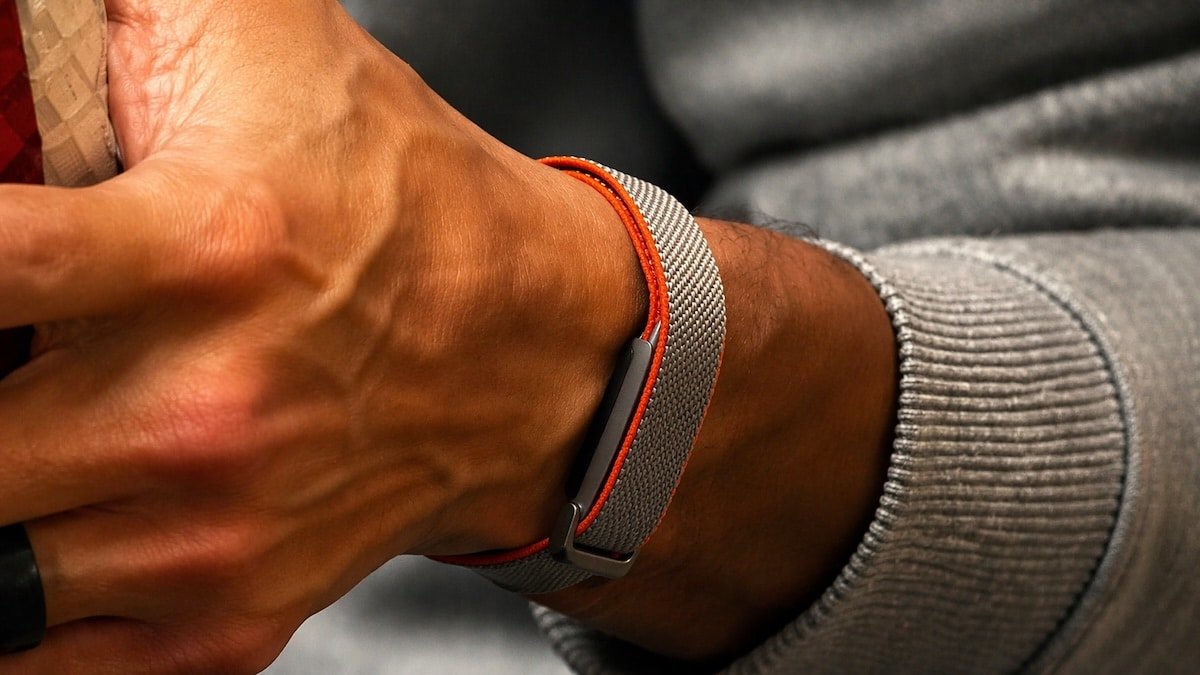
Google’s upcoming Fitbit Air is shaping up as a thin, screenless recovery band expected to launch at around $100, with passive health tracking and app-based insights doing most of the heavy lifting. It looks clean, lightweight and modern, but the more details that emerge, the harder it becomes to see what is actually new here.
A familiar idea in a slimmer package
A lot of the early excitement around Fitbit Air comes from how different it looks compared to a typical smartwatch. Based on what we have seen so far, there is no display, the tracker body sits neatly under the strap and the whole thing looks very discreet.
But Fitbit has been here before. Its early identity was built on simple, app-first bands like the Flex, where the wearable itself stayed in the background and the app handled the real experience. In that sense, Fitbit Air feels less like a bold new direction and more like a return to old ideas with cleaner hardware.
That is not necessarily a bad thing because plenty of people do not want another bright screen on their wrist. They already wear a mechanical watch, a Garmin or something else and simply want background tracking without extra distractions.
The problem is that this concept is no longer fresh. Whoop already owns the recovery band conversation, Oura dominates the discreet wellness category through smart rings and Garmin covers the serious training crowd with deep performance metrics.
Fitbit Air is entering a space where the strongest players are already well established. That makes the launch feel more like catching up than leading, even if the product itself ends up being solid.
The real product is probably software
The thing is, it’s not just about hardware. Whoop’s biggest advantage is not the strap itself. It is the software platform built around recovery, strain, sleep analysis and daily coaching.
Users pay for the interpretation of the data, not just the collection of it. The band is simply the access point, while the value comes from how useful and consistent the insights feel over weeks and months.
That is why Fitbit Air’s rumored connection to a wider Google Health platform may matter more than the hardware. If Google is replacing Fitbit Premium with something broader and genuinely more useful, that could end up being the real story behind this launch.
If not, Fitbit Air risks becoming a nice-looking band with very little reason to choose it over a current smartwatch or smart ring. People have already shown they are willing to pay for recovery insights, but only if those insights actually help them change behavior.
Google has struggled with this before. Fitbit hardware often looked good, but users pushed back when the software felt too limited or when useful features sat behind another subscription wall.
If that happens again, excitement will disappear quickly. A thinner strap cannot fix weak software.
A $100 price tells its own story
The expected price of around $100 makes Fitbit Air much easier to approach than something like Whoop, especially if Google avoids a heavy monthly subscription model. That lower entry point could be a plus.
At the same time, the price also suggests expectations should stay realistic. This is unlikely to be packed with advanced sensors or major new health technology that changes the category.
It will probably rely on familiar tools like heart rate tracking, sleep monitoring, activity data and recovery estimates, all wrapped inside a better-looking and more discreet form factor. That is useful, but it also means the real value has to come from interpretation rather than raw data.
The very thin design raises another practical question, battery life. Recovery wearables work best when users forget they are there, and that only happens if charging stays out of the way. There is only so much battery you can physically fit inside a very slim device.
Comfort matters and a lightweight design absolutely helps. But comfort alone is not enough to make people excited about a new wearable.
Good product, limited excitement
Fitbit Air could still be a perfectly sensible product for the right user. It may be comfortable, affordable and exactly what some people want as a second wearable that quietly tracks recovery in the background.
That is especially true for people who already wear a traditional watch or a larger sports watch and do not want another bright display on the wrist. In that case, a slim recovery band makes complete sense.
But being sensible is different from being exciting. Right now, the strongest argument for Fitbit Air seems to be that it is thinner, simpler and cheaper than the alternatives.
That can absolutely sell products, but it does not create much launch energy. For a brand that once helped define consumer fitness tracking, many people were probably hoping for something that felt bigger and more ambitious.
Instead, Fitbit Air looks like a polished version of an idea the market already understands. Useful, maybe, but not especially surprising.
Subscribe to our monthly newsletter! Check out our YouTube channel.
And of course, you can follow Gadgets & Wearables on Google News and add us as a preferred source to get our expert news, reviews, and opinion in your feeds.
