

Our modern internet is fast—really fast. Personally, I’ve been enjoying Gigabit internet speeds for a few years now, a far cry from the 33.6Kbps internet connection I started out on in the late ’90s.
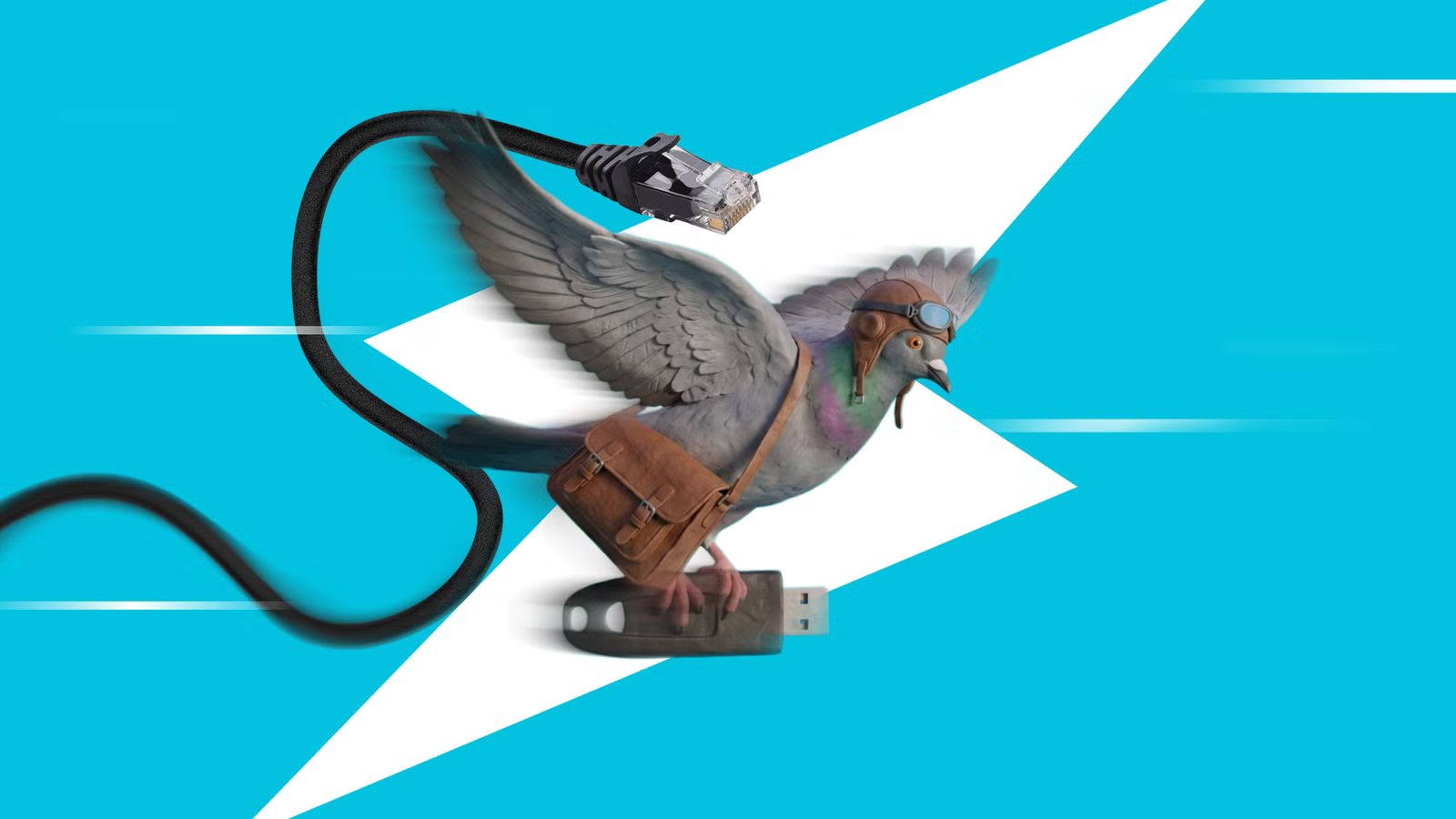
Yet, there’s one infamous test that I think even our fast modern internet can’t beat—strapping storage to a carrier pigeon.
The pigeon test wasn’t a joke—it was an indictment
There’s no hiding from the ugly truth
Credit: samoila ionut/Shutterstock.com
It all happened in my home country of South Africa. For many years, we only had a single state-owned phone company, which was notorious for offering poor service. The technology press took great pleasure in ripping our only phone company to shreds in the press, especially later when they started to get some real competition.
In 2009, as per Reuters, a company pulled a publicity stunt where a carrier pigeon named Winston carried a 4GB flash drive 60 miles, while the same data was sent using the state’s internet service provider.
The data carried by the pigeon was downloaded and ready to use in just over two hours. Meanwhile, during that same time, the internet transfer only managed to move 4% of the data. Pretty embarrassing for the state ISP, assuming anyone who worked there was able to experience shame.
Related
This tiny memory card is actually an NVMe SSD (Here is why)
This finger nail-sized storage drive is finally usable
Bandwidth and latency are not the same thing
Networks can be confusing sometimes
The interesting thing about the pigeon stunt is that it clearly shows the difference between bandwidth and latency. Latency in this case is how long it takes from your request for a download to where the first bit of data arrives. Whereas the bandwidth describes how much data you can move in a given amount of time, usually measured per second.
Credit: Shutterstock/asharkyu
Winston had terrible latency, but moving 4GB of data in two hours comes out to around 4.5Mbps, which isn’t exactly broadband by modern standards, but quite respectable for the time.
Ironically, latency today is still pretty much as good as it was in 2009 for all practical purposes. We might now have connections with single-digit latency (measured in milliseconds), but from a human point of view, even 100ms of latency on an old DLS connection wouldn’t make much real-world difference for a web page, or a file transfer.
Storage density kept the meme alive
We keeping packing more bits in the same space
Credit: Jordan Gloor / How-To Geek
Bandwidth today blows Winston’s old record out of the water, but it’s not only internet speeds that have improved. Storage has become much, much more dense. The biggest thumb drive you can buy as I write this clocks in at a cool 8TB.
That gives us two thousand times the storage that Winston was carrying at a similar weight and size. Which would have pushed that 4.5Mbps effective bandwidth to 9Gbps. That’s probably faster than your internet, unless you’re one of the lucky few people in the world who have 10Gbps internet at home.
But 8TB isn’t our limit. I looked up how much weight a carrier pigeon can safely carry, and it seems like 30g is a good number that won’t overload the poor bird. Two 8TB M.2. SSDs (sans the optional heatsinks) come in at less than 20g, leaving enough for the harness. So that’s potentially 18Gbps of effective bandwidth over the same two-hour flight.
Related
When an HDD dies, it destroys data—when an SSD dies, it saves it
Stop putting your important files on HDDs—do this instead
Of course, the longer the flight takes, the lower that pigeon bandwidth number becomes, but maybe we can do even better if we don’t care about storage speed. In 2024, SanDisk announced an 8TB SD card (as per TechRadar) which you still can’t buy as far as I can tell, but we know it actually exists.
A standard SD card (the big ones) weighs 2g. So with our same 20g budget, we could have ten of these cutting-edge SD cards, totaling a whopping 80TB of data. In fact, I bet we could squeeze in a few more without overloading our bird, but at this point it probably doesn’t matter how far it has to fly, the effective bandwidth will still likely be faster than any home internet connection.
It’s hilarious that the pigeon test still holds true
I’m not mad, I’m impressed
Storage density will keep going up, so unless internet speeds rapidly outpace that process, I think the carrier pigeon will probably always have the edge. At least within the practical radius of how far such a bird can fly, which is apparently between 600 miles for the average sky-rat and 1000 miles per flight, for the most elite birds.
Of course, there is a bit of a point to all this silliness. Even today, data centers and other large organizations will still send information on physical disks inside trucks or planes, because you can stuff petabytes of information in the volume of a typical minivan. It’s completely impractical to send that much information using even the fastest enterprise-grade networking.
It’s also why it’s often just faster to carry a flash drive from my computer to my wife’s instead of using a NAS or sending her a link to my Google Drive! Maybe I’ll experiment with strapping a hard drive onto my dog.
