

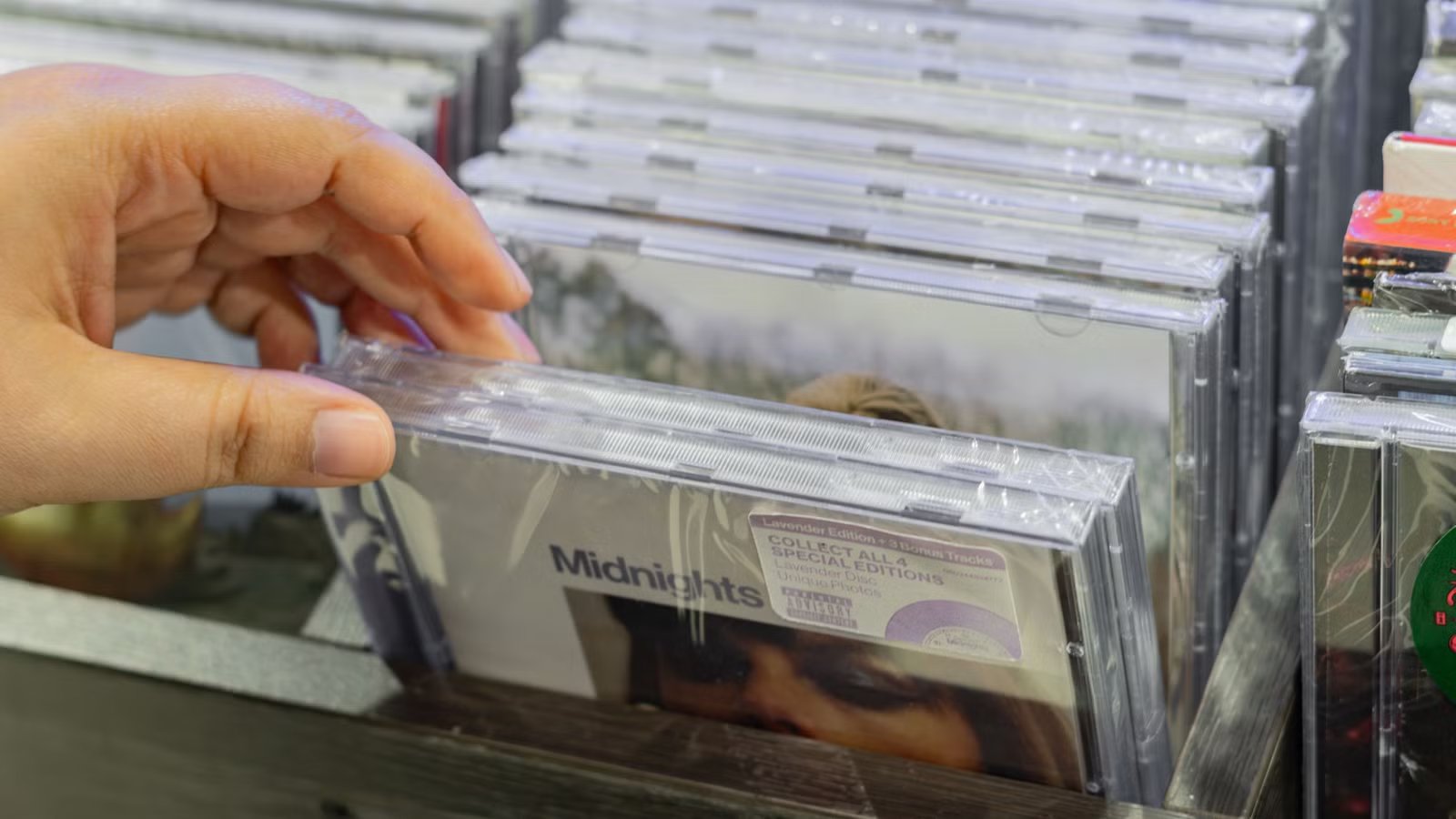
Physical media is having a bit of a revival at the moment, and vinyl is getting a lot of attention with claims about its supposed superiority over digital audio. Music CDs, on the other hand, have received a more muted revival.
This is a little odd to me, given that as impressive as vinyl is, CDs are far more impressive both as an audio medium and as pure technology. Considering the level of consumer technology at the time, it might as well have been from outer space.
The compact disc was a physics flex from day one
Credit: Blossom Stock Studio/Shutterstock.com
When CDs and CD players hit the market in the early 1980s, they wiped the floor with vinyl and cassettes. I still remember when we moved from a vinyl record player to CDs in the early 1990s. My dad bought a new Hi-Fi that included a CD player, and the vinyl we’d been listening to up to that point now sounded positively unlistenable to me.
Learning how CDs worked when I was a kid was mind-blowing. A laser beam fires at the surface of the CD where pits and lands either reflect or diffuse it. This represents binary code, which in turn consists of a digital audio file. Our computer at home hadn’t even been upgraded to the newer 1.44MB floppy disks yet, and here was a shiny disc that held 650MB of data!
I remember spending hours with headphones on, listening to my parent’s CD collection in the 90s. No hiss, no pops, and absolute clarity in the audio. It’s a big reason I was so surprised to see new vinyl enthusiasts extoll the virtues of that medium. Clearly they must be hearing something I’m not. Whether what they hear is real or not, there is a question for another day.
CDs solved problems we forgot were problems
Credit: Jordan Gloor / How-To Geek
One of the reasons CDs seem “boring” today is that they solved so many pain points so thoroughly that we stopped thinking about them.
The first is durability. Both vinyl and tape cassettes wear down with every play. This means the quality of the audio gets worse with every repeat. Under normal use, the audio on a CD will always be perfect, and play in exactly the same way.
CDs are less fragile than vinyl. I still remember the day my dad ripped my copy of The Offspring’s Americana out of the hi-fi and threw it against the wall. I was none too happy since it was the first album I had bought for myself, but the disc was no worse for wear. A vinyl would have shattered, and a cassette would have spilled its guts so badly no amount of pencil-twirling would save it.
Dust on a CD just means you have to clean it properly. On a vinyl or tape it causes noise and artifacts in the sound. If you handled your CDs correctly, scratches weren’t an issue, but if you did scratch a CD, as long as it wasn’t in the actual data layer, the built-in error-correction system could usually deal with this on the fly without you noticing.
My parents have plenty of CDs from the 90s that work just fine today, and while there are rare issues like disc rot, in general a CD should last longer than you if you store and handle it correctly.
They quietly powered the PC revolution
Credit: Jordan Gloor / How-To Geek
But, music is only half the story. CDs completely blew up computer technology. The leap from 1.44MB floppies to 650MB CDs was so enormous that it changed things overnight. Video games came alive, and I had whole encyclopedias on CD with video clips and endless articles to read.
Optical media were so crucial to the development of computer technology, that it’s abandonment in the PC world took me by surprise. Though who knows? Optical media might make a comeback to PCs one day, and it hasn’t left gaming consoles quite yet either. Though ironically, the PlayStation 5 lacks CD support.
The tech inside a CD is still impressive today
The technology in CDs, and the DVDs and Blu-ray discs that came after them is still incredibly impressive today. Consider this image shared by YouTuber Ben Krasnow showing the surface of these disc technologies under an electron microscope.
Credit: Ben Krasnow
This is one thousandth of a millimeter scale, and we were using these discs in the 80s? That’s just incredible in retrospect. The whole system has so many parts that have to work perfectly in sync. The speed of the disc’s spin has to be just right, and you need a small memory buffer to ensure there’s no break in the data stream.
Today people think of CDs and other optical media as obsolete, but they’re often still the best quality media you can find for audio and video, in the case of DVD and Blu-ray. There’s no online requirement, no question over ownership, and if you use the right type of writable discs, it might even be the best long-term way to store your own data. CDs and their direct successors haven’t yet had the last laugh, and we should respect this space-age 80s technology even now.
