

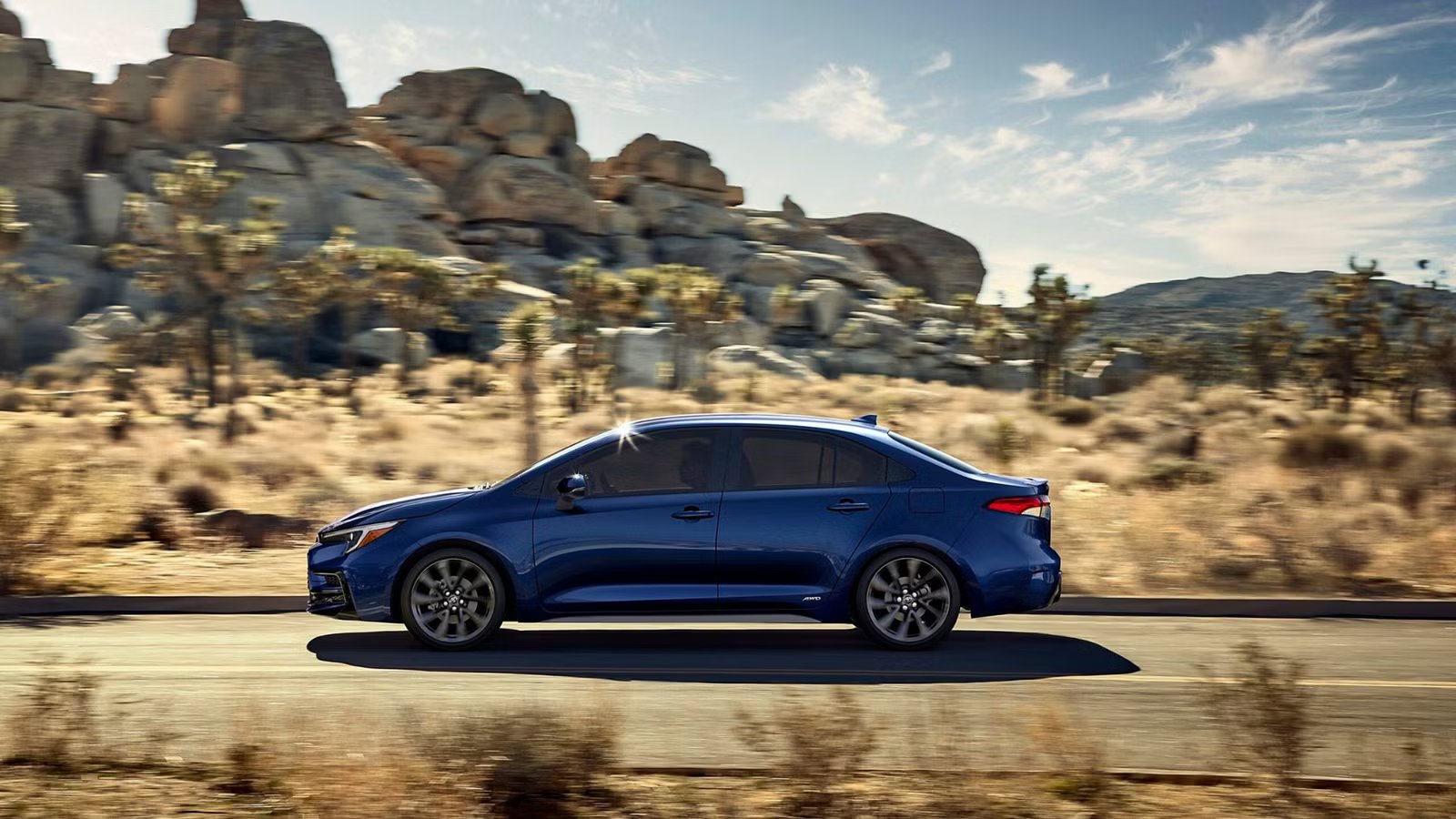
If you’re in the market for a compact hybrid sedan, there’s a good chance the Honda Civic Hybrid and Toyota Corolla Hybrid are both on your shortlist. They’re two of the most obvious choices for drivers who want efficiency and practicality without moving into SUV territory.
At first glance, there’s not much separating them, and both do the basics really well. But the Corolla Hybrid brings a few extra advantages that make the comparison more interesting than it first appears.
Those small differences start to add up when you look closer, and they could be enough to tip the decision in Toyota’s favor.
In order to give you the most up-to-date and accurate information possible, the data used to compile this article was sourced from Honda and Toyota, as well as other authoritative sources including J.D. Power, Kelley Blue Book, NHTSA, and CarBuzz.
Related
10 Hybrid Vehicles That Are Much Faster Than You’d Expect
Hybrid vehicles are no longer just about fuel efficiency—they can pack serious speed too.
Where the Corolla Hybrid edges ahead of the Civic Hybrid
The details that could sway the decision between the two
2026 Toyota Corolla Hybrid
2026 Honda Civic Hybrid
Powertrain
1.8-liter inline-4 + 1/2 electric motors
2.0-liter inline-4 + 2 electric motors
Power
138 hp
200 hp
Torque
105 lb-ft
232 lb-ft
Transmission
CVT
CVT
0–60 mph
10.3 seconds (FWD) / 9.7 seconds (AWD)
7.9 seconds
Top speed
107 mph
112 mph
On paper, the Corolla Hybrid and Civic Hybrid don’t look all that different. They’re both sensible, fuel-efficient family cars you’ll see everywhere, built around the same idea of low running costs and long-term reliability.
But there are a couple of key differences that start to separate them. The big one is all-wheel drive, which the Corolla Hybrid offers for drivers who want extra confidence in wet or snowy conditions.
The Civic Hybrid sticks with front-wheel drive only, while Toyota gives buyers the option of AWD for a relatively modest extra cost. It’s not a magic fix for bad roads, but it does make the Corolla a more flexible choice in tougher weather.
Credit: Toyota
There’s also a clear price gap that leans in Toyota’s favor. The Corolla Hybrid starts at $24,975, while the Civic Hybrid comes in higher at $29,395 for the sedan and $30,595 for the hatchback, before destination charges are added.
Even once you factor in the $1,400 cost for AWD, the Corolla still undercuts the Civic by a noticeable margin. In a segment where small price differences matter, that extra headroom gives Toyota a strong value advantage.
Related
10 Best Bang for Your Buck Hybrids on the Market Today
These 10 hybrids offer the best mix of efficiency, features, and value, proving you don’t have to spend big to get great fuel economy.
Corolla Hybrid vs Civic Hybrid: which is cheaper to run
How both models compare once fuel, maintenance, and reliability are factored in
Credit: Toyota
Reliability data for the Corolla Hybrid and Civic Hybrid is often bundled into their wider model lineups, which makes it harder to separate hybrid-specific performance from the broader range. Even so, both cars—and their families as a whole—carry strong reputations for dependability.
For the 2026 Toyota Corolla, J.D. Power gives it a Quality and Reliability score of 81/100. The hybrid model’s NHTSA record shows no current recalls or complaints, although earlier model years since its 2020 debut have seen four recalls covering areas like seat belts, stability control, steering, and braking.
Looking at running costs, Kelley Blue Book estimates the Corolla Hybrid’s five-year total ownership cost at $37,071. That breaks down into roughly $5,167 for fuel, $15,550 for insurance, $3,418 for financing, $4,452 in state fees, $6,804 for maintenance, and about $1,680 for repairs, or around $336 per year.
Credit: Honda
The 2026 Honda Civic carries a J.D. Power Quality and Reliability score of 84/100, slightly ahead of the Corolla on paper. Its NHTSA record is tied to the broader Civic lineup, including non-hybrid versions, and the 2026 model shows no recalls but does have 16 complaints.
The hybrid system itself is still relatively new, introduced for the 2025 model year, which has recorded two recalls and 51 complaints. These issues relate mainly to a fuel pump leak and steering-related concerns.
When it comes to running costs, the Civic Hybrid is very close to the Corolla Hybrid. Kelley Blue Book estimates its five-year ownership cost at $35,612, broken down into about $7,221 for fuel, $14,835 for insurance, $3,364 for financing, $4,402 for state fees, $4,123 for maintenance, and around $1,667 for repairs (roughly $333 per year).
Even with those similar figures, the Corolla Hybrid still holds the advantage thanks to its lower entry price and the option of affordable AWD. Taken together, that combination makes Toyota the more flexible overall choice.
Related
Why the 2026 Honda Accord is the best value sedan you’ve overlooked
One safety feature really stands out.
Inside the Corolla Hybrid: engine, cabin, and technology
How Toyota balances efficiency, comfort, and everyday usability
Credit: Toyota
The 2026 Toyota Corolla Hybrid uses a 1.8-liter inline-four engine paired with an electric motor to deliver a combined output of 138 horsepower. In front-wheel-drive models, a single motor handles assistance, while AWD versions add a second rear-mounted motor that kicks in when extra traction is needed.
Inside, the focus is on everyday comfort and usability rather than flash. Available features include heated front seats, ambient lighting, and dual-zone climate control, depending on trim level.
The hybrid is only offered as a sedan, which helps with rear-seat legroom compared to the hatchback. You do lose a bit of trunk space as a result, but the rear seats fold down to add flexibility when needed.
Credit: Toyota
The Corolla Hybrid’s infotainment setup starts with an 8.0-inch touchscreen as standard, with a larger 10.5-inch display available on higher trims. Apple CarPlay and Android Auto come included, making it easy to mirror your phone for navigation, music, and apps.
Other available tech includes a subscription-based Wi-Fi hotspot and four USB-C ports, which help keep devices charged on longer drives. Wireless charging and a JBL audio system are also offered if you want to step things up.
Because the hybrid powertrain is limited to LE and SE trims, it comes with a 7.0-inch digital driver display. Higher trims like the XSE and XLE get a larger 12.3-inch screen, but those are reserved for non-hybrid versions.
Related
The 5 most efficient new cars in 2026 under $30,000
These cars prove efficiency doesn’t have to be expensive.
Why hybrid cars make more sense than ever right now
Efficiency, cost savings, and practicality are reshaping buyer decisions
Credit: Toyota
Over the past 20 years, hybrid cars have gone from a niche option to a mainstream choice for drivers across the US and beyond. They’ve built a reputation for combining everyday practicality with lower running costs and a more efficient way of getting around.
A big part of that appeal comes down to fuel efficiency. With fuel prices staying high, mileage matters more than ever for most buyers, and hybrids are designed to deliver strong economy without changing how you drive.
Take the 2026 Corolla Hybrid as an example, which returns up to around 50 mpg combined. While hybrids can cost more upfront due to their more complex powertrains, that efficiency helps balance things out over time by reducing day-to-day fuel spend.
Credit: Toyota
Hybrids also aren’t the slow, boring options they used to be. Electrification can actually improve responsiveness thanks to instant electric torque, and hybrid tech is now used everywhere from everyday commuter cars to high-end performance models.
They also sit in a useful middle ground between traditional petrol cars and full EVs. You still get lower running costs and reduced emissions, but without needing to change how you use the car day to day or worry about charging.
For most drivers, that makes life simpler. There’s no range anxiety, no reliance on charging infrastructure, and just the convenience of filling up and driving as normal.
On top of that, hybrids tend to produce fewer emissions than equivalent petrol models, which makes them an easier fit for buyers who are trying to cut their environmental impact without going fully electric.
