

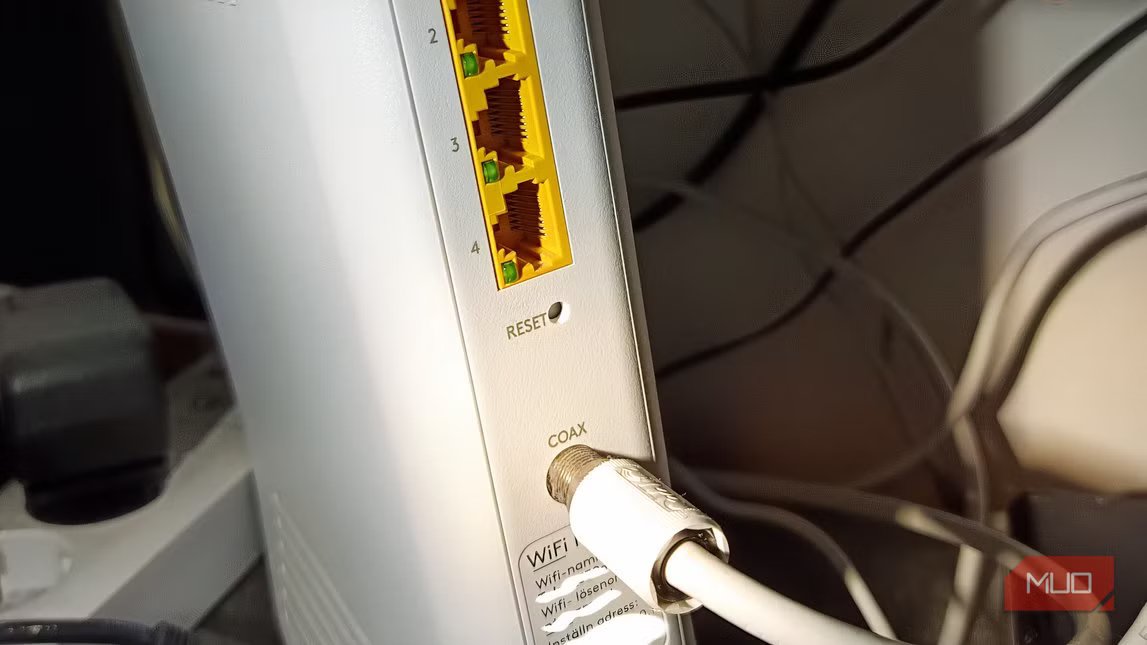
If you think coaxial cables only exist to deliver bad daytime TV and sports channels you never asked for, you are not alone.
Most people have no idea that the same cable quietly screwed into their wall can also deliver fast, stable internet. Even fewer people realize that a lot of us are running our entire digital lives on it.
But it can absolutely be done, and I’d even say more people should consider it, as I get a steady 100/50 Mbps connection into my home, and never have any connection issues.
What internet over coax actually is
It doesn’t have to be fiber to be fast
Credit: Roine Bertelson / MakeUseOf
The internet via coax uses the same physical cable that brings cable TV, if you don’t want to stream at home. Remember that thick, round, stubborn cable? Inside that cable lives a copper core surrounded by shielding that is very good at carrying high-frequency signals without turning them into noise soup.
Instead of just blasting TV channels one way, internet providers use a standard called DOCSIS to send data both down to you and back up to the network. That means emails, video calls, cloud syncs, streaming, backups, and yes, endless browser tabs. The internet arrives as radio signals riding inside the coax cable. Your cable modem listens, decodes, responds, and hands the data over to your router. From there, it behaves like any other home network. It’s nothing magical; just very well optimized old tech doing new tricks.
Your internet does not travel over coax the entire way across the country, as that would be a nightmare. Instead, providers use a hybrid fiber-coaxial network, where fiber carries data at insane speeds from the provider’s core network to a neighborhood node. From that node, coax takes over for the last stretch into homes.
That final stretch is where most people connect. So, the fiber connection is used for long-distance transmissions, whereas the coax is used for local distribution. Furthermore, coax is efficient, proven tech that’s already installed in millions of buildings—you might even have this tech in your home without realizing.
We remember cable TV and associate coax with the past, in part because marketing departments have trained everyone to think that only fiber equals modern internet speeds. The reality is that modern coax connections can easily deliver hundreds of megabits per second and, in many cases, hit gigabit download speeds, meaning 4K streaming, huge file downloads, internet for every device, and all without breaking a sweat.
The part where coax still lags behind fiber is uploads. That is not a flaw. It is a design choice rooted in history.
Why coax is faster for downloading than uploading
Don’t forget about the stability of your connection
Cable networks were originally built for one-way traffic. TV went down to you, and nothing went back up the cable. The internet changed that, but the infrastructure still favors downloads. That is why many coax plans still deliver much faster downloads than uploads.
Now, for most households, that is perfectly fine. Most are downloading more than they upload by way of streaming, browsing, updates, cloud app access, and so on. All of these uses lean heavily on download speed, with minimal requirements for uploads. However, coax might not be the best option for you if you upload large files, are into online gaming, require frequent cloud syncs, and similar.
But, with that said, I run my “normal” digital life using the internet over coax and very rarely run into any problems with speed, and it suits my daily use. Another feature of the internet over coax I really value is the stability of the connection, which, as someone who works from home, is incredibly valuable.
Coax is thick, shielded, and resilient. It does not mind electrical noise, and it does not mind the weather as much as people think. Furthermore, it’s physically tougher than fiber in many real-world installations, and once it is working, it tends to just keep working. Latency is slightly higher than fiber but well within acceptable ranges for video calls, gaming, remote work, and creative workflows. Unless your local network is overloaded, it feels solid and predictable.
Coax is shared around your neighborhood
Something many people don’t realize about coax is that internet delivered using this method is shared at the neighborhood level. That doesn’t mean that other people can see what you’re doing on your home network, but it does mean that everyone connected to the same local node effectively shares a bandwidth pool. You’ve probably already twigged what this means: when everyone is online, your speeds can take a beating.
Competent internet over coax providers manage and mitigate against these issues with built-in network redundancy, and in reality, most people never really notice a significant dip in speed. As you might expect, coax speed issues tend to center on peak hours and then drop off later in the evening. Although this is less than ideal, it’s far from the mess some make it out to be.
Related
I Use These Tricks to Get the Fastest Internet From My Router
This is how I get faster speeds without upgrading my internet plan.
Why I run coax at home and why I won’t be changing it soon
Who coax internet is actually for
If you’re like me, you’ll have several different internet connection options to choose from. However, I appreciate that’s not the case for everyone. But if you have coax available, it’s worth considering for a few reasons:
- Availability: It’s already coming into your home, so why not give it a try?
- Speed: Internet over coax can typically deliver more than enough speed to work, create, stream, sync, and experiment without thinking about your connection.
- Consistency: I don’t know about you, but I’d rather have boring, reliable internet than theoretical perfection that isn’t installed in my building yet.
In that, coax especially makes sense if:
- You do not have fiber access yet
- You want fast downloads without premium pricing
- You value stability over bragging rights
- You work from home and need a predictable performance
- You do not upload terabytes every day
The thing is, coax isn’t new or flashy, so people don’t think about it. But it is there in the background, quietly getting on with the work, and that’s something I truly appreciate.
