

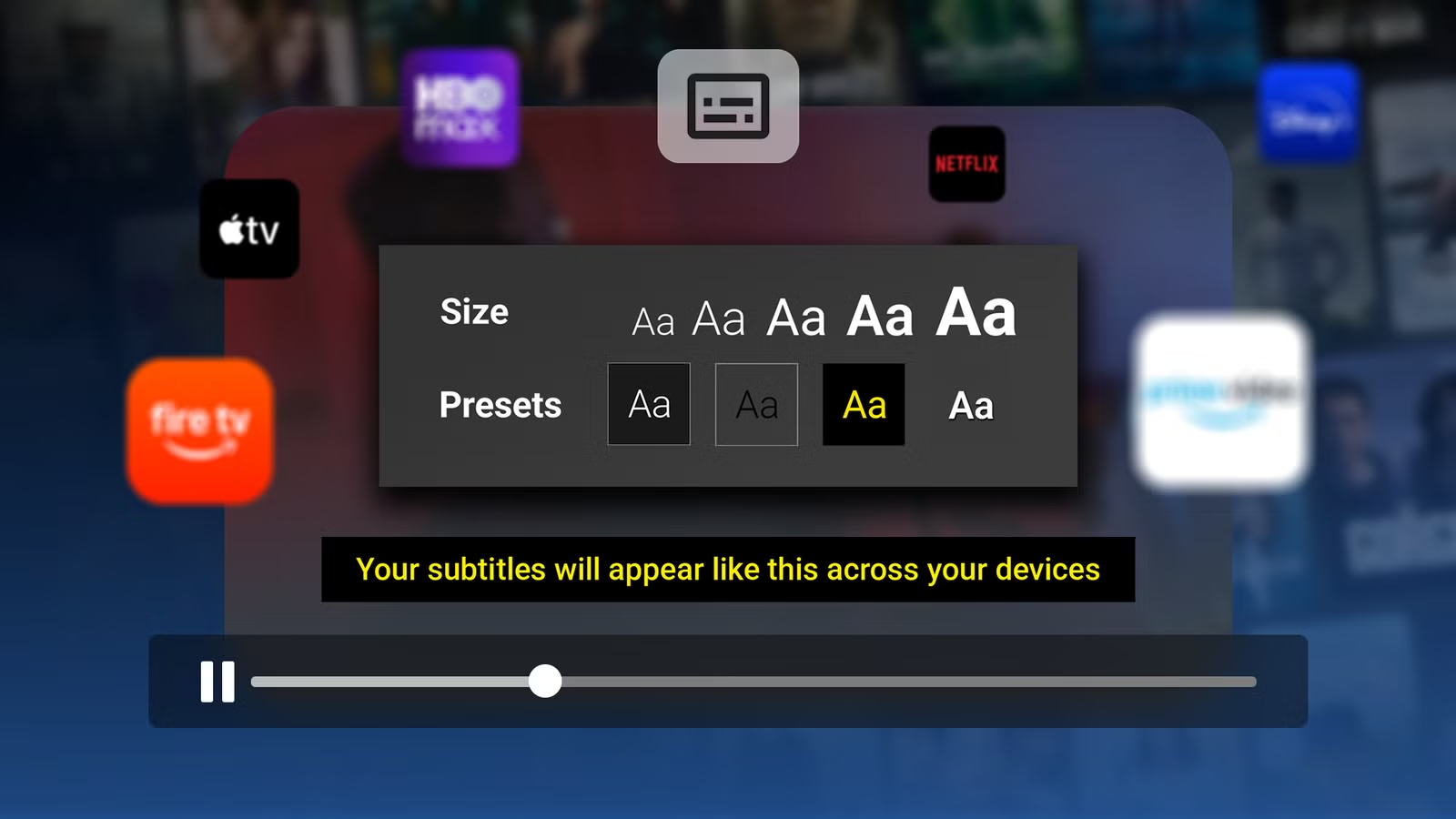
As a person of a certain age who played in loud bands, went to loud concerts, and has reviewed more than his fair share of albums and loud audio products over his career, I’ll admit that subtitles are a regular necessity of my TV-watching routine.
But regardless of one’s hearing deficiencies, and other factors like age or language preferences, subtitles have become a default for a growing number of viewers, especially younger people. In fact, a 2025 study conducted by the Associated Press revealed that 40% of U.S. viewers aged 18 to 44 years old watch with subtitles “always or often.”
I use them because, yes, my hearing isn’t what it used to be. But I also find them extremely useful to catch quick-moving dialog, say, involving characters with heavy accents, unpredictable audio mixing that buries dialog under everything else, and when I want to keep the volume down during late-night TV sessions.
Another fun part of getting older is when your eyes start to go, and you also need to increase the text size or visibility of those handy subtitles. Sadly, finding the settings and preferences to adjust them across the wide range of streaming devices and streaming services isn’t so easy. We’re here to help. Here’s how to adjust subtitle text on the biggest streaming services.
Device-level subtitle adjustment
One subtitle setting to rule them all … sort of
Credit: Derek Malcolm/How-To Geek
Before getting into specific streaming services and apps, it might be best to point out that while most make subtitle customization fairly painless, once you know where to look, the paths to them vary more than they should.
As a general rule, if subtitles are something you know you want to have consistently on across all your streaming apps, all the major devices have system-level subtitle and captioning settings that you can set and that sometimes override in-app defaults across all your streaming apps at once.
With all of them, you can customize things like fonts, font size, font color, background color, opacity, edged style, highlights, and more. You can also create new styles and save them as presets.
For Apple TV: On the Apple TV device, go to Settings > Accessibility > Subtitles and Captioning > Style. Here you’ll be able to adjust all kinds of subtitle formatting options.
For Fire TV: Open the Settings menu and choose Accessibility > Closed Caption, where you’ll find menu items for text, text background, and more.
For Roku: From the Settings menu, select Accessibility > Captions style for a wide range of options.
For Android TV: From the Settings menu, navigate to Device Preferences > Accessibility > Captions.
For Google TV: From the Home Screen, select Settings > Accessibility > Caption preferences > Caption size and style.
Be aware that some apps like Netflix have their own subtitle settings that are unaffected by this, while others rely on these system-level settings.
Netflix
Profile-based settings that sync across all your devices
Credit: Lucas Gouveia/How-To Geek
As mentioned above, Netflix takes care of its own subtitle preferences, which are tied to your account profile, and can be adjusted differently for each. The best way to make these changes is through a web browser, which will sync across the Netflix apps on all your devices.
- At Netflix.com, log in to your account and select your profile.
- From the dropdown menu, select Account > Profiles > and then the profile you want to change.
- Under Subtitle Appearance, you’ll find a range of great modifications you can make—from text size, font, and text color to adding drop shadowing and background colors to make text stand out over busy images.
- Make the changes you want, which you’ll be able to preview before hitting save.
- You can always choose Restore to Default if you want to start again or walk away.
- The changes will take effect across your profile on all your signed-in devices.
On smart TVs or streaming devices like Apple TV, Fire TV Stick, or Roku, depending on your app’s version, you may also be able to access these settings by pausing a video you’re watching, and choosing the gear icon.
Prime Video
Save presets that you can switch between during playback
Credit: Lucas Gouveia/How-To Geek
Amazon Prime Video offers one of the more flexible subtitle systems, allowing you to save multiple style presets and switch between them during playback, often across several devices. Like Netflix, though, one of the best ways to adjust and personalize them is on the web.
- In a web browser, while a video is playing, you can click or tap the Subtitles & Audio icon (speech bubble) in the upper-right corner of the player.
- Select Subtitles Settings from the menu.
- Here you can adjust font size and choose from four presets.
To build and manage those presets so you can access them on the other devices and apps that allow it, though, the best way to adjust is on the web. Log in to primevideo.com and through your profile, go to Account & Settings > Subtitles, where you can edit up to four saved presets.
HBO Max
Different options depending on how you’re watching
Credit: Lucas Gouveia/How-To Geek
Adjusting subtitle settings on HBO Max (beyond just turning them on and off, etc.) varies depending on how you’re watching.
On the web: At hbomax.com, click your profile, then go to Settings > Subtitle Style to adjust font, color, size, and opacity.
On TV and mobile devices: Select the Audio and Subtitles icon during playback for basic styling. For size controls and more, this is handled at the device level (see the top of this post).
Disney+
Access subtitle options from various points
Credit: Lucas Gouveia/How-To Geek
Disney+ has several different ways to adjust subtitle formatting depending on how you’re watching.
On mobile devices that run iOS and Android, they’re accessed through the system’s Settings > Accessibility menus.
On smart TVs, you can access it while watching a video. Press pause and then select the Audio & Subtitles menu that appears at the top right. Then select the Subtitle Styling option.
Apple TV and Fire TV also use their system-level preferences that can be accessed through their Settings > Accessibility and captioning options.
If you watch Disney+ through a web browser, you can access them by pausing a video and selecting Audio & Subtitles in the top right corner. A Gear icon will appear, which will lead to the Subtitle Styling settings. Make your style adjustments and click the back arrow to continue watching.
Credit: Derek Malcolm / How-To Geek
Hulu
Multiple subtitle options across your viewing entry points
Credit: Jordan Gloor/How-To Geek
If you’re watching Hulu through Disney+, then you can use the same steps above. If you’re using the Hulu standalone app or Hulu online, it’s pretty similar, too.
On smart TVs and supported streaming devices, from the Home screen, scroll left or select Back to access the Settings > Subtitles & Captions.
On mobile devices like iOS and Android, you can find them through the Settings and Accessibility menus under Subtitles & Captioning/Captions.
Through a web browser, it’s found through the Settings icon > Subtitles & Audio > Settings.
Paramount+
Mostly player-based, with universal device overrides
Credit: Lucas Gouveia/How-To Geek
For Paramount+, subtitle customization is available directly from the player on most devices, but it can also use your device’s system settings (see the top of this post for how). Some devices, like Apple TV, allow you to access and adjust those settings from within the Paramount+ app itself.
On smart TVs and streaming devices, during playback, click the speech bubble icon in the upper-right corner, or bottom right. Depending on your device, you will have different options for adjusting subtitle formatting. The Apple TV device, for example, lets you access some style presets as well as gives you a path to accessing the device’s universal settings through Manage Styles.
On the web, you can access subtitle options through the Settings > Subtitles + Audio menus.
On smart TVs like Hisense, LG, and Samsung, go through the Paramount app’s Settings > Closed Captions menus.
Credit: Derek Malcolm / How-To Geek
Apple TV
No in-app controls, it’s all handled at system levels
Credit: Lucas Gouveia/How-To Geek
Unlike every other service here, Apple TV has no in-app subtitle size controls. It defers entirely to system-level settings, which do apply globally.
On an Apple TV device, go to Settings > Accessibility > Subtitles and Captioning > Style. This will affect all streaming apps that use the universal settings.
On iPhone or iPad, go to Settings > Accessibility > Subtitles & Captioning > Style and customize from there.
On a Mac, Go to Apple menu > System Settings > Accessibility > Captions.
Credit: Derek Malcolm / How-To Geek
Most streaming services make subtitle customization fairly painless, once you know where to look. As a general rule, if a service feels limited on your TV, check your streaming device’s system-level accessibility settings. On Roku, Fire TV, Apple TV, and most Android TV devices, a single caption style preference can override in-app defaults across all your streaming apps at once.
Subscription with ads
Yes, $8/month
Simultaneous streams
Two or four
Live TV
No
Price
Starting at $8/month
