

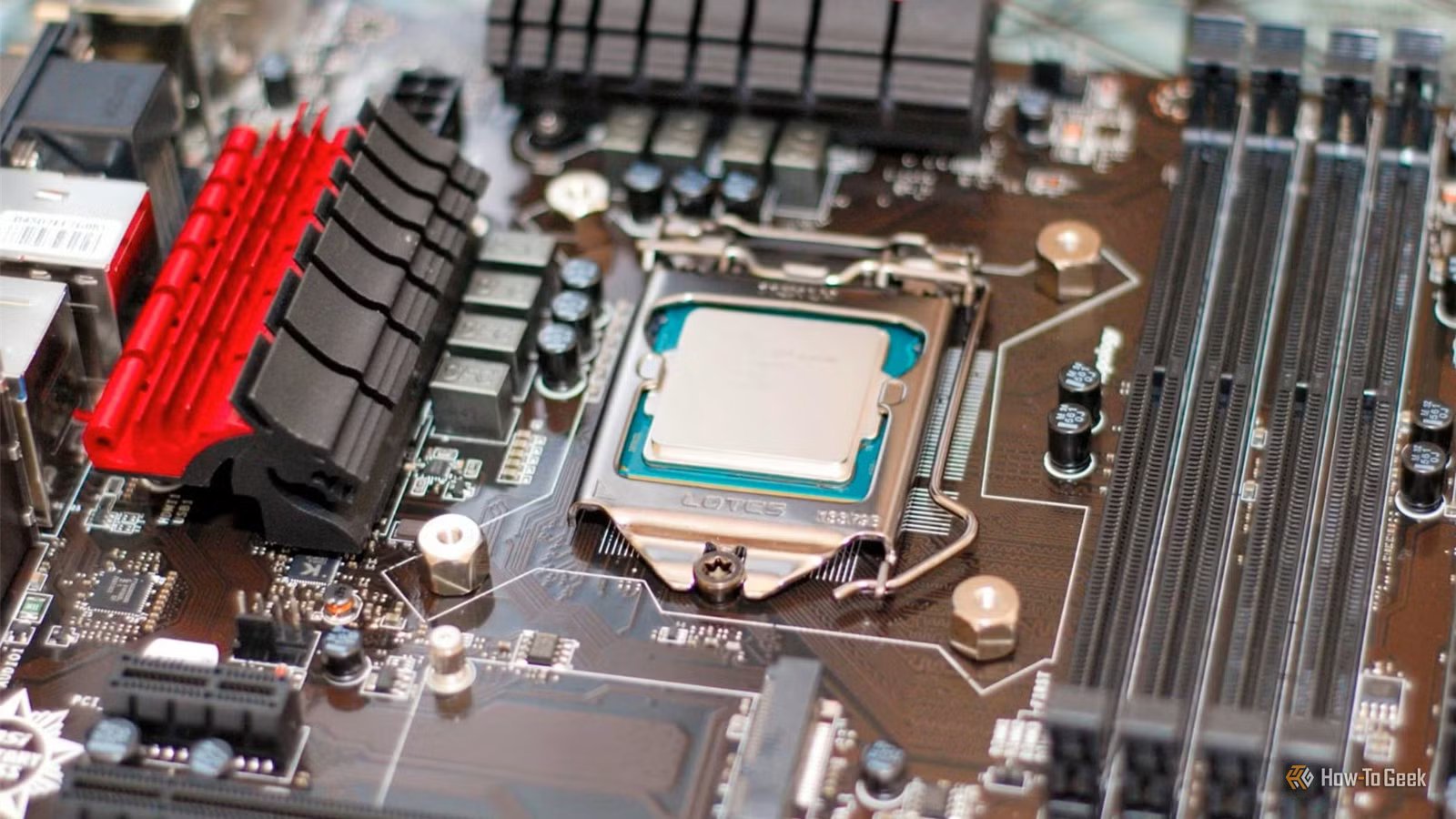
Desktop PCs are super upgradeable—that’s one of their biggest perks. But if there’s one upgrade that feels like a chore and actually is a chore, it’s the processor.
Swapping out your CPU usually means doing the same with the motherboard, and that can pull along a host of different upgrades. Before you know it, you’ve spent a few hundred dollars.
However, as a PC builder of 20 years, I’m here to tell you that you probably don’t need a new CPU. At the very least, check out these common bottlenecks before buying a new processor.
A CPU bottleneck isn’t always a CPU problem
It’s funny how that works, right?
The CPU is often the first part to catch some flak when something goes wrong in your PC. It’s either that or the GPU, and just like many people believe that graphics cards age poorly, many are quick to jump on the “CPU bottleneck” bandwagon.
And sure, if there’s something wrong with your CPU, you can bet that the entire PC will feel it, and soon. But more often than not, it’s just the CPU reacting to a problem somewhere else.
A lot of these problems don’t show up as obvious failures, either (thankfully). It’s not like your entire PC goes up in flames. Apps still launch, frame rates in games may look alright, and Task Manager may look fine. But if your PC is choppy, inconsistent, underperforming, or, worst of all, crashing, it’s easy to blame the CPU. However, the CPU may not even be the culprit.
That’s why CPU troubleshooting needs to be broad. Looking at the big picture, including memory, storage, and temperatures, should be the first step here.
Quiz
8 Questions · Test Your Knowledge
DIY PC building
Trivia Challenge
From socket types to cable chaos — test your knowledge of building computers from scratch.
HistoryHardwareTroubleshootingQuirksTips
Begin
What year did Intel release the first consumer processor that popularized the DIY desktop PC market — the Intel 8086?
A1972B1975C1978D1981
Correct! The Intel 8086 launched in 1978 and gave birth to the x86 architecture still used in PCs today. It was a 16-bit processor running at 5–10 MHz — a far cry from today’s multi-GHz giants. This chip laid the foundation for decades of DIY computing.
Not quite — the Intel 8086 debuted in 1978. It introduced the x86 instruction set that still underpins virtually every desktop and laptop processor sold today. IBM later used the cheaper 8088 variant for its first PC in 1981, which is sometimes confused as the origin point.
Continue
When building a PC, what does ‘POST’ stand for in the context of the boot process?
AProcessor Output Self TestBPower-On Self-TestCPrimary Operating System TransferDPower Output Signal Threshold
Correct! POST stands for Power-On Self-Test, a diagnostic routine your motherboard runs every time you boot up. It checks that critical components like RAM, CPU, and GPU are present and functional. If POST fails, you’ll often get beep codes or LED indicators to help diagnose the problem.
The correct answer is Power-On Self-Test. Every time you press the power button, your motherboard runs POST to verify that essential hardware is connected and working. Failed POST is one of the first hurdles new PC builders encounter, often caused by unseated RAM or a forgotten power connector.
Continue
Why do experienced PC builders recommend touching a metal part of the case before handling components?
ATo warm up your hands for better gripBTo check if the case is properly grounded before installingCTo discharge static electricity from your bodyDTo magnetize your fingers for handling small screws
Correct! Static electricity built up on your body can silently destroy sensitive PC components in an instant — a phenomenon called electrostatic discharge (ESD). Touching bare metal grounds you and neutralizes that charge before it can zap your CPU or RAM. Anti-static wrist straps work even better for extended build sessions.
The answer is to discharge static electricity. Your body can carry thousands of volts of static charge without you feeling a thing, but that invisible zap can permanently damage a CPU or RAM stick. It’s one of the oldest and most important safety habits in PC building — cheap insurance for expensive parts.
Continue
A newly built PC powers on, fans spin, but there’s no display output. What is the MOST common first thing to check?
AReplace the CPU thermal pasteBEnsure the monitor is plugged into the GPU, not the motherboardCReflash the BIOS using a USB driveDCheck the SATA cables are firmly connected
Correct! This is arguably the most common rookie mistake in PC building — plugging the monitor into the motherboard’s video output when a dedicated GPU is installed. The motherboard’s HDMI or DisplayPort is disabled by default when a GPU is present. Always connect your display directly to the graphics card.
The most common culprit is having the monitor plugged into the motherboard’s video port instead of the dedicated GPU. When a graphics card is installed, most systems disable the motherboard’s integrated video outputs automatically. It’s such a frequent mistake that it has become a running joke in PC building communities.
Continue
What is the purpose of thermal paste when installing a CPU cooler?
AIt acts as an adhesive to hold the cooler in place permanentlyBIt fills microscopic imperfections between the CPU and cooler to improve heat transferCIt insulates the CPU from electrical interference caused by the coolerDIt lubricates the cooler’s fan bearings for quieter operation
Correct! Even finely machined metal surfaces have tiny imperfections and air gaps at the microscopic level. Thermal paste — also called thermal interface material (TIM) — fills those gaps to ensure maximum heat conduction from the CPU to the cooler. Without it, air pockets act as insulation and temperatures can skyrocket dangerously.
Thermal paste fills microscopic gaps between the CPU lid and the cooler’s base plate. Metal surfaces may look flat and smooth, but at a microscopic scale they’re riddled with tiny ridges and valleys that trap air — and air is a terrible heat conductor. A thin, even layer of thermal paste eliminates those gaps and keeps temperatures in check.
Continue
The ATX motherboard form factor, which became the standard for DIY desktop PCs, was introduced by which company and in what year?
AAMD in 1990BASUS in 1993CIntel in 1995DIBM in 1988
Correct! Intel introduced the ATX (Advanced Technology Extended) standard in 1995, replacing the older AT form factor. ATX standardized component placement, power supply connectors, and airflow direction — making DIY builds far more practical and interchangeable. Nearly 30 years later, ATX and its derivatives like Micro-ATX and Mini-ITX still dominate the market.
ATX was introduced by Intel in 1995. It was a major leap forward from the previous AT standard, defining a common layout for motherboards, cases, and power supplies that made mixing and matching components from different vendors straightforward. That standardization is a huge reason DIY PC building became so accessible.
Continue
When installing RAM into a motherboard with four slots, where should you install two sticks to enable dual-channel mode on most boards?
ASlots 1 and 2 (the first two slots nearest the CPU)BSlots 1 and 3, or slots 2 and 4 (alternating slots)CSlots 3 and 4 (the two slots farthest from the CPU)DAny two adjacent slots work equally well
Correct! Dual-channel mode requires RAM to be installed in matched pairs on alternating slots — typically A2 and B2, or slots 2 and 4. This allows the memory controller to access both sticks simultaneously, effectively doubling memory bandwidth. Your motherboard manual will show the exact recommended slots, usually color-coded for convenience.
To enable dual-channel mode, RAM should go in alternating slots — such as slots 2 and 4, often color-coded on the motherboard. Placing both sticks in adjacent slots (like 1 and 2) forces single-channel operation, which can noticeably reduce performance in memory-intensive tasks. Always check your motherboard manual for the exact recommended configuration.
Continue
What is ‘coil whine’ in the context of a newly built gaming PC?
AA rattling sound from an improperly secured case fanBA high-pitched noise produced by electromagnetic vibration in inductors under high electrical loadCThe sound of a CPU cooler fan spinning at maximum speed during stress testsDNoise caused by the hard drive’s read/write head seeking data rapidly
Correct! Coil whine is a high-pitched, sometimes whirring or buzzing noise caused by tiny electromagnetic coils (inductors) on a GPU or PSU vibrating at audible frequencies under heavy electrical load. It’s technically a defect in manufacturing tolerances but is extremely common and not usually harmful to the component. Ironically, it’s often loudest in high-end GPUs under uncapped framerates.
Coil whine is that annoying high-pitched squeal coming from inductors on your GPU or power supply vibrating under electrical load. It tends to be loudest when framerates are uncapped or during heavy computational tasks. While alarming to new builders, it’s usually harmless — though some manufacturers will replace components with severe coil whine under warranty.
See My Score
Challenge Complete
Your Score
/ 8
Thanks for playing!
Try Again
5 fake bottlenecks that may seem like a CPU problem
The usual suspects, now with receipts
Credit: Patrick Campanale / How-To Geek
Before you start blaming your CPU, do some thorough troubleshooting. It can save you some major time and money. Here are the most common culprits that might look like a CPU bottleneck at a glance, but are, in fact, fixable for free (or cheap).
1. Single-channel RAM is starving your CPU
A lot of people don’t think much about their RAM layout, but if you’re using single-channel RAM, meaning just one stick instead of two, that can explain some performance issues. Using just one stick or putting two sticks in the wrong slots can really hinder PC performance, as the PC won’t be getting data as efficiently as it should. This hurts frame pacing, minimum frames per second (fps), and overall responsiveness.
The fix here is pretty simple, although expensive in the current RAM-pocalyptic climate: Install two matching sticks in the correct dual-channel slots listed in your motherboard manual.
2. XMP or EXPO is off, so your RAM is super slow
Credit: Ismar Hrnjicevic / How-To Geek
Your RAM may be fast out of the box, but run at a fraction of the advertised speed in your PC. That’s because RAM manufacturers advertise the speeds when XMP or EXPO profiles are enabled, and your RAM may not have this enabled right out of the box.
Another easy fix here. Go into your BIOS and enable XMP or EXPO so that your RAM runs at its rated speed. This is technically overclocking, so tweak as needed if you run into stability issues.
3. Background junk is chewing through frametime
Your CPU carries a heavy burden every single day. It’s dealing with your games, apps, launchers, RGB software, updates, browsers, scans, and whatever else is going on in the operating system. None of that is enough to tank performance on its own, but stack up too much at once and you may be wondering about CPU bottlenecks.
Well, before you think about bottlenecks, think about disabling unnecessary startup apps. Close background software and dig through the Task Manager for processes that don’t need to be there. You may win back quite a bit of performance.
4. Storage stalls make your games feel CPU-bound
Credit: Patrick Campanale / How-To Geek
Filling your SSD to 100% is never a good idea, and the more your storage approaches that threshold, the more performance will suffer. Games may hitch while loading in new areas, apps may pause and take ages to load, daily tasks may feel slow … and it might not be your CPU.
There are a few ways to fix this, from creating an abuse drive for the random junk and letting your main SSD take center stage, to simply deleting some unnecessary files.
5. Thermal throttling is slowing down your entire PC
If your CPU is choking on dust 24/7, it’s never going to offer the performance it was meant to deliver. Thermal throttling is very much a thing, and just because the computer doesn’t crash doesn’t mean it’s not suffering from it.
The fix costs exactly zero dollars: just clean your PC regularly. If that doesn’t help temps, you might need to overhaul the whole cooling setup, which is still cheaper and easier than a CPU + mobo upgrade.
Save your CPU upgrades for last
If you can avoid it, it’s often for the best
Credit: Ismar Hrnjicevic / How-To Geek
Upgrading an aging CPU is a huge bother. Processors themselves can be bought on the cheap these days, but the best variants like the 9800X3D and up still cost a pretty penny. Even if you aim for the mid-to-low-range, you’ll have to factor in around $100 or more for a motherboard, and that might only be the beginning.
If you can avoid it with any of the above fixes, that’s a lot of hassle avoided.
A CPU can be a massively meaningful upgrade, under the right circumstances
I’ve seen the power of a new CPU in an aging PC firsthand, so I’m not trying to tell you never to upgrade your CPU. If the processor is years old and has clearly fallen behind the rest of your platform, it might be time to spend that money, spend that time, and get that upgrade.
Go over the list above first and try to avoid the upgrade, but if it’s not possible, the good news is that now is a strangely good time to buy a CPU. While GPU or RAM upgrades are still a nightmare, processors are still semi-affordable.
