

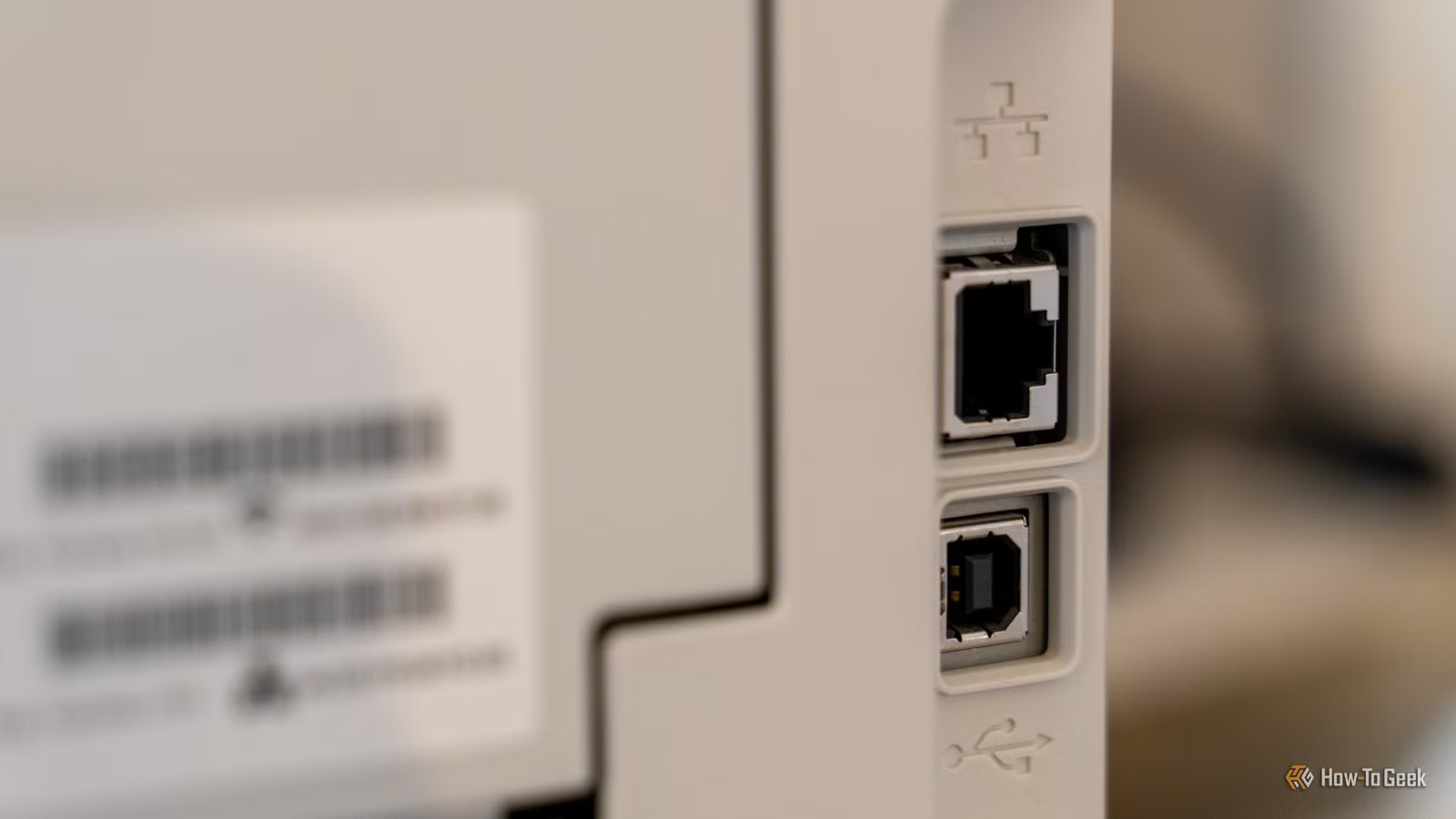
I’m tired of trying to plug my printer in and failing multiple times because of the archaic USB-B connector on it. That connector is 30 years old, and it’s time to ditch it. Arduino did, even on its lowest-cost microcontrollers. If Arduino can embrace USB-C, so can printer manufacturers.
Arduino went relatively unchanged for over a decade
From 2011 to 2023, Arduino used USB-B as its primary connector.
Credit: Patrick Campanale / How-To Geek
Arduino is both a niche device while being extremely popular at the same time. The original Arduino was released way back in 2005, with the infamous Arduino UNO R3 being launched around 2011.
The Arduino has become the gold standard for microcontroller projects in the past 15+ years. Chances are, if you’ve used a microcontroller-powered project, it was either prototyped on an Arduino to start with or the Arduino IDE was used in some capacity during the programming. Arduino is synonymous with microcontroller programming. Even non-Arduino microcontroller projects are often compiled with the Arduino IDE.
As such, in 2023, Arduino released its first major update in over a decade with the Arduino UNO R4. The entire Arduino R4 lineup, including the UNO R4 Minima, UNO R4 Wi-Fi, and Nano R4, all switched to USB-C from the traditional USB-B connector that Arduino is so well-known for using. It took a while, but Arduino finally adopted the modern USB-C standard, making their infamous microcontrollers more universal and easier to program.
Related
Arduino’s new DIY electronics starter kit has an UNO R4 board
Get started on those electronics projects.
USB-B is a connector of the past
Released in 1996, it’s time to retire this 30-year-old connector.
Credit: Patrick Campanale / How-To Geek
Listen, USB-B is a great connector, don’t get me wrong. It’s satisfying to plug in, creates a very secure connection (most of the time), and has been around so long that just about every house likely has at least a few of the cables in a drawer somewhere. The problem is, it’s old. Very old. In fact, USB-B was released as part of the original USB spec in 1996—30 years ago this year.
While USB itself has undergone many updates over the years, USB-B has been relatively unchanged outside a brief stint of USB-B 3.0 that was quickly done away with once USB-C hit the scene.
I really don’t know why USB-B is still so prevalent in our day and time. My normal printers still all have USB-B on them. My label printer still uses USB-B. In fact, some of the laser engravers in my workshop still use USB-B.
A few years ago, it would have been a little more understandable, as USB-C was still new on the scene (though USB-C has been a very solid standard for a decade at this point). In 2026, however, it’s just unacceptable for modern devices to ship with USB-B—it’s too old to still use.
There’s no reason for companies to not embrace a USB-C future
USB-C takes up less space, is more capable, and is extremely universal.
Credit: Hannah Stryker / How-To Geek
Why should devices adopt USB-C over USB-B? There are so many reasons. To start with, USB-C takes up far less space than USB-B does. Having a smaller connector leaves extra room for other components in a device, or simply just a smaller connector to use in general.
USB-C is also reversible, so you can connect the cable either way, so long as it plugs in. While USB-A only has two ways it can be plugged in, USB-B has four potential options—and I never get it right on try one, two, or three. Sometimes even try four is a fail and I have to start all over again.
Related
What Is USB-C? Here’s Why You Want USB Type-C
One port to rule them all.
Not only that, but USB-C is also capable of much higher data transfer rates than USB-B. Since USB-B is limited to USB 2.0 speeds, it’s capped at 480Mb/s, while USB-C can reach up to 40Gb/s under normal circumstances, 80Gb/s with USB4 2.0, and it peaks at 120Gb/s with technologies like Thunderbolt 5.
In the past, USB-C cost significantly more than USB-B, but that just doesn’t seem to be the case anymore. Going with a USB-C port over USB-B does add a little bit of extra cost, as the circuitry does need to be slightly more complex and include two 5.1kΩ pull-down resistors. However, in 2026, the cost is extremely minimal when developing modern electronics and there’s no reason to still be using USB-B.
I don’t know why the adoption of USB-C has been so slow. I do understand why USB-A is still used in many areas, but peripherals still using USB-B are just as bad as those still using microUSB.
As we head into 2026, I really hope to see more and more brands fully embrace USB-C, especially on peripherals. While I want to see desktops with USB-C exclusively, I don’t expect that. Peripherals using USB-C though, that I do expect.
