

UK pledges major defence package for Ukraine
Dan Sabbagh
Britain said it would send a further £540m worth of weapons to Ukraine, including spending £150m on buying US made interceptors, using a Nato-run funding scheme for the first time.
The latest commitment comes ahead of a meeting of the 50 country Ukraine Contact Group, which coordinates international weapons supplies to Kyiv, immediately after the Nato defence ministers summit.
Britain has not previously used Nato’s Prioritised Ukraine Requirements List (Purl) before. It was devised last year as a mechanism for European countries to buy US weapons for Ukraine, after the US said it would no longer donate them.
The remaining £390m will be spent on supplying 1,000 Lightweight Multirole Missiles (LMMs), which are manufactured in Belfast, to urgently bolster Ukraine’s air defences, which are struggling against nightly onslaughts of Russian attacks.
As he arrived in Brussels, UK defence secretary John Healey said: “This afternoon, I’ll be confirming that Britain is providing an extra half a billion pounds in urgent air defence to Ukraine.”
Share
Key events
Show key events only
Please turn on JavaScript to use this feature
Portugal urged to adapt to climate emergency after series of deadly storms
Elsewhere in Europe, Portugal is under pressure to draw up plans to adapt to the climate emergency as the country continues to be lashed by an unprecedented series of storms that have killed at least 16 people and left tens of thousands without electricity.
More than 3,000 people were evacuated from the Coimbra area of central Portugal on Wednesday as the Mondego River reached critical levels, while part of the country’s main motorway, the A1, collapsed after a dyke on the Mondego gave way under the weight of flood water.
Hundreds more people have been displaced across the country since what scientists have called the “longest train of storms within living memory” began at the end of January. The extreme weather, which has affected central and southern parts of the country, has cut off power to 33,000 people and caused an estimated €775m (£675m) of damage.
You can read the full report here:
Share
The US is ‘totally invested in Nato’, says Rutte
The US is “totally invested in Nato”, said Mark Rutte, as he brushed aside concerns that Washington has stepped back from its leadership role of the military alliance.
Nato’s secretary general said he has a “very good relationship” with US defence secretary Pete Hegseth (or officially the US Secretary of War) and that they are in direct contact.
That is despite Hegseth skipping the meeting of Nato defence ministers in Brussels today.
When asked about his absence during a press conference, Rutte said: “Pete Hegseth and I have a very good relationship and we are directly in contact as I am, of course, with the American president and with Marco Rubio, the secretary of state, who I will see in Munich in the coming days.”
“So that is a close cooperation,” he added.
“But you have to realise that the United States is the biggest country on earth, it is the most powerful military on Earth. It is 25% of world economy. So yes, they are totally invested in Nato. They are anchored in Nato. There’s no doubt about that.”
Share
Updated at 14.48 GMT
Nato’s secretary general Mark Rutte is speaking now after defence ministers met in Brussels for high-level talks on global security, defence cooperation and support for Ukraine.
You can watch the press conference live here:
NATO secretary general Rutte holds news conference – watch liveShare
Updated at 14.17 GMT
Zelenskyy has given a state award to the disqualified skeleton racer Heraskevych, according to Reuters.
Share
Ukrainian president Volodymyr Zelenskyy has said “sport shouldn’t mean amnesia” in response to the International Olympic Committee’s (IOC) decision to ban Ukraine’s skeleton racer Vladyslav Heraskevych over the use of a helmet honouring Ukrainian athletes killed in the war with Russia.
Heraskevych, a skeleton racer, was informed only minutes before he was due to compete in his Winter Olympics event that his accreditation had been rescinded.
A last-minute plea was made on Thursday for “any form of compromise” but to no avail, the IOC said in a statement. The IOC had suggested he wear a black armband during competition instead to pay tribute to fallen athletes, which the 26-year-old refused.
In a statement issued on social media, Zelenskyy said that “having courage is worth more than any medal”. He wrote on X:
Sport shouldn’t mean amnesia, and the Olympic movement should help stop wars, not play into the hands of aggressors.
Unfortunately, the decision of the International Olympic Committee to disqualify Ukrainian skeleton racer Vladyslav Heraskevych says otherwise.
This is certainly not about the principles of Olympism, which are founded on fairness and the support of peace.
Zelenskyy added:
It is Russia that constantly violates Olympic principles, using the period of the Olympic Games to wage war. In 2008, it was the war against Georgia; in 2014 – the occupation of Crimea; in 2022 – the full-scale invasion of Ukraine.
And now, in 2026, despite repeated calls for a ceasefire during the Winter Olympics, Russia shows complete disregard, increasing missile and drone strikes on our energy infrastructure and our people.
Share
Norwegian police search homes of ex-PM Jagland in Epstein probe
Norwegian police searched the homes of former prime minister Thorbjørn Jagland on Thursday, his lawyer said, as part of an ongoing investigation into ties between prominent Norwegians and late US sex offender Jeffrey Epstein.
Images circulated by Norwegian dailies VG, Dagbladet, Dagens Naeringsliv and Aftenposten showed investigators carrying cardboard boxes into Jagland’s Oslo residence.
The raid came a day after the Council of Europe, the continent’s leading human rights watchdog, which Jagland led from 2009 to 2019, lifted his diplomatic immunity, Reuters reported.
“Oekokrim is currently conducting searches of Thorbjoern Jagland’s residence and recreational properties. This was expected and is a standard part of an investigation of this nature,” Jagland’s lawyer Anders Brosveet said in a statement.
Thorbjørn Jagland speaks at the Russian International Affairs Council in Moscow on March 23, 2012. Photograph: Mikhail Metzel/AP
Jagland is now accused of aggravated corruption, his lawyer added, under Norway’s legal code that precedes formal charging and allows a suspect to get a lawyer and the police to arrest a suspect at some point. In Norway, formal charges are brought against someone much later in the legal process, sometimes only weeks before a court case begins.
“This does not represent any real change in the substance of the case, but is a legal consequence of the investigative methods used by the police,” said Brosveet.
Share
UK pledges major defence package for Ukraine
Dan Sabbagh
Britain said it would send a further £540m worth of weapons to Ukraine, including spending £150m on buying US made interceptors, using a Nato-run funding scheme for the first time.
The latest commitment comes ahead of a meeting of the 50 country Ukraine Contact Group, which coordinates international weapons supplies to Kyiv, immediately after the Nato defence ministers summit.
Britain has not previously used Nato’s Prioritised Ukraine Requirements List (Purl) before. It was devised last year as a mechanism for European countries to buy US weapons for Ukraine, after the US said it would no longer donate them.
The remaining £390m will be spent on supplying 1,000 Lightweight Multirole Missiles (LMMs), which are manufactured in Belfast, to urgently bolster Ukraine’s air defences, which are struggling against nightly onslaughts of Russian attacks.
As he arrived in Brussels, UK defence secretary John Healey said: “This afternoon, I’ll be confirming that Britain is providing an extra half a billion pounds in urgent air defence to Ukraine.”
Share
Preparations are under way in Munich for the arrival of high-ranking officials from around the world for the annual security conference, but an airline strike could disrupt the travel plans of passengers travelling to the summit.
The Guardian’s Jakub Krupa, who is in Munich to report from the security conference tomorrow, reports:
Almost 800 Lufthansa flights were cancelled on Thursday as the German airline’s pilots and cabin crew called a one-day strike escalating their dispute over pensions and working conditions.
Lufthansa’s estimates early afternoon showed almost 800 cancellations and 100,000 affected passengers, as reported by Reuters.
Some 275 flights from Munich were cancelled, the regional newspaper Süddeutsche Zeitung said quoting the airport’s spokesperson, hitting the city’s airport just a day before global leaders and foreign affairs and defence experts are set to meet at the Munich Security Conference.
Munich is Lufthansa’s second largest hub for international travel, after Frankfurt, Süddeutsche Zeitung said.
But after late cancellations overnight, many attendees were left scrambling to secure flights to other major airports nearby, including Vienna and Milan, in a hope of getting to Bavaria’s capital before the event gets under way. Normal operations are expected to resume tomorrow.
For those lucky enough to get here without disruption, they are welcomed by officials holding Munich Security Conference placards on arrivals, and digital adverts of defence and security companies keen to roll out their sales pitch to the attendees from the moment they step off the plane.
The main event gets under way tomorrow and continues over the weekend – and we will bring you the full coverage on Europe Live.
Share
While Ukraine is reeling from last night’s barrage of attacks, the Kremlin said it expected the next round of peace talks to happen soon.
“We have a certain understanding (of the details), and we will keep you informed,” Kremlin spokesman Dmitry Peskov told reporters.
“We expect the next (third) round of talks to take place soon.”
Ukraine and Russia took part in US-led talks over two days in Abu Dhabi last week, which ended with promise of more talks. You can read the Pjotr Sauer’s full report here:
Share
Time for US and Europe to march out together, says Colby
Dan Sabbagh
Meanwhile, at Nato HQ, Elbridge Colby, the US undersecretary for war, said it was time for the US and Europe to “march out together,” sounding a rare conciliatory note as he arrived in Brussels for a meeting of alliance defence ministers earlier today.
The hawkish Colby is representing the US instead of defence secretary Pete Hegseth, but his high status as arguably the leading military adviser to Donald Trump means his presence instead of his immediate boss is not being taken as a significant snub.
After a turbulent start to 2026 in which the US president repeatedly demanded to acquire Greenland from Nato ally Denmark – and at one point even refusing to rule out force – Colby’s initial remarks appeared to soothe tensions.
Elbridge Colby, the US undersecretary for war, speaks at the start of a meeting of Nato defence ministers in Brussels, Belgium. Photograph: Leon Neal/Getty Images
Colby said that in 2025 “you saw a reframing and a real, genuine commitment, because of the president’s leadership and the sec gen’s [secretary general’s] leadership, to actually have a Europe that leads the conventional defence of Nato”.
He was referring to the agreement at the Nato summit in The Hague last summer, where European members of Nato agreed to match US levels of defence spending at 3.5% of GDP.
“I think this year we actually have a good message to say, which is, now it’s time to march out together,” he said. The future of Nato would be “based on a partnership rather than dependency” by Europe on the US, he added.
Share
Updated at 12.08 GMT
UN calls on Russia to stop attacks on Ukraine energy sites
The United Nations has called on Russia to stop its attacks on Ukraine’s energy sites, which have plunged entire cities into darkness in the coldest winter of the four-year war.
Moscow has stepped up strikes on Ukraine’s power and heating infrastructure, and conducted another nationwide attack on energy facilities overnight that killed two people, AFP reported.
UN rights chief Volker Turk said in a statement:
The relentless attacks by the Russian Federation on energy infrastructure across Ukraine are depriving an already long-suffering civilian population of adequate warmth, water and electricity in an unbearably bitter and dark winter.
UN high commissioner for human rights, Volker Turk, speaks during a press conference, on June 26, 2025. Photograph: AP
He said civilians had faced continual bombardment and now had to face temperatures as low as minus 20C. Turk added:
Last night, the Russian Federation again carried out a large-scale attack targeting energy infrastructure across Ukraine. Hundreds of thousands of civilians woke up without electricity and heating.
The targeting of civilian infrastructure is prohibited under international humanitarian law. I call upon the Russian Federation to immediately cease these attacks.
Share
Bulgarian president Iliana Yotova, in an attempt to quell the country’s ongoing political instability, has appointed a senior central bank official as interim prime minister until national elections in April.
Andrey Gyurov, deputy governor of the Bulgarian National Bank, will lead a caretaker government whose main task will be to organize a free and fair vote in a country that is holding its eighth election in five years.
The political uncertainty that has plagued the EU and Nato member state during this period has eroded public trust in institutions, created an opening for populist and nationalist groups, and paved the way for Russian hybrid influence, AP reported.
President Yotova, who announced the appointment, said that she expects Gyurov to propose the members of his cabinet within seven days.
She would then have to approve the proposal and set the election date, which she had previously indicated would be 19 April.
Bulgarian president Iliana Yotova, right, appoints Andrey Gyurov to lead as prime minister. Photograph: APShare
Updated at 11.40 GMT
Orban: Europe should stop sending money to Ukraine to boost EU economy
Hungary’s prime minister Viktor Orbán, who is at the Belgium summit with other EU leaders this morning, said Europe should stop sending money to Ukraine it is serious about wanting to boosting its economy.
Orbán, widely viewed as Vladimir Putin’s closest ally in the EU, made the remarks to reporters as he headed into the informal talks (read more about that in an earlier post here).
“Don’t send your money to somebody else if you need it for your competitiveness, so don’t send the money to Ukraine,” he said.
It’s not unusual for Orbán to make disparaging comments regarding Ukraine, especially now since Hungary is due to hold parliamentary elections in April, in which his government faces a serious challenge by the opposition Tisza party. Orbán’s campaign has focused on opposing Ukraine’s potential accession to the EU and vowing to continue blocking the process.
Hungary’s prime minister Viktor Orbán arrives for the EU summit at Alden Biesen Castle in Bilzen-Hoeselt, Belgium. Photograph: François Walschaerts/APShare
Hundreds of thousands Ukrainians without power, heat and water after Russian attacks, officials say
Here are the main news lines from the onslaught of Russian missile and drone attacks reported last night in Ukraine that has plunged parts of the country in darkness and left hundreds of thousands of people without heat and water:
We reported earlier about the attacks in the southern city of Odesa where nearly 300,000 people have been left without water, according to Ukraine’s deputy prime minister Oleksiy Kuleba. He added that about 200 buildings also had no heating.
In the capital city Kyiv, about 3,500 buildings were without heating this morning after the attacks knocked out power supplies to 2,600 high-rise buildings, on top of the 1,100 already affected by previous strikes, the mayor, Vitali Klitschko, said.
In Dnipro in Ukraine’s south-east, four people were injured including a baby and four-year-old child, the regional governor, Oleksandr Ganzha, said.
The Ukrainian energy firm DTEK said one of its thermal power plants was targeted and “suffered extensive damage”, but did not disclose the location. “This is already the eleventh large-scale attack on the company’s thermal power plants since October 2025,” DTEK said in a statement.
Andrii Sybiha, Ukraine’s foreign minister, condemned the attacks, saying they undermine diplomatic efforts led by the US to end the war. “Russia must be forced to take diplomacy seriously and de-escalate,” he said in a social media post. “This can only be achieved through unity, strength, and increased pressure on Moscow.”
An explosion lights up the sky over Kyiv during a Russian missile and drone strike. Photograph: Vladyslav Sodel/ReutersThe damage inside a child’s room in a house hit by a Russian drone in Dnipro. Photograph: ReutersShare
Updated at 10.46 GMT
EU leaders head to a Belgian castle for talks
Jennifer Rankin
Away from Ukraine, EU leaders are gathering this morning in the bucolic setting of the Alden Biesen castle in the east Belgian countryside for a summit dedicated to economic revival in the face of Donald Trump’s tariff threats and fierce competition from China.
The venue, founded by Teutonic Knights in the 13th century, was chosen because it offers a change of scene for the leaders. The summit, in EU parlance, is an informal meeting, i.e. a brainstorming session, rather than a day for big decisions.
Readers may wonder why the 27 EU leaders meeting in Belgium cannot convene in the Europa building in Brussels, the purpose built venue for EU summits.
Alden Biesen castle in Rijkhoven, Belgium, where EU leaders will participate in an informal meeting. Photograph: John Thys/AFP/Getty Images
For EU officials that misses the point of what European Council president António Costa has described as a retreat.
One senior EU official said it was useful to change the location.
“Why do they need to go to Alden Biesen or to a more secluded place with a different environment? Well, precisely because we’ve seen that it is useful to create the atmosphere for these types of discussions. And we’ve seen that these discussions are very useful in our decision-making process.”
In February 2025, EU leaders – with prime minister Keir Starmer as a guest – held their first-ever summit dedicated to defence at the Palais d’Egmont in Brussels. The meeting paved the way for an €800bn (about £697bn) ReArm Europe plan a month later.
Share
Updated at 09.59 GMT
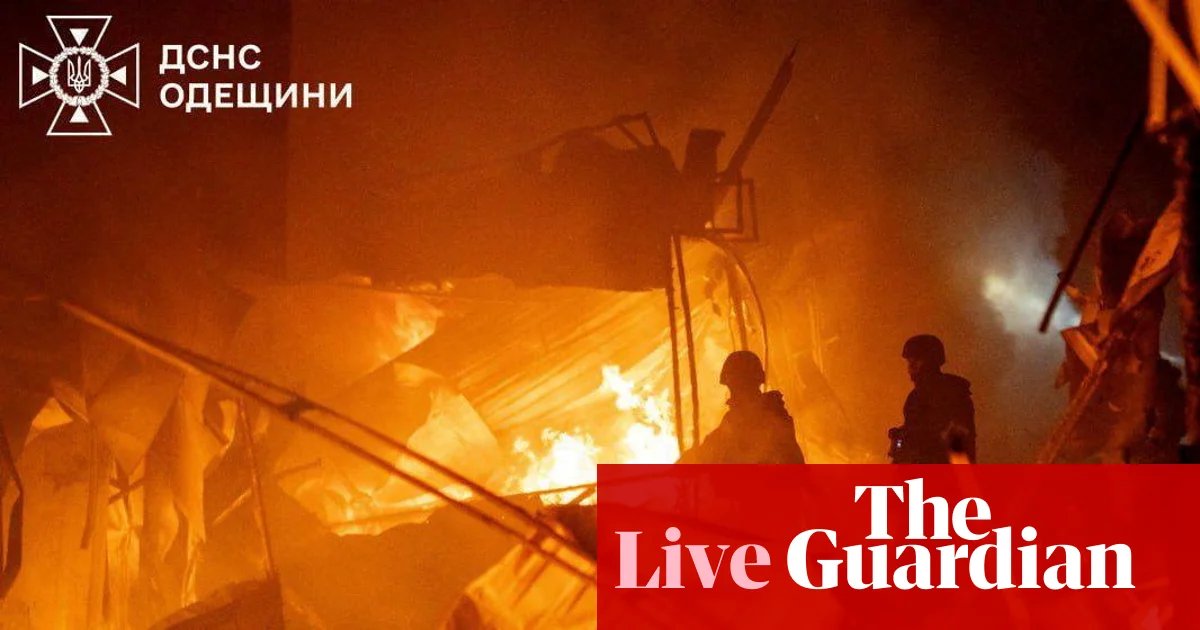
Pictures: Russian drone strikes spark inferno in Odesa
We have some images from the newswires showing the fires that engulfed parts of Odesa in Ukraine’s south last night and the aftermath. Local officials said the Russian attack damaged residential buildings and the city’s markets.
Photograph: State Emergency Service Of Ukraine/Reuters Photograph: State Emergency Service of Ukraine/AFP/Getty Images Photograph: State Emergency Service Of Ukraine/Reuters Photograph: Michael Shtekel/AP Photograph: Michael Shtekel/AP Photograph: Michael Shtekel/APShare
Ukrainian athlete disqualified from skeleton over helmet tribute
Our sports team have the latest on the International Olympic Committee’s (IOC) decision to ban Ukraine’s skeleton racer Vladyslav Heraskevych from competing in the Winter Olympics over the use of a helmet honouring Ukrainian athletes killed in the war with Russia.
Ukraine’s Vladyslav Heraskevych wears a helmet with pictures of Ukrainian victims of his country’s war with Russia. Photograph: Franck Fife/AFP/Getty Images
The IOC said the helmet depicting the faces of Ukrainian athletes and coaches killed in the war wouldn’t be allowed in competition, citing a rule against making political statements on Olympic sites and venues.
A last-minute plea was made on Thursday for “any form of compromise” but to no avail, the IOC said in a statement. The IOC had suggested he wear a black armband during competition instead to pay tribute to fallen athletes, which the 26-year-old refused.
Follow our live coverage of the Winter Olympics 2026 to get the latest developments on this story:
Share
Updated at 09.06 GMT
Morning opening
Hello, Taz Ali here to bring you the latest news for our Europe live blog.
Hundreds of thousands of people have been left without power or water supply in the southern Ukrainian city of Odesa after Russia launched a large-scale overnight drone strike, according to local officials. Nearly 300,000 people have been affected by the power outage, while one person has been reported injured.
It was part of a widespread attack across the country that targeted energy infrastructure in cities including the captial Kyiv and Dnipro in south-east Ukraine, an official said.
“Hundreds of drones and ballistic missiles targeted energy system, depriving people of power, heating, and water,” Ukraine’s minister of foreign affairs, Andrii Sybiha, said on social media. He added that a toddler and four-year-old child were among the dozen or so injured from last night’s attack.
While diplomatic efforts have been ongoing to try to bring an end to the war, Russia has pressed on with attacks in Ukraine that have mainly aimed at weakening the country’s energy systems in the depths of winter.
The site of a Russian drone strike in Odesa, Ukraine. Photograph: State Emergency Service Of Ukraine/Reuters
Meanwhile, EU leaders are meeting at a castle in Belgium today to brainstorm how to compete with the US and China and transform the bloc into a major economic powerhouse. They’re not expected to make any decisions at the informal summit in the Alden Biesen Castle, but the talks might give some indication on how the 27 member states plan to strengthen the single market, reduce Europe’s dependence on foreign powers and make the EU more competitive.
We will also bring you the latest on the flooding and devastation wrought in Portugal and other parts of Europe after a succession of deadly winter storms. It has led to the resignation of Portugal’s interior minister Maria Lúcia Amaral over criticism of her government’s response to the weather disasters.
Share
Updated at 09.51 GMT
