

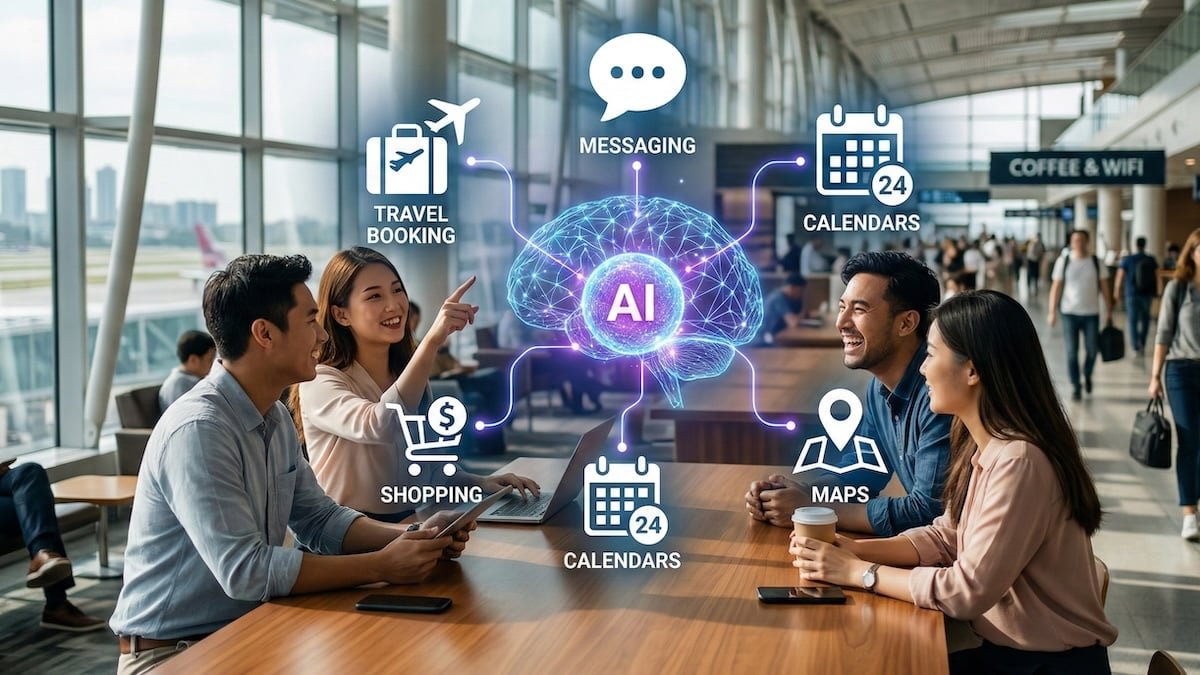
Cristiano Amon, CEO of Qualcomm, says 2026 will be the year AI agents move from concept to everyday reality. The shift may elevate the role of smartwatches from brands such as Garmin and other wearable devices in ways that are easy to overlook.
The prediction came during Qualcomm’s recent discussion at MWC in Barcelona, around the future of AI computing. Amon’s argument is simple. Instead of opening apps and manually navigating digital services, people will increasingly rely on AI systems that can act on their behalf.
Those systems, commonly referred to as AI agents, would handle tasks automatically. That might include booking travel, summarising messages, organising schedules or managing digital services across multiple platforms. The user sets an intent and the system handles the steps required to complete it.
Most of the conversation around agents focuses on smartphones, PCs and cloud systems. But wearables could become one of the most natural companions for this new computing model.
Why wearables fit naturally with AI agents
AI agents depend heavily on context. They need to know what a person is doing, where they are, how busy they are and often even how they are feeling.
Smartwatches track movement, heart rate, sleep patterns and activity levels. Some devices also capture stress signals, skin temperature or other physiological data. Fitness rings and bands add another layer of continuous sensing.
Essential reading: Best smartwatches and health tech
When an AI agent has access to that kind of data stream, its ability to act intelligently increases significantly. Instead of responding only to a command, it can respond to a situation.
For example, an agent connected to a smartwatch might delay notifications when the user is asleep or during intense exercise. It could adjust daily schedules based on activity levels or recovery. A running watch could feed training data into an AI system that modifies workout plans automatically.
A new interface that moves beyond apps
Another reason wearables matter in this shift is the interface. AI agents are likely to rely less on traditional app navigation and more on voice, prompts and quick interactions.
Smartwatches already operate in that environment. Screens are small, input methods are limited and users tend to rely on voice or short actions rather than complex navigation.
That design constraint suddenly becomes an advantage in an agent driven world. A wearable can act as a simple access point to a more powerful system running locally on a phone or in the cloud.
Edge AI brings more power to wearable ecosystems
Qualcomm’s comments also reflect a broader industry shift toward running AI directly on devices rather than relying entirely on remote servers.
This approach, often referred to as edge AI, reduces latency and improves privacy while allowing systems to respond instantly. Qualcomm’s chips are already widely used in smartphones and increasingly in wearable devices.
As these chips gain stronger neural processing capabilities, more AI tasks can run locally on the device itself. That includes real time analysis of sensor data collected by wearables.
For smartwatches this could mean faster health insights, more adaptive training systems and smarter assistants that respond immediately without needing constant cloud access.
Wearables as the always available assistant
There is also a practical reason why agents and wearables could work well together. Smartwatches and rings are almost always worn.
Phones move in and out of pockets or bags. Watches remain on the wrist throughout the day and often during sleep. That constant presence makes them a natural channel for AI systems that operate continuously.
Subscribe to our monthly newsletter! Check out our YouTube channel.
And of course, you can follow Gadgets & Wearables on Google News and add us as a preferred source to get our expert news, reviews, and opinion in your feeds.
