

My kitchen junk drawer has resisted all attempts to tame and organize. I’ve bought little baskets of various sizes and even tried to limit what we put in them, but they always end up an unmitigated mess. My silverware organizer, too, has never quite fit all the items we need to keep in there, leaving big sections of just “whatever fits there.”
Then I got a 3D printer.
As I’ve learned more and more about printing practical things for my home (dog food can lids, chip clips, mail boxes for the office, etc.), I stumbled upon Gridfinity, a 3D printable, customizable modular storage system that not only lets you create different containers for your stuff, but in an infinite number of ways. Need a smaller container for the silverware drawer? Just print it. Want to add a space for Sharpies in your junk drawer? Print it out. Gridfinity makes it super simple (once you figure out how to print the bottom grid) to customize your organized space. I can’t wait to find more solutions to our home disarray as I continue browsing new Gridfinity printables.
What is Gridfinity and why does it work so well?
It’s like LEGO for organization, and just as addictive
Created by maker Zack Freedman, Gridfinity was released for free under an MIT license in April 2022. It’s build on a grid of 42x42mm squares with 7mm height increments. There are two core components: the baseplate foundation, which locks into your drawer or onto your surface, and the bins, modular containers that snap into the gridded baseplate. Everything is interchangeable because the community designs and builds to these same specs. The snap-fit design ensures that once you’ve locked the grid in place with spacers, screws, adhesive, or magnets, your bins don’t slide around. You can rearrange at a whim. It’s all very fun.
Solving the junk drawer
Measure twice, print again and again
Before Gridfinity, my junk drawer contained all the ephemera we had no other use for. Batteries, coins, old keys, scissors, pens and pencils, and just stuff of every size. Every time we opened the drawer, this junk would slide around and mix itself into different messes, all in the same drawer. Ugh. While I don’t have a before picture, I’m sure you have a similarly appointed junk spot in your own home.
For my first Gridfinity project, I had to measure the drawer and determine which size baseplates to print. My BambuLabs P1S has a 256 x 256 printing plate, so it also had to fit there. I ended up with two 4×4 grids, set side by side in the drawer. I printed some spacers that I could squeeze into the sides to keep the baseplates from sliding around, since my drawer isn’t a perfect multiple of 42mm.
Since the baseplates I used are super thin, I had to increase the temperature of my printer plate and slow the printing speed down a bit. Your mileage may vary, based on the temperature and humidity around your own printer. There are also several web-based tools like Gridfinity Generator to help create baseplates in any size you can imagine.
Once the baseplate was sorted, I printed out a bunch of bins that would fit my stuff. One for the scissors and other longer items, one for pens and pencils, and several smaller ones to hold all the little objects and gadgets that were stored there. I took the opportunity to put coins away and get rid of old keys while I was at it. The result is a well-organized drawer where each “thing” has its own little space. It’s been a couple of months now, and so far, everyone in the household is using the system. That’s a big win.
Reinventing the silverware drawer
The kitchen is an underrated Gridfinity use case
Lots of Gridfinity projects you find on the web target workshops and desks, but the application for kitchen drawers is just as strong. In fact, since we all likely have a silverware drawer, it might have even more universal appeal.
For my project, I again measured the drawer (this one was wider and I ended up printing nine 3×5 baseplate grids to cover most of the bottom of the drawer. I then grabbed a pre-made set of silverware holders from MakerWorld, figuring I could arrange and adjust as needed. The original holder only had room for a few types of utensils, leading to us having to double up things like spoons and forks. The new system has plenty of space, and in fact has more places to put silverware than we need. It was fantastic when we got some new large spoons from Goodwill; there was a spot already for them to go. In the future, if our needs change, we can print new bins and add them into the drawer, even replacing sections on the fly. It’s really been great.
Starting a desk system (and what I’d do differently)
Smaller spaces need a different approach
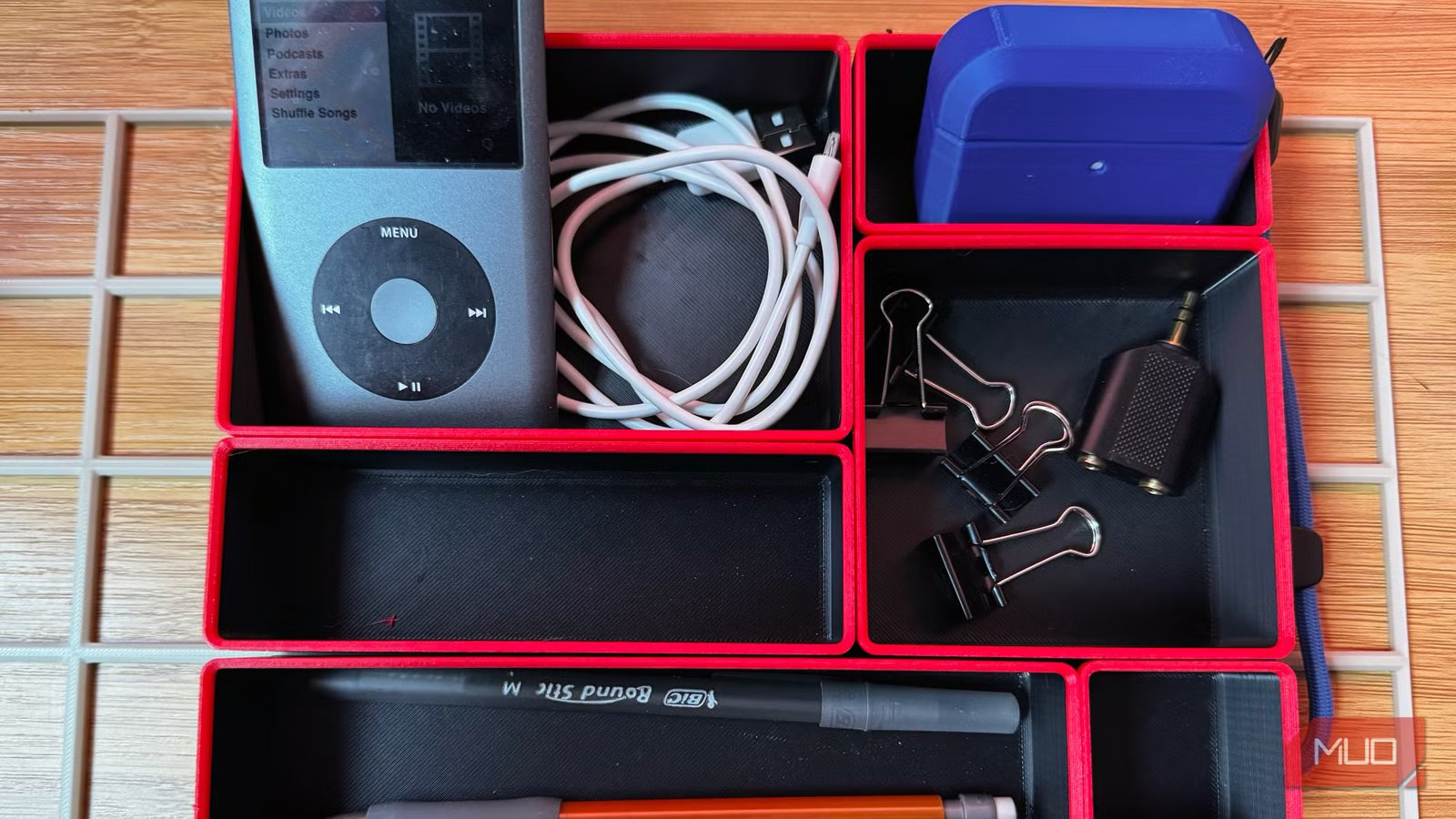
Finally, the desk organizer system is a work in progress. on this compact desk, vertical space is more available than horizontal. I can’t just fill the desk with baseplates and hope to find bins to fit everything. I have a weird monitor footprint (a giant V), a Mac Mini, and a PC laptop, along with a Thunderbolt dock and various office stuff and gadgets (iPod, AirPods, paper clips). Gridfinity bins stack in 7mm increments, making it easy to create taller bins for pens and cables that can coexist with shallower bins for smaller items. There are also designated desk surface organizers, not just drawer inserts, that I’m planning to explore. For now, I have a basic bin setup to hold some of the looser items on my desktop, but I definitely plan on continuing my search.
What you need to get started
You don’t need to learn CAD, thank goodness
The first thing you’ll need, of course, is a 3D printer. I’m partial to Bambu Lab printers, as they’re pretty easy to use and repair (my first was an A1 Mini that still keeps busy today). My P1S is large enough to print bigger items, but also enclosed and small enough to fit in my workspace. My advice for your first print (after you print a “benchy,” a little tugboat that will ensure your printer is working) should likley be something fun and small. After that, start checking out all the Gridfinity stuff online; it’s a deep rabbit hole.
Gridfinity can be found at several sites, including MakerWorld, Printables.com, Thingiverse, Thangs.com, and even Freedman’s github repository. Which is great, because most of us don’t want to have to learn 3D modeling just to organize a kitchen drawer. There are thousands of bin designs for everything you can think of, and likely a ton of things you can’t, like battery holders, SD card bins, and (of course) kitchen utensils.
10/10
Brand
Bambu Lab
Build Volume
256 x 256 x 256mm
Connectivity
Wi-Fi (and Bluetooth for setup)
A superb beginner-friendly enclosed printer with outstanding software for your smartphone or desktop. Combined with the AMS (Automatic Materials System), the P1S can produce stunning multicolor prints: up to four filaments can be stored in a single AMS, and up to 4 AMS units can be combined for 16 filament printing. However, you should be aware the multicolor prints produce a lot of waste, and to mitigate that, you’ll need to print either in multiples or print additional “waste” objects to soak up the purged filament.
The best organizer is one that fits your actual stuff
Look, store-bought organizers are useful, but they force you to use their system and sizes. There’s no way to customize them to your stuff. Gridfinity works because it’s created around your own specific measurements and your specific things. The startup cost is the printer, some filament, and a few hours of printing. The payoff is a system you won’t have to replace, just maybe rearrange from time to time. If you already have the printer, you owe it to yourself to give this a shot.
