

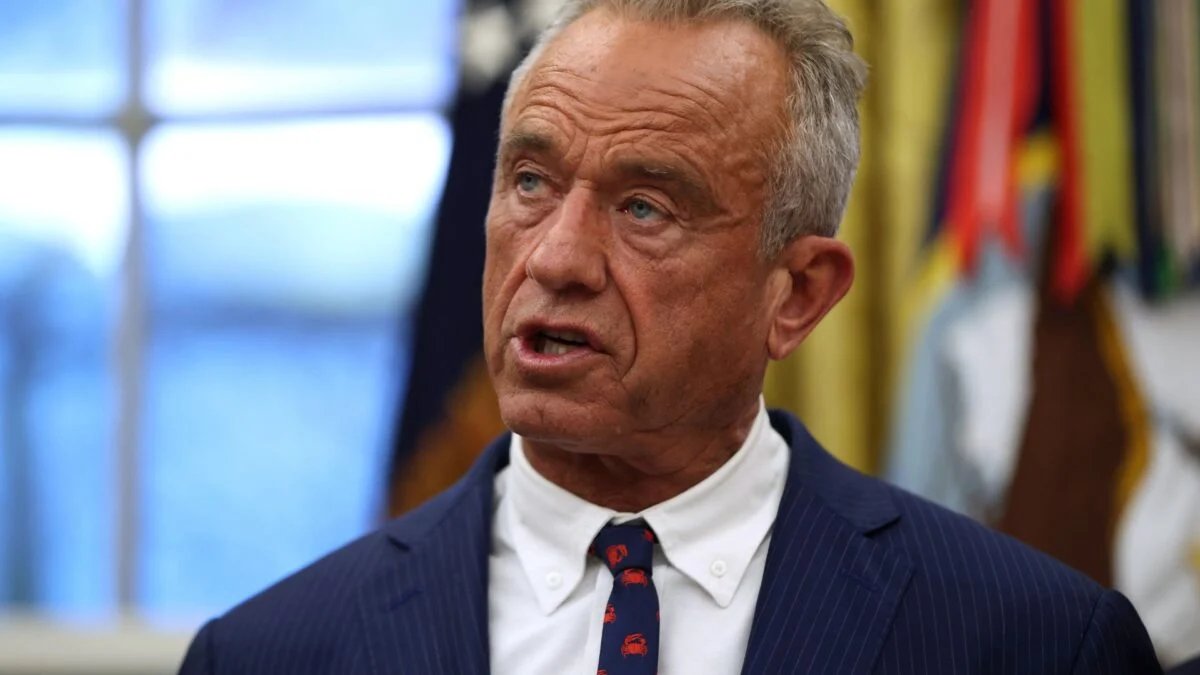
U.S. Health Secretary Robert F. Kennedy’s plan to tear down vaccines has been stopped dead in its tracks by a federal judge in Massachusetts—for now, at least.
This week, U.S. District Judge Brian Murphy issued a ruling in favor of the American Academy of Pediatrics and other medical groups currently suing RFK Jr. and the U.S. Department of Health and Human Services. Murphy temporarily blocked several key aspects of Kennedy’s vaccine agenda, stating that RFK Jr. and his allies had unlawfully circumvented federal procedure to carry out the changes. Among other things, the court decision prevents the government from slashing the number of vaccines recommended for children, a policy announced early this year.
“Today’s ruling is a tremendous victory for vaccines, for the protection of our nation’s children, and for the rule of law,” Richard Hughes IV, an attorney representing the plaintiffs, told Gizmodo.
The Kennedy kibosh
Last July, in the U.S. District Court for the District of Massachusetts, the AAP and others filed a lawsuit against Robert F. Kennedy Jr., HHS, and other senior health officials. The lawsuit originally argued that Kennedy had overstepped his legal authority as HHS chief by unilaterally deciding to revoke the government’s recommendation that most children and pregnant women receive the covid-19 vaccine. As RFK Jr. and his allies continued to trample on established vaccine policies over the following eight months, the plaintiffs amended their complaint further.
On Monday afternoon, Murphy issued a preliminary injunction barring Kennedy and the Centers for Disease Control and Prevention from moving ahead with the CDC’s decision to only widely recommend 11 childhood vaccines (down from 17). He also ruled to halt the latest iteration of the Advisory Committee on Immunization Practices (ACIP), the panel of outside advisors organized by the CDC to help guide vaccine policy.
Last summer, RFK Jr. fired all 17 members of the previous ACIP and installed his own allies (13 to date), many of whom had or have since expressed unsupported claims about the dangers of vaccination, much as Kennedy has in the past. Current ACIP chair Kirk Milhoan has claimed that covid-19 vaccines can cause cancer and miscarriages, for instance, neither of which appears to be true.
In striking down the current ACIP, Murphy stated that Kennedy had likely violated the Federal Advisory Committee Act when he tried to reform the committee without following the procedural rules that govern it.
Murphy’s ruling forced the ACIP to postpone its planned meeting this week, where they were expected to try to change how serious vaccine injuries from the covid-19 shots are tracked. Though such injuries have happened, they’re incredibly rare and are vastly outweighed by the net benefits of covid-19 vaccination. Outside experts who viewed the ACIP working group’s report on the topic, leaked over the weekend, quickly criticized the report for its selection of “cherry-picked” and poor-quality data intended to inflate the risk of these injuries.
The ruling also blocks the recommendations previously made by RFK Jr.’s ACIP, which were all adopted by the CDC. These included a ban on the few remaining vaccines containing thimerosal, a now-rarely used preservative antivaxxers have long blamed for causing autism (no strong evidence has supported this link); a recommendation against the combination MMR/chickenpox vaccine for children under four (the CDC had previously left the decision up to families); and revoking a recommendation that all children at birth be vaccinated against hepatitis B.
What happens now?
The federal government is planning to issue an appeal of Murphy’s injunctions. Even if these appeals aren’t granted, there’s no guarantee that the court will ultimately rule in favor of the AAP and its partners.
For the time being, though, RFK Jr.’s understated goal to sow doubt and fear about the value of vaccines is now more in danger than it’s ever been during his tenure at HHS, and that’s all the better for America’s public health. And unsurprisingly, many health organizations are happy about the recent turn of events, including the American Medical Association, which filed an amicus brief in support of the AAP.
“Today’s ruling is an important step toward protecting the health of Americans, particularly children,” said David Aizuss, board chair of the AMA, in a statement Tuesday. “Vaccines are one of the safest and most effective tools in medicine, and strong, science-based immunization policies save lives.”
