

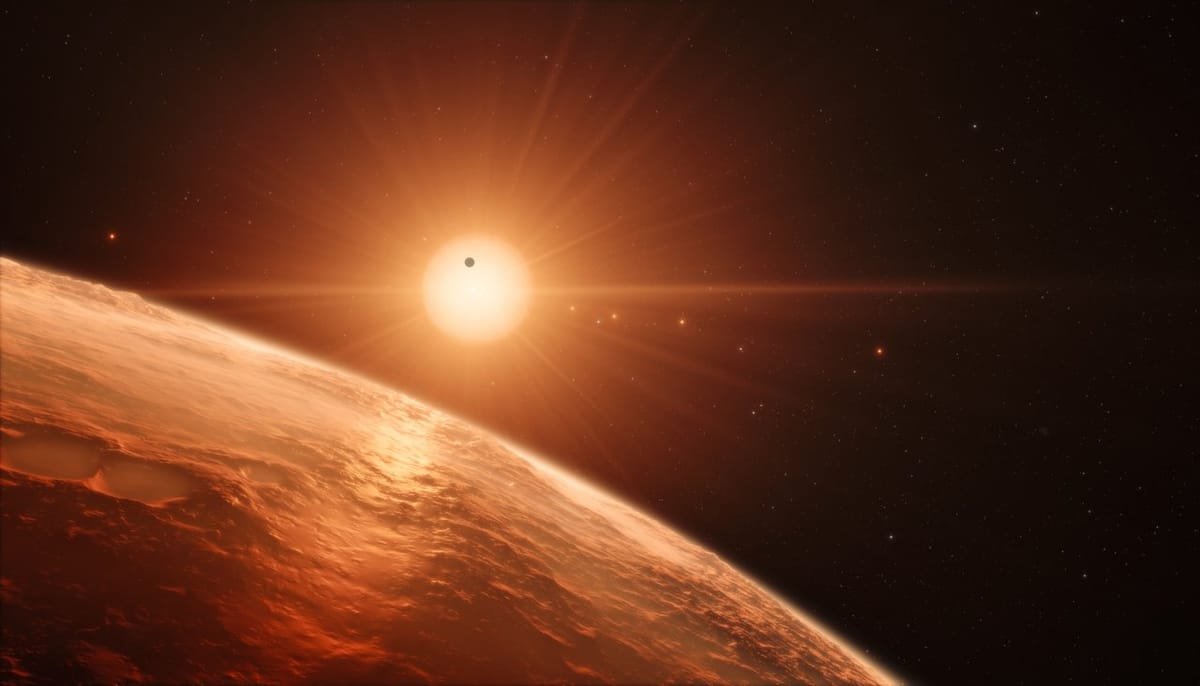
Welcome back to the Abstract! Here are the studies this week that visited strange new worlds, broke the adorability scale, pigged out, and took in an alien light show.
First, scientists sift through thousands of planets to find the best possible sites for life. Then: meet a Cretaceous cutie, check out some python blood, and travel to the biggest moon in the solar system.
As always, for more of my work, check out my book First Contact: The Story of Our Obsession with Aliens or subscribe to my personal newsletter the BeX Files.
The best of all possible worlds
Bohl, Abigail et al. “Probing the limits of habitability: a catalogue of rocky exoplanets in the habitable zone.” Monthly Notices of the Royal Astronomical Society.
Scientists have discovered more than 6,000 exoplanets, which are planets that orbit other stars, but most of these worlds are hopelessly inhospitable to life. To hone in on the best candidates for habitability, a team combed through the catalogue of exoplanets to identify the best potential alien homes.
The short-list includes 45 rocky worlds that are no bigger than twice the size of Earth and orbit within the habitable zone (HZ) of their stars, which is the region where liquid water might exist on the surface. The most exciting destinations include four planets that orbit the red dwarf star TRAPPIST-1, about 40 light years away, or Proxima Centauri b, which is the closest known exoplanet, located just four light years from Earth.
“To assess the limits of surface habitability, it is critical to characterize rocky exoplanets in the HZ,” said researchers led by Abigail Bohl of Cornell University. “Observations of known rocky exoplanets on the edges of the HZ can now empirically explore these boundaries.”
“The resulting list of rocky exoplanet targets in the HZ will allow observers to shape and optimize search strategies with space- and ground-based telescopes… and design new observing strategies and instruments to explore these worlds, addressing the question of the limits of exoplanet surface habitability,” the team added.
A diagram depicting habitable zone boundaries across star type with rocky exoplanets.
While previous studies have compiled similar lists, this work includes updated observations and also organizes the planets according to key properties such as age, orbital characteristics, radiation exposure, and ease of observation from Earth. In this way, the researchers pave the way toward testing individual factors that influence habitability, such as whether older planets seem to be more hospitable to life.
It could also be useful to compare planets that orbit at the edges of the habitable zone to planets right smack dab in the middle. After all, in our own solar system, Venus and Mars are at the inner and outer edges of the solar system, while Earth is vibing right in the Goldilocks zone.
It may be that planets in other star systems are similarly limited in their habitability as they approach the edge of the zone—or maybe not! We won’t know until we look. And now, we know where to start. To the observatory!
In other news…
Forever young at 100 million years old
Jung, Jongyun et al. “A new dinosaur species from Korea and its implications for early-diverging neornithischian diversity.” Fossil Record.
It is my great pleasure to inform you that an incredibly cute baby dinosaur has been discovered in South Korea, where dinosaur fossils are very rare. Meet Doolysaurus, named for the popular Korean cartoon character Dooly the Little Dinosaur. This little infant lived in the mid-Cretaceous period, about 100 million years ago, and represents a new species of thescelosaurid, a type of bipedal dinosaur.
The skeletal anatomy of a juvenile Doolysaurus huhmini. The graphic highlights the fossil bones that were found with the dinosaur. Image: Janet Cañamar, adapted from Jung et al 2026.
“Here, we describe a small, well-preserved skeleton…recognized as the holotype of a new genus and species, Doolysaurus huhmini” which includes “the first diagnostic cranial material of a dinosaur from Korea,” said researchers led by Jongyun Jung of the University of Texas at Austin. “It contributes novel insights into the diversity of the Korean dinosaur fauna, which has previously been known primarily from ichnofossil and egg fossil records.”
An artist’s interpretation of a juvenile Doolysaurus huhmini. Image: Jun Seong Yi
To top it off, this dinosaur might have sported a fuzzy coat. Jurassic Park has primed me not to trust any tech billionaire that wants to resurrect dinosaurs for public spectacle, but I’ll make an exception for Doolysaurus.
The right stuff for being stuffed
Xiao, S., Wang, M., Martin, T.G. et al. “Python metabolomics uncovers a conserved postprandial metabolite and gut–brain feeding pathway.” Nature Metabolism.
At dinnertime, pythons go whole hog—often literally. These huge snakes can devour their own body weight in a single meal, allowing them to fast for more than a year between feedings. In a new study, scientists probe these extreme eaters by analyzing the blood of Burmese pythons during their “postprandial” (after-gulp) phase.
“Burmese pythons display a remarkable array of postprandial responses, including more than 40-fold increase in energy expenditure, sustained tissue protein synthesis and more than 50 percent increase in the size of most organs,” said researchers co-led by Shuke Xiao of Stanford University, Mengjie Wang of the University of South Florida, and Thomas G. Martin of the University of Colorado, Boulder.
A Burmese python held by an author of the study. Image: Patrick Campbell/CU Boulder
In other words, the snakes “undergo extensive gastrointestinal remodelling” that truly put humanity’s best competitive eaters to shame. Joey Chestnut would have to simultaneously swallow over 2,000 hot dogs to even rival their sublime engorgement, just in case you are interested in some mustard-smeared napkin math (his world record is a measly 83).
Ganymede gets a glow-up
Cao, Xin et al. “Auroral Emissions on Ganymede: New Constraints on Their Electron Energy Dependence.” Geophysical Research Letters.
We’ll close, as all things should, with an extraterrestrial aurora. This week, let’s gaze into the glowing skies of Jupiter’s moon Ganymede, the largest moon in the solar system and the only one endowed with its very own magnetic field.
Now, scientists discovered that “Ganymede’s auroras are brighter than previously thought,” according to a study based on new atmospheric measurements and laboratory data.
Ganymede “mini-magnetosphere [is] embedded within Jupiter’s powerful magnetospheric environment,” said researchers led by Xin Cao of the Dublin Institute for Advanced Studies. “This unique configuration allows for auroral processes similar in morphology to those observed on magnetized planets, but driven by different external and internal conditions.”
The research illuminates the complex magnetic interactions between Ganymede and Jupiter, which will be studied more in depth by future missions, such as the European Jupiter Icy Moons Explorer (Juice) that is currently on its way to the gas giant, aiming for a 2031 arrival. I hope this news of cosmic radiance adds some sparkle to your weekend.
Thanks for reading! See you next week.
