

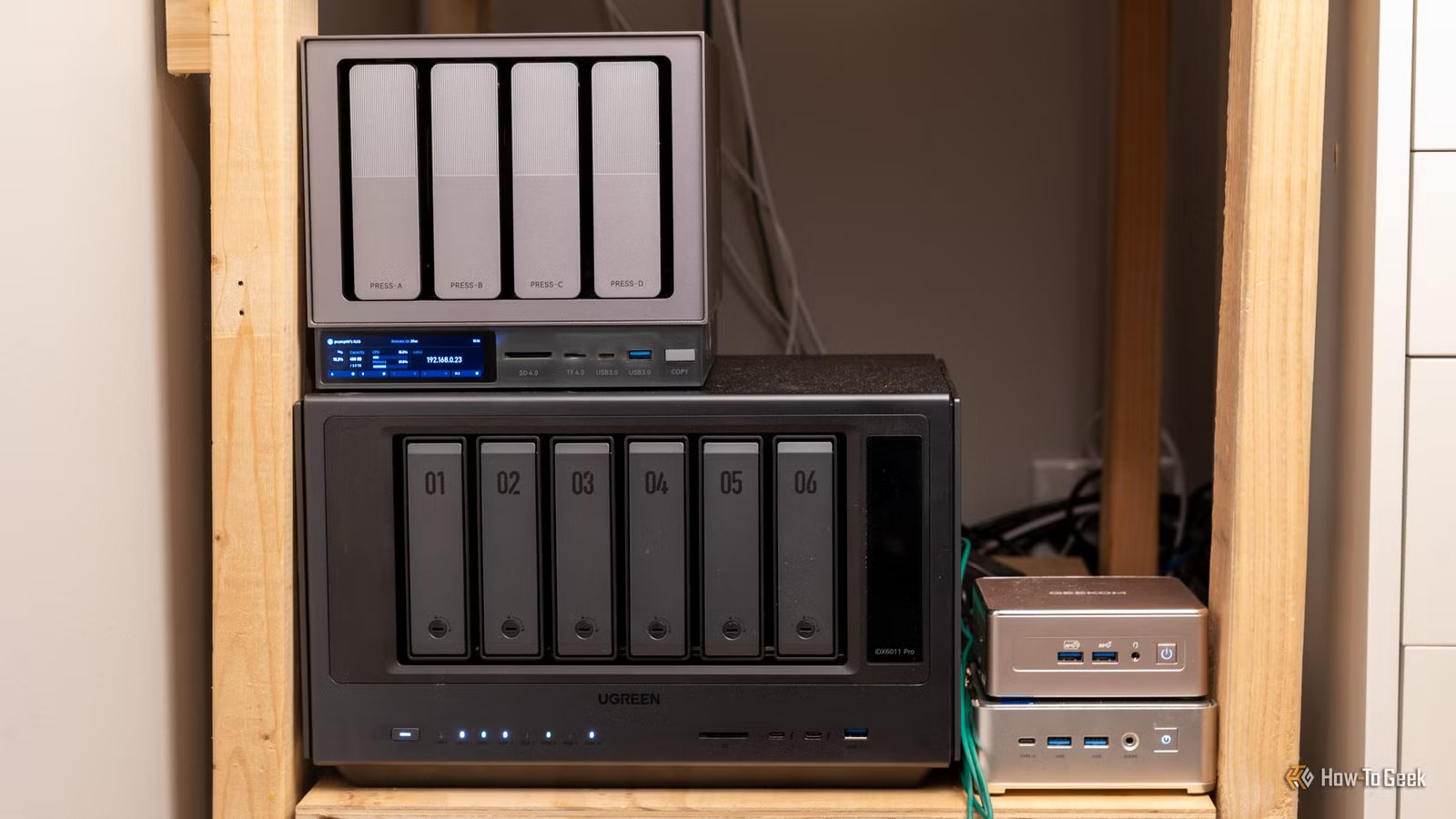
Network Attached Storage (NAS) has really changed how we handle storage. It’s moved from being just a specialized tool for big businesses to a key part of a home that you can build from a laptop. However, a lot of people treat these advanced machines like any other appliance you just set up and then forget about. They tuck them away in closets or under desks without really thinking about the physics that make them operate. Since mechanical hard drives are high-precision instruments that work with tiny tolerances, how long they last completely depends on how stable their environment is and how specific their hardware setup is.
Using desktop drives instead of NAS-rated drives
You get drives for the hardware you need
When setting up your NAS, the most critical change you can make to keep long-term reliability is to swap out standard consumer HDDs for NAS-specific drives. This could be the WD Red Plus or Seagate IronWolf, or something else. It’s incredibly common for beginners to overlook drive selection and install regular desktop drives.
It’s important to keep in mind that this simple mistake can slowly destroy your system. This happens because of fundamental engineering differences between how desktop drives and NAS drives are engineered to work. Standard desktop drives are strictly built to run for only about eight hours a day, five days a week. Your desktop harddrives are not, so don’t use them that way.
A NAS is designed to operate 24 hours a day, seven days a week, continuously serving files, handling backups, and streaming media without taking a break. Since they never rest, NAS-specific drives are purposely built with durable, heat-resistant components to sustain constant operation and dissipate the resulting thermal load that would otherwise cause premature failure in standard drives.
Sticking with desktop drives might save a few dollars initially. However, the relentless 24/7 workload and compounded rotational vibrations will inevitably shake them to an early death.
Ignoring proper ventilation and cooling
Give it a chance to breathe
Quiz
8 Questions · Test Your Knowledge
Network Attached Storage (NAS)
From basement file servers to enterprise data vaults — test how much you really know about NAS technology.
HistoryHardwareUse CasesProtocolsSecurity
Begin
Which company is widely credited with introducing one of the first commercially successful NAS appliances in the early 1990s?
ASynologyBAuspex SystemsCBuffalo TechnologyDWestern Digital
Correct! Auspex Systems released the NS3000 in 1989, widely regarded as one of the earliest dedicated NAS appliances. They pioneered the concept of a standalone file server accessible over a network, laying the groundwork for the modern NAS industry.
Not quite. The answer is Auspex Systems, which launched one of the first dedicated NAS appliances — the NS3000 — back in 1989. While companies like Synology and QNAP are household names today, Auspex was breaking new ground decades before them.
Continue
Which network file sharing protocol is primarily used by NAS devices to serve files to Windows-based clients?
ANFSBFTPCSMBDiSCSI
Correct! SMB (Server Message Block) is the dominant protocol for file sharing with Windows clients. Originally developed by IBM and later popularized by Microsoft, SMB is what allows Windows machines to seamlessly browse and access NAS shares as if they were local drives.
Not quite. The answer is SMB (Server Message Block). NFS is the protocol of choice for Linux and Unix clients, iSCSI is used for block-level storage, and FTP is a general file transfer protocol not optimized for seamless file system integration.
Continue
What does the RAID level ‘5’ specifically require as a minimum number of drives to function?
A2B4C3D6
Correct! RAID 5 requires a minimum of three drives. It stripes data and parity information across all drives, meaning it can tolerate the failure of one drive without any data loss — making it a popular choice for NAS users who want a balance of performance, capacity, and redundancy.
Not quite. RAID 5 requires a minimum of three drives. The parity data distributed across all drives allows one drive to fail without losing data. RAID 1 only needs two drives, while RAID 6 requires four — so options vary depending on your redundancy needs.
Continue
What is ‘media server’ functionality on a NAS most commonly used for in a home environment?
AEncoding video files to reduce file size automaticallyBStreaming locally stored movies, music, and photos to devices on the networkCBacking up cloud storage services like Google DriveDHosting a public-facing website from home
Correct! Media server functionality — often powered by software like Plex, Emby, or Jellyfin running on the NAS — allows you to stream your locally stored media collection to TVs, phones, tablets, and more. It essentially turns your NAS into a personal Netflix for your own content library.
Not quite. The core use of a NAS media server is streaming locally stored movies, music, and photos to other devices on your network. Software like Plex or Jellyfin handles the heavy lifting, including transcoding video on the fly for devices that need it.
Continue
What is the ‘3-2-1 backup rule’ that NAS users are often advised to follow?
AKeep 3 NAS devices, 2 in the cloud, and 1 on-siteBKeep 3 copies of data, on 2 different media types, with 1 copy offsiteCBack up every 3 days, verify integrity twice, and keep 1 year of historyDUse 3 RAID drives, 2 parity disks, and 1 hot spare
Correct! The 3-2-1 rule means: keep 3 total copies of your data, store them on 2 different types of media (e.g., NAS and external drive), and keep 1 copy in an offsite or cloud location. This strategy protects against hardware failure, theft, fire, and other disasters that could wipe out local backups.
Not quite. The 3-2-1 rule stands for: 3 copies of your data, stored on 2 different media types, with 1 copy kept offsite. It’s a best-practice framework designed to ensure your data survives almost any disaster scenario, from a failed hard drive to a house fire.
Continue
Which protocol allows a NAS to present storage to a computer as if it were a locally attached block device, rather than a file share?
ASMBBSFTPCWebDAVDiSCSI
Correct! iSCSI (Internet Small Computer Systems Interface) transmits SCSI commands over IP networks, allowing a NAS to present raw block storage to a host computer. The computer then formats and manages that storage like a local disk — making iSCSI ideal for virtual machines and databases that need low-level disk access.
Not quite. The answer is iSCSI. Unlike SMB or NFS, which share files over a network, iSCSI exposes raw block storage — the host computer sees a NAS volume as though it were a physically attached hard drive, which is critical for workloads like virtual machine datastores.
Continue
Which of the following best describes a ‘surveillance station’ use case for a NAS?
AMonitoring NAS drive health with built-in diagnostics softwareBRecording and managing footage from IP security camerasCTracking network traffic and logging connected devicesDEncrypting files automatically when stored on the NAS
Correct! Many NAS brands — including Synology and QNAP — offer dedicated surveillance station software that turns the NAS into a Network Video Recorder (NVR). It can connect to multiple IP cameras, record footage continuously or on motion detection, and store months of video locally without a subscription fee.
Not quite. A surveillance station on a NAS refers to software that connects to IP security cameras, records video footage, and stores it locally. This makes a NAS a powerful and cost-effective alternative to cloud-based security systems, since you own and control all your recorded footage.
Continue
Synology, one of the most recognized NAS brands today, was founded in which year and country?
A1998, JapanB2000, South KoreaC2000, TaiwanD2004, United States
Correct! Synology was founded in Taiwan in 2000 and has grown into one of the most beloved NAS manufacturers in the world. Their DiskStation Manager (DSM) operating system is frequently praised for its polished interface and rich feature set, making Synology a top choice for both home users and businesses.
Not quite. Synology was founded in Taiwan in 2000. Taiwan has become a major hub for NAS hardware development, with competitors like QNAP also headquartered there. Synology’s DiskStation Manager software helped set the standard for what a user-friendly NAS experience could look like.
See My Score
Challenge Complete
Your Score
/ 8
Thanks for playing!
Try Again
A lot of folks treat their NAS like a simple plug in and forget about it gadget, stashing it away where you can’t see it. It is not okay to put it in an enclosed space, a tight cabinet, or even a carpeted closet with no air movement. When you do that, you’re pretty much building a slow-cooker for your data. Spinning HDDs naturally create a good deal of friction and heat, and that needs to get out efficiently so your system can keep running safely.
Heat is the main silent killer of HDDs, since mechanical wear and disk failure rates speed up quickly when drive temperatures get too high. When a drive runs in those really hot conditions, its physical parts start to wear out. The important lubricating fluid in the spindle motor gets thinner, and the internal magnetic platters expand just a bit because of all that constant warmth.
Since the read and write heads float on a tiny cushion of air only nanometers above the spinning platters, even a little bit of heat-related distortion puts huge stress on the precise motor and seriously raises the chance of a terrible head crash.
Frequent hard power cycles
Very few electronics can handle a hard cycles
Credit: Patrick Campanale / How-To Geek
Hard drives are precise mechanical devices that experience their highest levels of physical stress during the initial spin-up phase. The internal platters must rapidly accelerate from zero to thousands of revolutions per minute. When a sudden power outage occurs, the drive is violently deprived of electricity, forcing its read and write heads to initiate an emergency park sequence.
While modern drives use residual rotational inertia to quickly retract the heads to a safe landing zone, these abrupt power losses still carry a significant risk of causing the heads to crash or create micro-abrasions on the delicate magnetic platter surfaces. Also, unexpected power loss abruptly stops the drives right in the middle of active read or write operations.
NAS systems frequently hold data in memory or volatile write-back caches before committing it to the physical disk; pulling the plug or suffering a hard blackout can completely obliterate this queued data. Basically, frequent hard restarts routinely lead to severe file system corruption and damaged RAID metadata.
When your NAS is finally powered back on, the compromised system is forced to work overtime, initiating exhaustive parity checks and grueling RAID rebuild processes just to restore array synchronization.
Excessive vibration and unstable surfaces
It’s not meant to be extremely durable
To really improve how long and how reliably your data storage lasts, the main thing you need to do is move your NAS to a solid, heavy surface and keep it far away from active vibration sources such as speakers or subwoofers.
Hard drives work a lot like really fast record players, operating with microscopic tolerances that are precisely measured in nanometers. Specifically, the actuator heads that read and write data using magnetic charges float on a very thin cushion of air just above the rapidly spinning disk platters; this flying height can be as tiny as three nanometers, which is only slightly larger than the width of a single grain of sand.
These internal mechanical components operate with such extreme, uncompromising precision that any external physical interference is quite damaging. If your NAS is sitting on a flimsy desk that wobbles when you type, or if it’s near a pulsing subwoofer, those external vibrations directly mess with the drive’s accuracy. When rotational vibration jolts the unit, it causes the read/write heads to temporarily misalign with the underlying magnetic data tracks.
Overfilling the capacity (above 80-90%)
Don’t add too much
Credit: Jordan Gloor / How-To Geek
One of the most common yet overlooked mistakes people make is treating their NAS like a bottomless pit. To keep your drives healthy and lasting a long time, keep your total storage utilization below 80%. Storage architecture experts strongly suggest leaving at least 20% to 30% of your drive space completely free. This makes sure there’s always continuous space available for data.
When a drive is almost full, the file system struggles to find contiguous space, which causes extreme fragmentation. As your drives fill up, the lack of continuous free space means the file system has to break up new or changed data apart. It places this data in scattered fragments wherever it can find a tiny bit of room across the disk.
Since the data isn’t stored linearly anymore, the drive can’t retrieve it in one smooth, sequential action. Instead, the drive’s read/write head has to physically jump across the platters much more frequently to gather pieces of a single file. By simply keeping your storage utilization below 80%, you prevent this mechanical exhaustion.
Your NAS is meant to be treated like an important piece of equipment
Keeping your NAS infrastructure working for a long time means you can’t just have a set-it-and-forget-it approach, because that often causes hardware to fail too soon. It’s clear, mechanical hard drives are delicate instruments that need particular operating conditions. When you focus on using NAS-rated drives with rotational vibration sensors, you make sure your storage can deal with all the noise from a multi-disk environment. Ultimately, how healthy your data is depends on whether you’re willing to respect the hardware, and if you ignore these principles, you’re simply building a cooker for your files.
Brand
Zettlab
CPU
RK3588
Memory
16GB LPDDR4x
Drive Bays
4x 3.5-inch, 1x M.2 NVMe
