

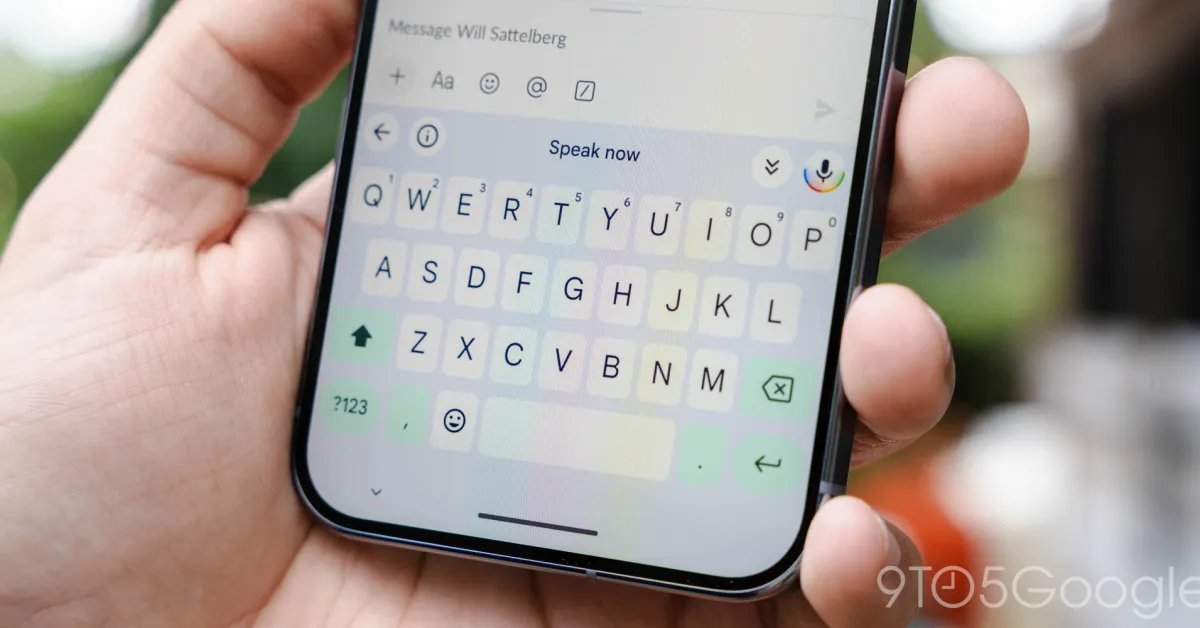
There are a lot of reasons I love using a Google Pixel phone, but voice-to-text might just be the most underrated upgrade on these devices. Every time I use a Pixel, without fail, I struggle to switch back to literally any other Android device in part because the voice-to-text experience is just so much worse. But, finally, there’s a brighter future in view.
Gboard is Android’s main keyboard offering, and it has built-in voice-to-text dictation. It works well enough, but it gets supercharged on a Pixel. Google first made this change over half a decade ago, with the improved experience on Pixel not only being much faster, but also more accurate. Between actually getting the words right and being able to include punctuation, it just makes voice-to-text on a Pixel drastically better than any other Android device.
And that’s regardless of what keyboard you’re using. Gboard on a Pixel versus Gboard on a Samsung Galaxy are two incredibly different experiences. The version found on other Android devices doesn’t support punctuation (without you saying the punctuation out loud), often needs more time to load, and is rarely as accurate. Don’t get me wrong, it could be worse – Samsung Keyboard’s voice-to-text is an actual travesty – but I really do wish Google would make some improvements here.
It really seems like the solution to this is right on the horizon, though.
It’s AI.
I’m still iffy on most applications of AI, but if there’s one thing LLMs are good at, it’s text – it’s right there in the name, after all. So voice-to-text has become a very popular use of AI, and one of the most useful to the end user. Google, technically, was way ahead of the curve here with Gboard’s improved voice typing on Pixel being a result of machine learning. Newer models have just supercharged this.
One of the first places I came to enjoy this was “Wispr Flow,” an AI-powered voice-to-text dictation service that launched on Android earlier this year, and that I’ve been using in the time since.
I think this has two main things going for it.
First and foremost, Flow doesn’t replace Gboard, or whatever other keyboard you want to use. Instead, it acts as a floating button/pop-up on top of whatever other app you’re trying to use. It absolutely takes some muscle memory to stop tapping Gboard’s microphone button and instead use Flow’s, but it’s as good of a solution as I can think of. You couldn’t pry Gboard away from me, and I don’t think I’m alone there – Gboard is possibly one of Google’s best pieces of software on Android. The floating button doesn’t show all of the time, but rather appears somewhat intelligently based on the app you’re using and what you’re actually doing. I say “somewhat” because I have caught it appearing at times I don’t need it. Flow seems to focus on detecting the app rather than the simple method, just seeing when the keyboard is triggered.
Still, it’s one of the better implementations I’ve seen. Hitting the button starts the voice-to-text and hitting the checkmark processes it and pastes it in your active text box. I do wish it showed a preview of the text, but it works well enough.
Those aren’t the only trade-offs, of course. You need to give Wispr Flow some extra permissions such as displaying on top of other apps, as well as accessibility access. As a result, the app shows notifications in the tray. There’s no status bar icon and they’re muted by default, but you’ll need to manually disable them through Android settings if you truly want to hide them. I quickly shut off the persistent notification through Android’s settings, but it is a little frustrating that there’s a constant notification when apps have the ability to display on top of others now. I get why it exists – it’s easy to abuse that functionality – but, man, it’s such a drag on this experience. It’s the main thing that has pushed Flow into a “come-and-go” status. I still use it from time to time, but I’ve been turning it off a lot just because it feels in the way.
You’ll also have to trust Wispr on the privacy side of things here. The app does have a “Private Mode” which it says will “keep data stored only on your device.”
That said, the actual performance more than makes up for it.
I’ve been using this on my Galaxy Z Fold 7 – my daily driver and the exact phone that constantly reminds me how bad Gboard voice-to-text is outside of a Pixel – and I’m just astounded by how well this all works. The voice-to-text model here is crazy accurate, being able to perfectly transcribe what I’m saying regardless of the context. Whether a quiet room or one full of loud music, it picks up my voice and nails the text. It’s not infallible, with the occasional misspelling or misunderstanding, but it feels just about as accurate as the experience on Pixel. It inserts punctuation fairly well too. I think Google’s experience on Pixel is still a bit better here, but Flow does a really good job.
The main place I see Flow beating Gboard on Pixel is in understanding context. Where you can transcribe through Pixel and end up with words like “cuz” in places where that’s not the most appropriate thing, Flow automatically corrects for phrases like that. The app will eventually support a custom dictionary and other ways to tailor the output, but I really like it as is.
But, as mentioned, Flow’s big problem is that it’s not native.
That’s where the next step here comes in. This is the sort of tech I can easily see more Android brands looking to take advantage of. Nothing started the ball rolling this week with the launch of “Essential Voice,” which is basically a native Wispr Flow for Nothing Phones. It drops the added cost, while also better integrating the voice typing into your normal experience as it works both through and the physical Essential Key (and the keyboard too).
It feels somewhat inevitable that more Android brands will follow. As everyone tries to squeeze AI into everything, voice-to-text improvements are pretty much a home run in my book. It’s a feature that we all use in some capacity and one that AI is actually good at.
This Week’s Top Stories
Google’s screen-less fitness tracker is the “Fitbit Air”
We reported that Google’s screen-less fitness tracker will be called the “Fitbit Air,” with additioanl reporting revealing that the device will potentially cost around $100 and come in several colors. It might launch within the next two or three weeks, too.
Android 17 QPR1 Beta 1
Before the first stable Android 17 release, Google has already dropped the first beta of Android 17 QPR1. It’s very minor, with perhaps the most notable thing being wallpapers destined for Pixel 11 Pro Fold.
More Top Stories
From the rest of 9to5
9to5Mac: iPhone 18 Pro Max camera thicker, iPhone Ultra dummy unit compared to iPad mini
9to5Toys: Nintendo just released new Switch 2 gameplay and details for Yoshi and the Mysterious Book
Electrek: Tesla Model YL prototype spotted on US roads for the first time
Follow Ben: Twitter/X, Threads, Bluesky, and Instagram
FTC: We use income earning auto affiliate links. More.
