

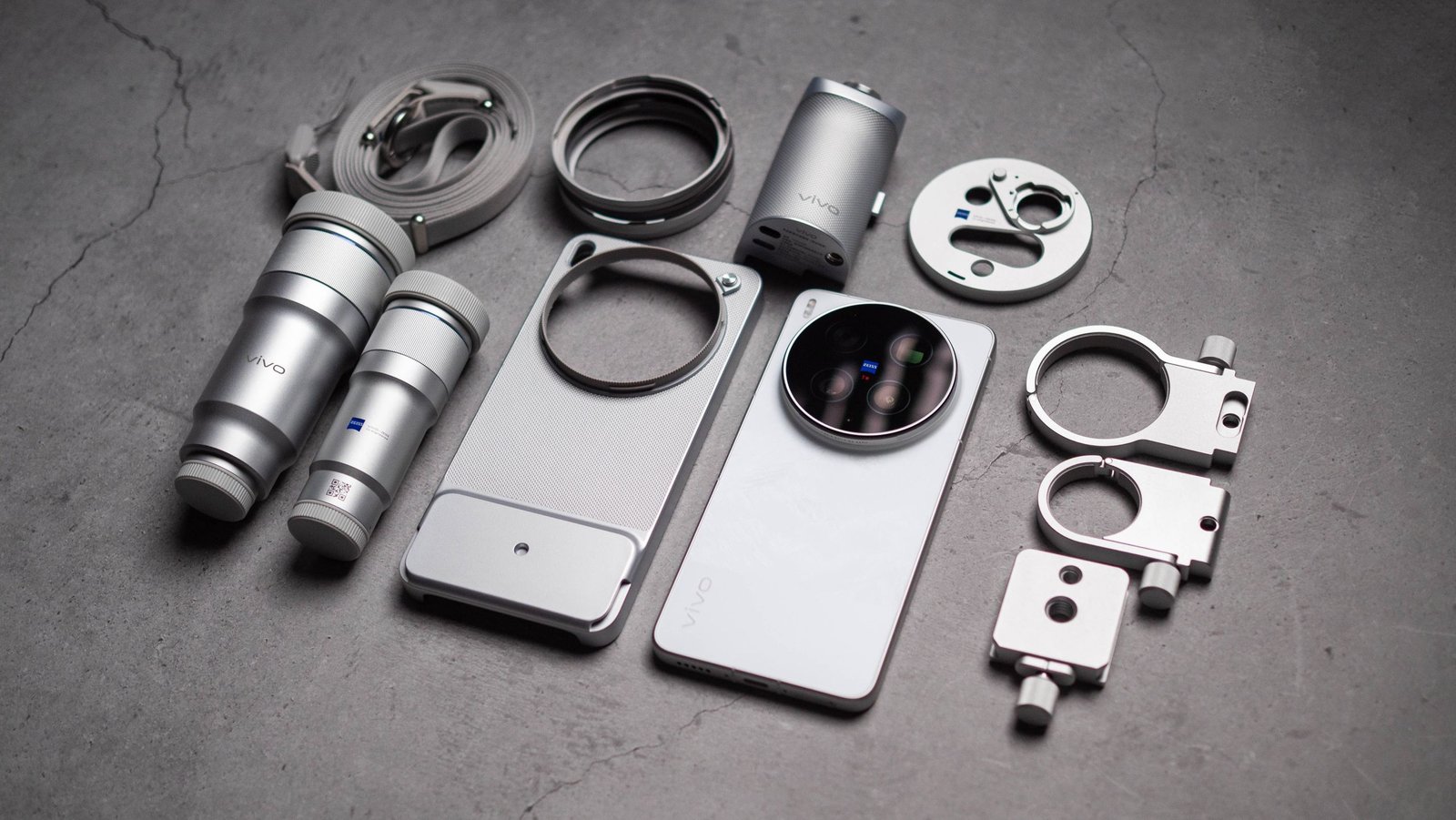
Phones sold in China are vastly different to their global counterparts. As these phones don’t have the Play Store, each brand offers its own individual app store, and they handle updates differently as well.
I used Chinese variants of Vivo, OPPO, Xiaomi, Huawei, and Honor phones in the last 12 months, and what stood out was that there isn’t as much variance to the global model — at least in terms of the software — as there used to be.
Article continues below
You may like
Data transfer is instantaneous
(Image credit: Harish Jonnalagadda / Android Central)
Google has a built-in tool that handles data transfers to a new Android phone, and while it’s slower than I’d like, it does an effective job moving your content — including photos, videos, messages, apps, calls, contacts, and so on — to your new phone.
But as Chinese phones don’t use Google services, brands have their own alternative. In Vivo’s instance, the manufacturer uses EasyShare to transfer data to your new device, and it is significantly faster than Google’s solution. I moved over 100GB of data while setting up the Chinese model of the Vivo X300 Ultra from the Xiaomi 17 Ultra, and it took just under 10 minutes to transfer all that data over.
What I like the most is that it brings all the apps on your existing phone over, and this solves a lot of the problems of not having the Play Store pre-installed.
It’s trivial to install the Play Store and Google services
(Image credit: Harish Jonnalagadda / Android Central)
The biggest limitation to using a Chinese phone is that it doesn’t have Google Mobile Services (GMS). That means you don’t get the Play Store, Chrome, YouTube, Gmail, or any other Google services installed out of the box.
However, that is not an issue on modern Chinese phones, as you can easily install the Play Store, and then download all the apps you normally use. Most of these phones have something called Google basic service management, which is located in the settings. You’ll need to enable this, and it provides the requisite services that Google uses to do a lot of the things that you get on global models with the Play Store.
After that, you can just go to the brand’s app store and install the Play Store like you would any normal app. Honestly, doing this is so easy these days that I don’t mind using phones with Chinese software. Once you have the Play Store set up and log in to your Google account, it’s just like using a global model.
What to read next
You’ll inevitably run into notification issues
(Image credit: Harish Jonnalagadda / Android Central)
The only real problem that hasn’t been resolved is notification issues. When using phones with Chinese ROMs, I continue to see issues with push notifications in apps like Gmail, Slack, WhatsApp, and so on. This is because of the way the Chinese models address background memory use — it is a little different to how global models do it.
Basically, as the Play Store isn’t seen as a system app (as it isn’t pre-loaded), anything you install using it doesn’t have easy access to background memory use. This is done as a measure to curtail nefarious apps from siphoning your data, but the downside is that it affects legitimate apps just the same. The workaround I use is to disable battery optimization and memory management by going into the individual app’s settings. This works moderately well; after about a week of use, I get notifications from most apps I do this with, but there are still intermittent issues — that’s just something you need to account for.
Get ready to see a lot of bloatware
(Image credit: Harish Jonnalagadda / Android Central)
Whether it’s a custom search engine, AI agents that can’t be disabled, or things like satellite connectivity on the X300 Ultra that needs a China Mobile SIM, there are plenty of features on Chinese phones that aren’t usable outside China.
While that’s frustrating in its own right, what’s even more annoying is the sheer amount of bloatware on these devices. While most brands are doing a good job in this regard on their global models — I don’t see as many pre-installed apps on my global X300 Ultra — the Chinese model has extensive bloatware. Thankfully, it’s easy enough to uninstall most apps, but it is irksome, and when it comes to AI-assisted chatbot or a digital assistant that can’t be disabled, you can only mute the feature and figure out how to not trigger it accidentally.
You may not get after-sales service
(Image credit: Harish Jonnalagadda / Android Central)
After-sales service is still spotty if you’re using a phone sourced from China. Now, this isn’t particularly problematic if the phone in question is sold in your country. In that scenario, you should be able to get the device serviced, but again, it is entirely down to whether the service center has the requisite spare parts.
In the case of the Vivo X300 Ultra or the Find X9 Ultra, this isn’t a problem as both phones are launching globally. However, if you’re in a country where neither brand has a presence — like the U.S. — you just don’t get any after-sales service. I didn’t have issues getting Chinese models of older Xiaomi phones serviced in India, but warranty-related claims aren’t anywhere as straightforward as global models.
You can save up to a massive 40%
(Image credit: Harish Jonnalagadda / Android Central)
The main reason for getting a Chinese phone is the cost differential. The X300 Ultra starts at 6,999 RMB in China, and the 16GB/1TB configuration is available in the country for 8,999 RMB ($1,319). To put that into context, the same 16GB/1TB variant of the global model retails for an incredulous €1,999 ($2,341) in Austria, and there’s a $1,000 difference in the cost between the two.
Yes, you will need to pay an additional $100 to $200 as you’ll have to buy these phones via a reseller, but that’s still close to 40% less than what you’d end up paying when buying the global model.
While there are shortcomings to using the Chinese models, they’re nowhere as pronounced as in the past, and honestly, the only real issue is the lack of consistent push notifications. Outside of that, I don’t see any usability problems with the Chinese version of the X300 Ultra, and if you’re interested in a camera phone and are willing to try out something different, getting the Chinese model is a legitimate alternative.
